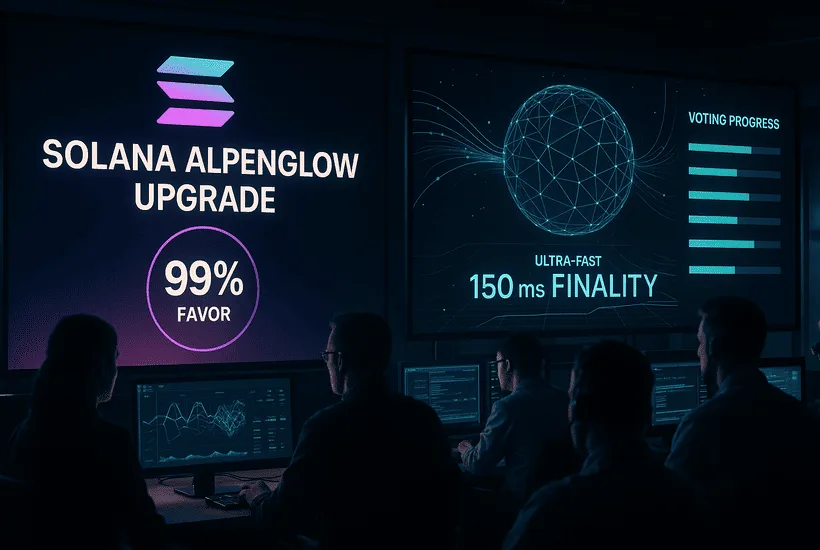



Given overwhelmingly positive support, Solana’s Alpenglow proposal is expected to pass and position the network for transaction finality in about 150 milliseconds, which is a nearly 100× speedup from today’s 12.8 seconds and comparable to real-time internet experiences like a Google search. Over 99% of voters support the change, the quorum criterion has been met, and assuming present participation continues, the proposal should succeed with two days remaining in the voting.
In May, Alpenglow dubbed the biggest protocol change in Solana’s history was unveiled by Anza, a Solana development company that was split out of Solana Labs. In order to significantly reduce latency while maintaining consensus safety, the design aims for single-round finalization when 80% of the stake is responsive or two rounds at 60%. Adopted, Solana would outperform existing high-throughput L1s in terms of time-to-finality, matching web-scale responsiveness at 150–200 ms and surpassing Sui’s 400 ms.

Alpenglow: vote status, votor/rotor, and the web-native leap
Alpenglow’s governance started on August 21 and is set to end at epoch 842 on Tuesday at 1 pm UTC. With turnout already exceeding the 33% quorum, current figures indicate that 99.6% of yes+no votes are “yes,” handily exceeding the two-thirds supermajority requirement. The update has invigorated developers who view sub-second finality as a gateway to new real-time application categories beyond gaming, trading, and payments, ranging from interactive media and on-chain microservices to latency-sensitive social protocols.
The architecture of Alpenglow replaces two essential parts. TowerBFT is replaced by Votor, which manages voting transactions and finalization logic and permits the one- or two-round commit flow. Rotor transforms data distribution by reducing the time it takes for all nodes to converge on state and assuming tasks that were previously related to proof-of-history timestamping. According to the white paper, customer variety is still essential and Alpenglow is not a panacea for outages. Since Solana now only uses one production client, Agave, a bug might affect the entire network. However, later this year, the Firedancer client is scheduled to launch on the mainnet to improve performance and robustness.
Solana’s latency profile may raise the bar for L1 blockchains if the overwhelming “yes” wins out in the end. Fractions of a second of finality redefines what is genuinely web-native on-chain, not merely cheaper or faster.