



The Ethereum Foundation plans to convert 5,000 ETH into stablecoins through CoW Swap as part of its treasury management strategy.
Meanwhile, the foundation explained that the swap forms part of its ongoing work to support research and development, grant programs, and donations.
Ethereum Foundation swaps 5,000 ETH into stablecoins
The Ethereum Foundation announced on Wednesday that it will convert 5,000 ETH into stablecoins using CoW Swap’s time-weighted average price feature. At current prices, the transaction is worth about $11 million.

By using TWAP, the order can be split over time rather than executed all at once, which may reduce visible market pressure.
Data tracked by Arkham Intelligence showed that the transactions were drawn from a wallet linked to the Ethereum Foundation’s DeFi activity. Arkham labels that wallet as “Ethereum Foundation DeFi Ecosystem.”
So far, the CoW Swap TWAP transactions tied to the sale have been valued at just under $1 million each. The latest move appears to be the foundation’s first TWAP sale since October, when it converted 1,000 ETH that was then worth about $4.5 million.
The sale fits the treasury framework the Ethereum Foundation published in June 2025. Under that policy, the organization set annual operating expenses at 15 percent of total treasury value and aimed to maintain a cash reserve equal to 2.5 years of operating needs.
That structure means the foundation reviews whether its fiat and stablecoin reserves meet its target. When reserves fall short, ETH sales can follow during the next quarter. The new CoW Swap transaction appears to be part of that routine approach rather than a one-off decision.
Ethereum Foundation changes treasury approach
The EF has changed the way it funds operations after years of criticism over direct ETH sales. Last year, the organization moved away from relying only on recurring sales and started using a wider treasury model that includes staking and DeFi deployment.
As part of that change, the foundation seeded its DeFi Ecosystem wallet with 50,000 ETH in January 2025. It later outlined a broader plan to use capital more actively while limiting direct spot sales where possible.
The treasury policy also showed that the foundation wants to lower annual spending over time. It aims to reduce that rate from 15 percent to a 5 percent baseline within five years, while narrowing the scope of its operations during that period.
At the same time, the policy described 2025 and 2026 as important years for Ethereum. That helps explain why spending remains elevated now even as the group prepares for a leaner structure in later years.
The Ethereum Foundation has also placed more emphasis on “Defipunk” principles in treasury management. Under that approach, it prefers open-source, permissionless, privacy-focused systems and seeks to reduce reliance on admin keys and external control points.
The shift also includes staking as a major income source. Earlier this month, the foundation said it had staked 47,050 ETH, which it described as two-thirds of the way toward a 70,000 ETH goal. It has presented staking rewards as a way to support grants and operations over the longer term.
Staking, OTC sales, and DeFi now shape EF funding
The latest CoW Swap sale is only one part of the Ethereum Foundation’s wider funding pattern. In March, the foundation sold 5,000 ETH, worth about $10.2 million, to BitMine Immersion Technologies through an over-the-counter deal.
That transaction was the foundation’s second OTC sale to a corporate treasury buyer. In July 2025, it also sold 10,000 ETH to SharpLink Gaming. These deals showed that the foundation had started using private sales as another option alongside open-market activity.
On Tuesday, the foundation also transferred about $70,000 worth of ETH to an EF-owned Grant Provider address. That marked its first series of transactions since staking ETH on the Ethereum Beacon Chain.
Arkham data shows the Ethereum Foundation still holds a large on-chain treasury. Its main wallet contains about 102,000 ETH worth roughly $228 million, alongside 21,000 AETHWETH worth about $47 million and 6,000 WETH worth about $14 million.
The wallet also holds about $1 million worth of DAI and USDC combined. Taken together, the data shows that the foundation still has deep reserves even as it continues to rotate some ETH into stablecoins and other forms of liquidity.
Ethereum co-founder Vitalik Buterin has also converted millions of dollars worth of ETH into stablecoins in separate transactions tied to open-source project funding.
That activity reflects a broader move within Ethereum-related entities to use stable assets for operational planning rather than relying only on direct ETH holdings.
Will ETH break higher after reclaiming $2,200?
Ethereum traded near $2,210 at press time , with daily gains of roughly 5 percent (per CoinGecko’s data). Price action showed ETH recovering after a sharp decline and then consolidating around the $2,000 area.
On the daily chart, ETH has been attempting to develop a short-term bottom. The RSI was close to 58, which put the momentum above the 50-level but was below the overbought region. That reading indicated the enhancement of strength without demonstrating an overheated action.
In addition, the MACD also exhibited a weak positive signal. MACD line was at 16.1 and the signal line was at 16.0 with the histogram changing slightly to green. This arrangement implied a small upward movement instead of a definite breakout.
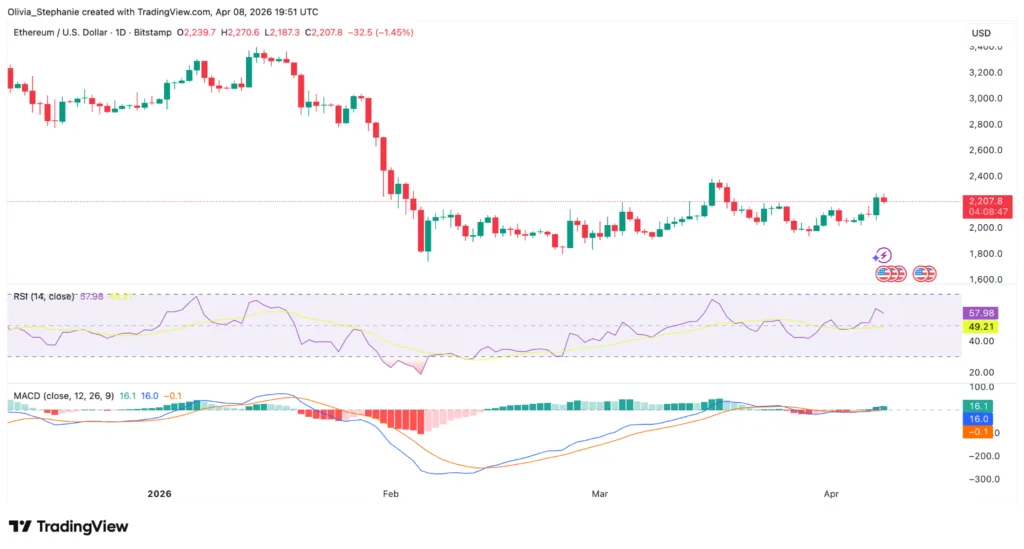
Market analyst Ted Pillows noted that the ETH had surpassed the $2,150-2,200 resistance range and that the asset could climb to last month’s peak in case it maintains prices above the 2,200 mark.
Meanwhile, he warned that this was not to be regarded as the beginning of a wide bull run and suggested that new lows might yet come further in 2026.
Macro conditions are also on the spot. According to Santiment, crypto markets moved higher after news of a two-week ceasefire involving the United States, Iran, and Israel. However, uncertainty remains over the terms of the arrangement and whether the Strait of Hormuz will stay open during the negotiation period.
Ultimately, that backdrop has left traders balancing short-term bullish momentum against wider caution.