




Ethereum has been through a rough stretch. After touching a new all-time high near $4,954 in August 2025, it spent the better part of six months giving everything back, briefly dipping below $1,800 in February before clawing its way toward $2,100 in recent weeks.
That kind of drawdown tends to shake out the impatient. But a cluster of onchain and macro signals is now suggesting the selling may be running out of steam, and that the setup forming right now has some historical precedent worth paying attention to.
A macro indicator flashing rare undervaluation
The most striking data point comes from the Capriole Macro Index Oscillator, which currently sits at -2.42. That number lands ETH in a zone that, historically, has been associated with capitulation bottoms and the early stages of trend reversals, and it has only appeared at this depth twice before in recent memory.

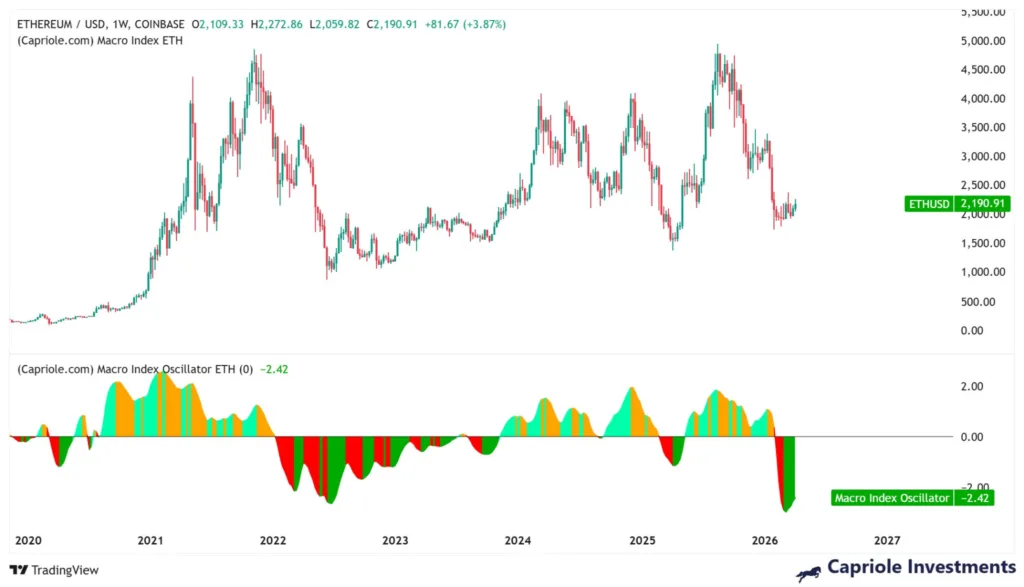
The first time was June to July 2022, when ETH bottomed near $1,000 to $1,200 while the oscillator fell to -2.2. The second came in October to November 2023, when a reading of -1 aligned with a price break out of the $1,500 range. Then in April 2025, another negative reading marked a local bottom near $1,500, setting the stage for a run above $4,000 over the following months.
The current reading at -2.42 is actually deeper than any of those prior signals. The oscillator tracks investment behavior, cycle positioning, and onchain data, with negative readings reflecting seller exhaustion rather than simply price depression. The distinction that matters here is that it’s not just that ETH is down, it’s that the people doing the selling may be nearly done.
ETH has fallen from highs near $4,800 to around $2,100 in the current drawdown, roughly the same percentage decline seen before prior macro recoveries. With the oscillator sitting near cycle lows, the downside risk appears increasingly asymmetric relative to the potential upside, at least according to this framework.
That said, the full confirmation signal would be a reclaim of the $2,400 to $2,500 level alongside the oscillator beginning to move back toward zero.
Price structure and the spot demand story
Beyond the macro indicator, Ether’s near-term chart has been quietly building a more constructive case. A 6.33 percent rally pushed price above the $2,150 resistance level, a zone that has been tested repeatedly over the past two months.
The frequency of those retests without a definitive breakdown is itself meaningful: resistance tends to weaken when buyers keep showing up at higher levels, which is what the data suggests has been happening.
The key distinction in the current move is where the demand is coming from. The aggregated spot cumulative volume delta (CVD) remained elevated in April at 184,500 ETH, reflecting sustained demand from actual spot buyers, not leveraged positions.
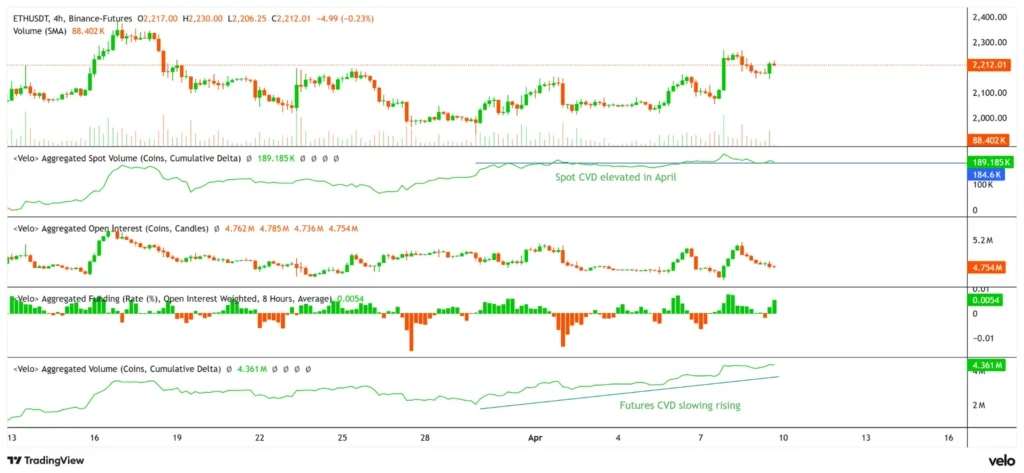
That’s an important qualifier. Spot-driven rallies tend to be sturdier than ones propped up by futures positioning, because there’s no margin call risk sitting underneath them.
Ethereum’s derivatives market has also shown a bullish shift, with net taker volume turning positive to $104 million for the first sustained period since 2023, indicating buyer activity has overtaken selling pressure in leveraged markets.
The futures CVD has trended gradually upward to 4.36 million ETH, suggesting derivatives traders are beginning to support, rather than lead, the move, a healthier dynamic than a leveraged-led pump. The funding rate remains positive at 0.0052, indicating a long bias, while open interest near 4.75 million ETH remains range-bound, signaling limited leverage buildup so far.
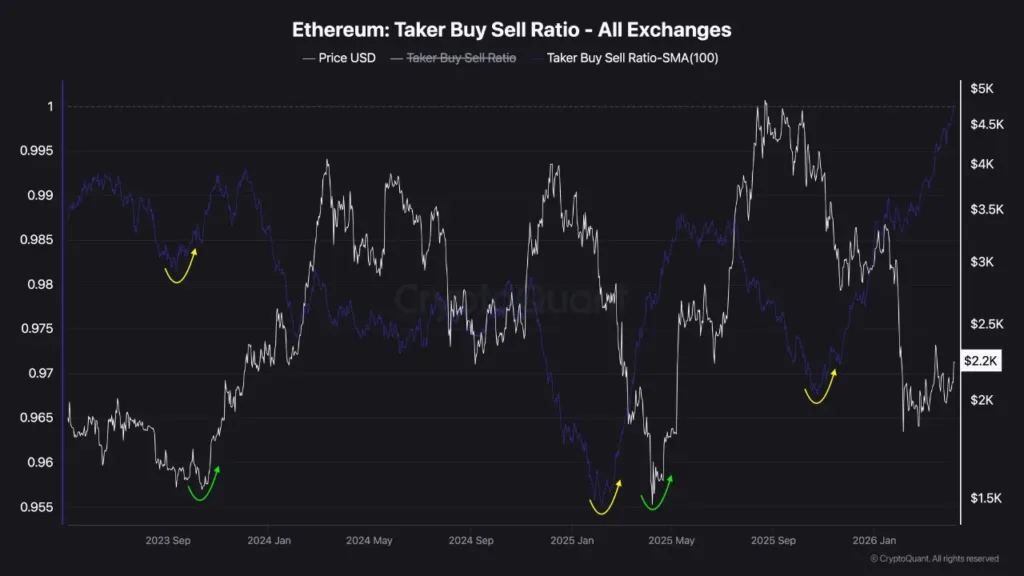
Analyst crypto sunmoon has separately noted that ETH’s taker buy/sell ratio has been trending upward for four to five months. Combined with the current drawdown depth, the structure reportedly resembles the setup that preceded the April to May 2025 rally, a period that ultimately saw ETH climb from $1,500 toward $4,000-plus.
On the four-hour chart, ETH is maintaining higher lows while attempting to break into the $2,250 to $2,300 range. A clean hold and breakout there would open the path toward a retest of March highs near $2,385, with the $2,475 to $2,635 fair-value gap above that acting as the next key magnet for bulls.
The counterarguments worth noting
None of this means the rally is guaranteed. Spot Ethereum ETFs recorded their fifth consecutive month of net outflows in March, with total redemptions significant enough to weigh on sentiment. US trade policy uncertainty has also sustained a risk-off backdrop across digital assets, and broader macro attention remains split between Federal Reserve rate signals and geopolitical developments.
The 14-day average taker buy/sell ratio sits at 0.9836, below the 1.0 threshold that would signal a confirmed shift in buyer dominance. One strong daily reading, like the 1.0388 print on April 3, does not yet make a trend.
Standard Chartered, for what it’s worth, has maintained a $4,000 year-end target for ETH in 2026, though the bank has also flagged a potential near-term trough near $1,400 as a downside scenario if macro conditions deteriorate further. That kind of range, $1,400 to $4,000 in a single year, reflects just how much uncertainty still surrounds the asset.
What does seem clearer is that the current setup shares more characteristics with prior bottoming processes than with the early stages of a continued decline. A stronger breakout would likely require an expansion in futures positioning to accompany the spot demand already present. Until that confirms, the picture is encouraging, but still pending.