




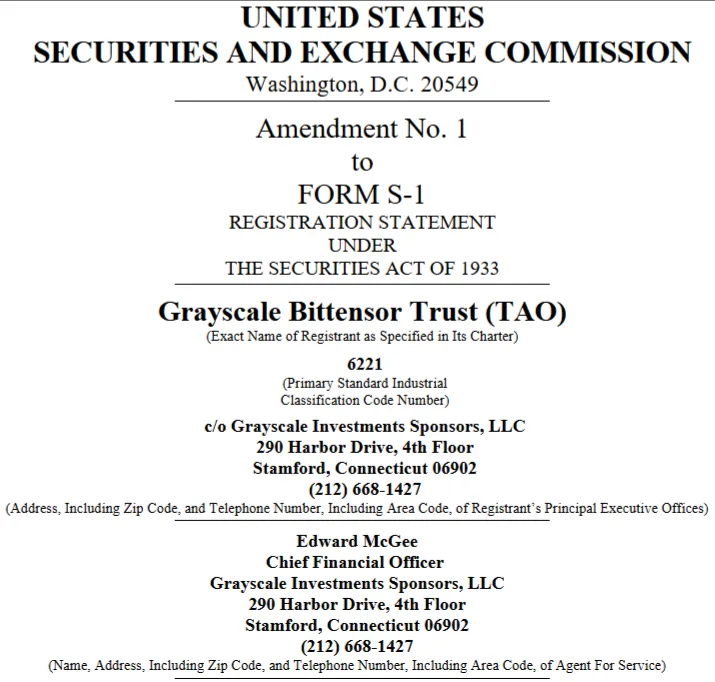
Grayscale Investments has taken a key step toward launching a spot Bittensor exchange-traded fund in the United States. The asset manager, on Thursday, filed an amended Form S-1 registration statement with the Securities and Exchange Commission (SEC) for the Grayscale Bittensor Trust.
The filing seeks to list shares of the trust on NYSE Arca under the ticker symbol “GTAO.” Grayscale first filed the S-1 on 30 December to convert the Bittensor Trust into an ETF.
If approved, the ETF would give investors an easier and more regulated way to gain exposure to Bittensor’s native token, TAO. They would not need to buy, hold, or store the token themselves.

Grayscale said the product will work as a passive investment vehicle. In other words, it will not try to beat the market or use leverage or derivatives. Instead, it will simply reflect the market value of the TAO it holds.
Right now, the trust is quoted on OTCQX under the symbol “GTAO”. However, Grayscale plans to rename it Grayscale Bittensor Trust ETF once the registration becomes effective and the shares begin trading on NYSE Arca.
How the ETF would work
The amended prospectus also explains more clearly how the ETF would work. Shares would be created and redeemed only in blocks of 10,000, which are called “baskets.” These transactions would be handled by large financial institutions known as authorized participants.
The filing also says that NYSE Arca already has regulatory approval to allow both in-kind and cash creations and redemptions.
Therefore, big market participants could either give TAO tokens to the trust and receive ETF shares, or give cash and receive ETF shares. They could also do the opposite when redeeming shares.
This structure is important because it usually helps the ETF price stay close to the actual value of the TAO held by the trust. It also makes the ETF easier to manage and trade once it is listed on the exchange.
Grayscale has appointed experienced partners to support the trust. Coinbase Custody Trust Company and BitGo Trust Company serve as custodians, holding TAO in secure offline storage. The Bank of New York Mellon acts as transfer agent and administrator.
The filing also highlights a key limitation. Grayscale said the trust could only add staking later if certain regulatory conditions are met.
Even then, there is no guarantee that approval go through. Therefore, shareholders would not receive staking rewards, even though direct TAO holders may still earn them on their own.
Filing explains TAO and the Bittensor Network
The filing also gives investors a simple overview of Bittensor. It says the network lets AI models compete and earn rewards based on performance. Miners submit models, validators review them, and the system distributes TAO accordingly.
The prospectus also notes that Bittensor launched its Dynamic TAO upgrade in February last year. That update introduced subnet-specific tokens and a new liquidity-pool staking model. Grayscale said these features are still new, which may add risk for investors.
The filing also shows how TAO’s market position has grown.
As of 31 December, about 11 million TAO were in circulation out of its maximum supply of 21 million. At that point, the token’s market capitalization stood at roughly $2.3 billion, making it the 35th-largest cryptocurrency by market value.
By the date of the filing, Grayscale said TAO’s market value had risen to about $3.3 billion. It also reported average daily trading volume of roughly $180.1 million over the previous 30 days.
The filing does not mean the ETF is live yet. The registration statement is still incomplete, and the shares cannot be sold until the SEC makes the filing effective. Still, the amendment shows Grayscale is moving closer to a NYSE Arca launch.
TAO price climbs over 4 percent
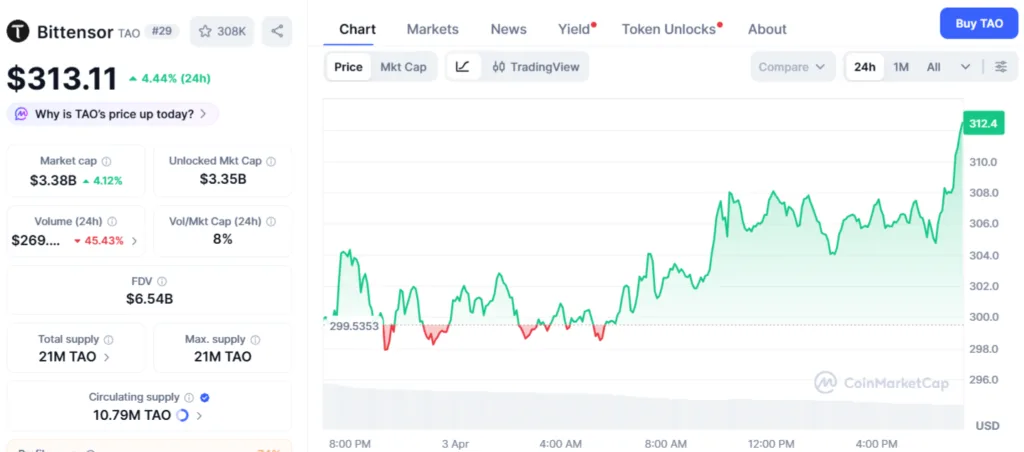
The filing appears to have strengthened market interest in TAO. Bittensor was among the top crypto gainers over the past 24 hours.
At the time of writing, TAO was trading at $313.11, up 4.44 percent on the day. Meanwhile, trading activity dropped sharply, 45 percent $269.2 million.
Recently, Strive and Tuttle Capital Management also moved to expand the market for crypto-linked investment products. The two firms filed for a new ETF that would focus on income from preferred shares issued by Bitcoin treasury companies.