


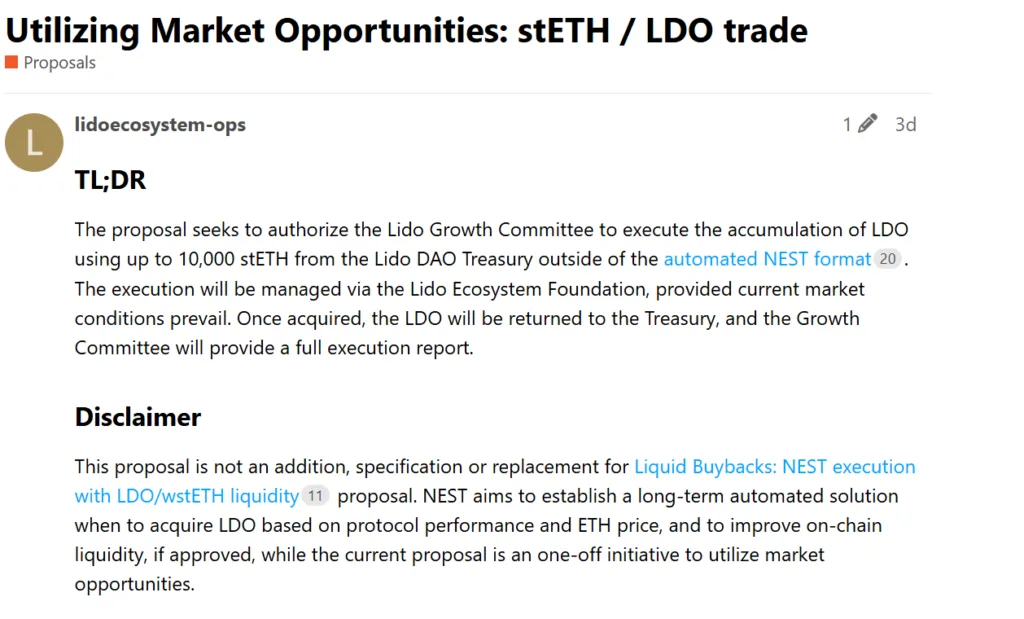
Lido’s ecosystem operations team has put forward a proposal to spend up to 10,000 stETH, worth roughly $20 million, from the DAO’s treasury to buy back LDO tokens.
The move, announced on Monday, comes as the ecosystem argues that the token is currently trading at what it sees as a historically depressed valuation. In simpler terms, the team believes the market may be undervaluing LDO right now and sees this moment as an opportunity to step in rather than sit on the sidelines.
The buyback is intended not only to support the token during a difficult stretch but also to show the community that the project is willing to use its resources to defend the health of its ecosystem.

At its core, a buyback is a fairly straightforward idea.The organization will then use its own resources to buy its native token in the market, hence reducing the number available for traders.
This is also common in traditional finance; companies often buy back their own stocks to show investors that they are confident in the company. Similarly, in cryptocurrency, if the company is willing to buy its own token, it is sending a signal that it believes in it, even if it is not performing well in the short term.
Funding for the buyback
The funds for the proposed buyback would come from stETH, Lido’s liquid staking token that represents Ether locked in staking on the Ethereum network.
That means the DAO would be converting part of its treasury, assets that are already earning yield, into LDO holdings. At current price levels, this $20 million allocation could potentially absorb 8 percent of LDO’s circulating supply, which is a significant amount of the market.
This does not necessarily mean that the price of LDO is going to increase, but it does mean that it would be harder for the token to fall.
The proposal comes at a particularly difficult time for LDO. The token hit an all-time low of $0.27 on March 7, but currently, it is trading at $0.31.
LDO, much like its DeFi counterparts, is feeling the sting of a broader market downturn. This is largely due to waning investor enthusiasm, a surge in competition within the liquid staking arena, and the prevailing economic climate.
For Lido, it is particularly important to maintain investor confidence in their governance token because of how integral LDO is to their operations.
Token holders use LDO to vote on key decisions, from technical upgrades to treasury spending. If the token price remains weak for an extended period, participation can decline and the overall ecosystem can start to feel less stable. That is one reason why treasury management decisions like this tend to attract close attention from the community.
Buyback different from previous programs
It is also worth noting that this proposal is independent of Lido’s previously announced “NEST” program, which is an automated form of buying back LDO in accordance with certain predetermined conditions.
The NEST program is not yet operational because the market conditions have not been met. However, in the current proposal, there is an intention to act in what is being termed a “one-time action,” which is essentially a deliberate decision by the team to act on market conditions.
That distinction highlights a more hands-on approach to treasury management. Instead of relying entirely on preset rules, the team is suggesting a flexible response to what it considers an unusually weak market environment. In other words, it is less about following a script and more about reacting to real-time conditions.
Like any other decision in decentralized autonomous organizations, there is still a need for approval from LDO token holders. This is in line with the voting process, which enables users to assess the benefits against the risks, which include the possibility that the buyback may not have the desired impact if market conditions remain unfavorable.
Overall, the discussion on the proposal is an example of how crypto projects have matured. The management of funds in decentralized organizations is beginning to emulate traditional finance, where there is active management in making key decisions on whether or not to invest in or stabilize markets.