



The decentralized AI landscape faced a brutal reality check this week with a liquidation of 20 percent hitting TAO. This unexpected instability came after an ill-publicized exit of the Bittensor ecosystem filling the community with fear and doubt.
The crash was a result of a criticism of a large developer. Covenant AI publicly declared that it was leaving the network. This action brought about a heated controversy on the very architecture of the project. There is a growing doubt among experts over the validity of its decentralized claims.
Covenant AI exit triggers $TAO sell-off
Covenant AI, the owner of the SN3, SN81, and SN39 subnets, has announced its exit from Bittensor, according to an official statement. Covenant AI founder Sam Dare accused Bittensor founder Jacob Steeves of dominating the network, referring to the governance as “decentralisation theatre.”

It asserts that Steeves used a “triumvirate” network topology, suspended emissions to Covenant’s subnets, removed their moderation privileges over their own community channels, deprecated their subnets, and dropped significant token sales.
Covenant AI had a visible presence in the Bittensor ecosystem. Its departure represented more than just a squad leaving. It highlighted systemic challenges related to Bittensor governance concerns. Developers frequently function as long-term investors in a project. When they walk away openly, their confidence immediately fades. This comes after Grayscale revises S-1 to launch the Bittensor ETF on NYSE Arca.
Centralization concerns haunt $TAO performance
The phrase “decentralisation theatre” elicited significant responses. It implied that decentralisation occurs only in appearance and not in actuality. This had a direct impact on the sentiment surrounding $TAO token analysis.
Critics contended that a tiny group may wield tremendous power over decisions. This undermines the fundamental promise of decentralised systems. As these assertions spread, dealers lowered their holdings to mitigate risk.
It is no longer about technical performance but governance integrity. The core team is now being required by many professionals to be more transparent. They believe $TAO cannot sustain its valuation without true decentralization. This internal conflict has reduced the bullish run that was experienced earlier this year.
The foundation is under close scrutiny by market players about how it is responding to these allegations. Their inability to address these issues might result in further capital flight. The community is still split as to whether or not the project has the potential to resolve these systemic problems.
$TAO price analysis
The $TAO price has dropped 18.16 perceny in the last 24 hours, trading at $264. The current 24-hour low and high are $262.51 and $341, respectively. Trading volume has risen by 166.5 percent in the last 24 hours, as investors seek to book profits.
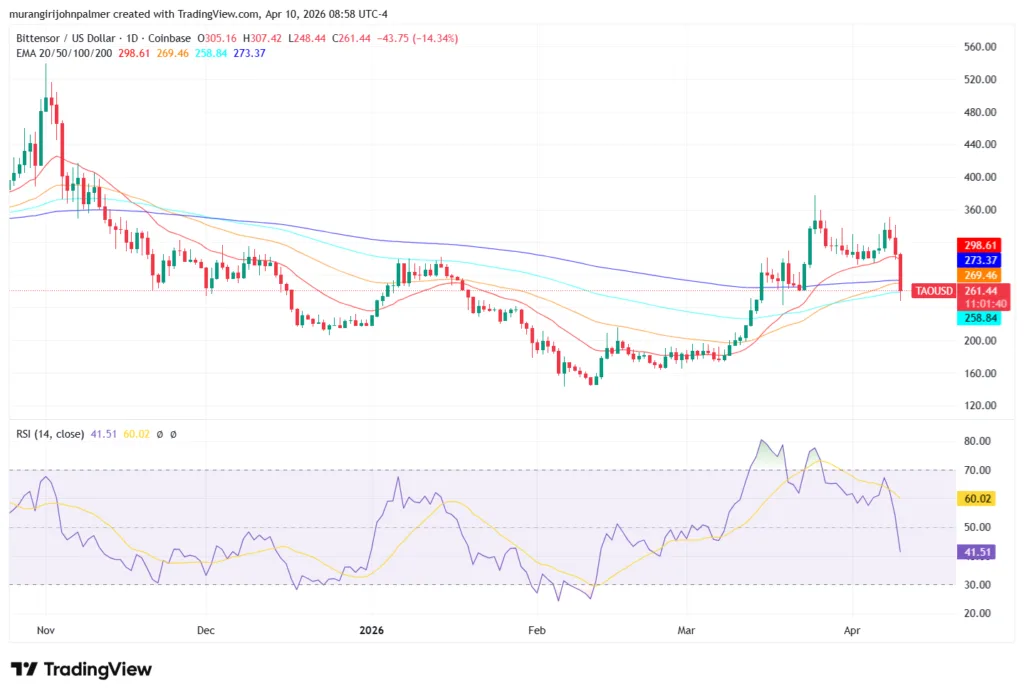
Technically, the 50-day moving average (now near $250) continues to provide dynamic support. This level has held up despite prior pullbacks in the recent upswing, making it an important line for bulls to defend. As long as TAO continues above this level, there is still a chance of a rebound, especially if selling pressure fades and volume contracts on the downside.
However, a break below this support would invalidate the short-term bullish structure, paving the way for a deeper slide into the $220-$200 range. On the upside, immediate resistance is near $300-$320, with a stronger supply zone around $350-$360. TAO is currently at a choice point: hold support and bounce, or lose structure and extend the correction.
A variety of things contribute to recovery. Market attitude, development activity, and governance changes will all influence the outcome. The TAO price drop does not imply a long-term decline, but it does raise major concerns.