
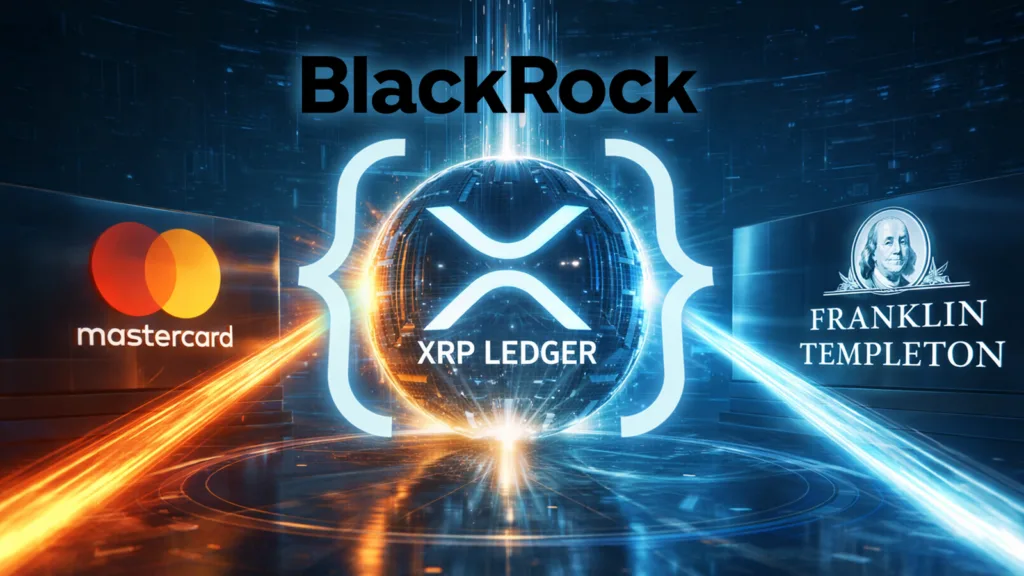



Discussion around the XRP Ledger has shifted from experiments to infrastructure talk. At Digital Assets Forum 2026, XRPL advocates described DeFi as “middleware” for global markets.
According to reports, Mastercard, BlackRock, and Franklin Templeton are among firms that have explored the network’s fit for payments and tokenized assets. XRP traded near $1.44 in recent sessions as the discussion picked up.
XRP Ledger interest rises as DeFi shifts into production rails
Institutional teams usually start with settlement risk, not memes. They look for rails that move value across entities and time zones. They also want audit trails that fit existing controls. That makes “who runs what” as important as throughput.

Odelia Torteman, who leads corporate adoption at XRPL Commons, has framed this shift in public remarks. She has also described DeFi as an invisible layer that moves value between asset classes. Event partners describe Digital Assets Forum 2026 as an institutional gathering for banks, asset managers, and infrastructure firms.
Torteman comments on a broader set of names including Mastercard, BlackRock, and Franklin Templeton. Those mentions do not confirm any production rollout. Mastercard has, however, announced at least one XRPL-linked settlement pilot through Ripple. BlackRock has not announced an XRP Ledger integration in a comparable public release.
XRP Ledger tokenized assets climb as RWA metrics jump 875 percent
Market updates peg tokenized value on XRPL between $2.3 billion and $2.5 billion. They also cite an 875 percent jump over recent months, tied to real-world assets activity.
Tokenized assets matter because they reduce the gap between trading and settlement. A bond token can move with the same speed as cash on-chain. That structure can also cut reconciliation work between custodians and brokers. Firms still need clear rules for identity, transfer limits, and disclosures.
Franklin Templeton has already put its name on XRPL use cases through formal channels. In September 2025, as reported DBS partnered with Franklin Templeton and Ripple around tokenized money market funds. Franklin Templeton is reportedly going to issue sgBENJI tokens on the XRP Ledger. DBS planned to list them alongside Ripple’s RLUSD stablecoin on DBS Digital Exchange.
Franklin Templeton has also described the network in its own ETF materials. In its 2025 Franklin XRP ETF release, the firm described XRPL. It called it open-source and built for payments, remittances, and tokenization. The release also referenced near-instant settlement and low energy use.
Meanwhile, SBI Ripple Asia has introduced a prepaid payment token platform on XRPL, with Tobu Top Tours expected to act as the inaugural issuer in Japan.The effort is reportedly tied to Japan’s prepaid market, which is at roughly ¥30 trillion annually.
Japan’s prepaid market is about 30 trillion yen. SBI Ripple Asia registered as a third-party prepaid payment instrument issuer under Japan’s Payment Services Act. That detail links the pilot to an existing regulatory track. It also hints at how issuers may structure compliance around stored value.
Post-quantum planning and XLS-100 widen XRPL settlement tools
Infrastructure buyers care about security timelines. In March 2026, Google-related coverage warned that quantum advances could pressure current cryptography earlier than expected. That risk has pushed more networks to map out post-quantum paths. It also raises “store now, decrypt later” concerns for long-lived data.
Ripple’s “Post-Quantum Readiness on the XRP Ledger” paper lays out a four-phase roadmap. It includes a “Quantum-Day” contingency plan for migration to quantum-safe accounts. The roadmap sets phased work across 2026 and targets a full transition by 2028. The paper also highlights key rotation and seed-based key generation as building blocks for migration.
On the functionality side, Ripple’s open-source documentation describes XLS-100 Smart Escrows. It adds a WebAssembly-based layer for programmable release conditions. Developers can write custom functions that control escrow completion. This kind of bounded programmability often appeals to institutions that want rules without full smart-contract sprawl.
Market data shows XRP is trading near $1.45 while staying inside a tight range. The market has spent weeks moving sideways, keeping price contained within a narrow band of roughly $1.30 to $1.45. This kind of “volatility squeeze” often reflects reduced follow-through from both buyers and sellers, rather than a strong directional trend.