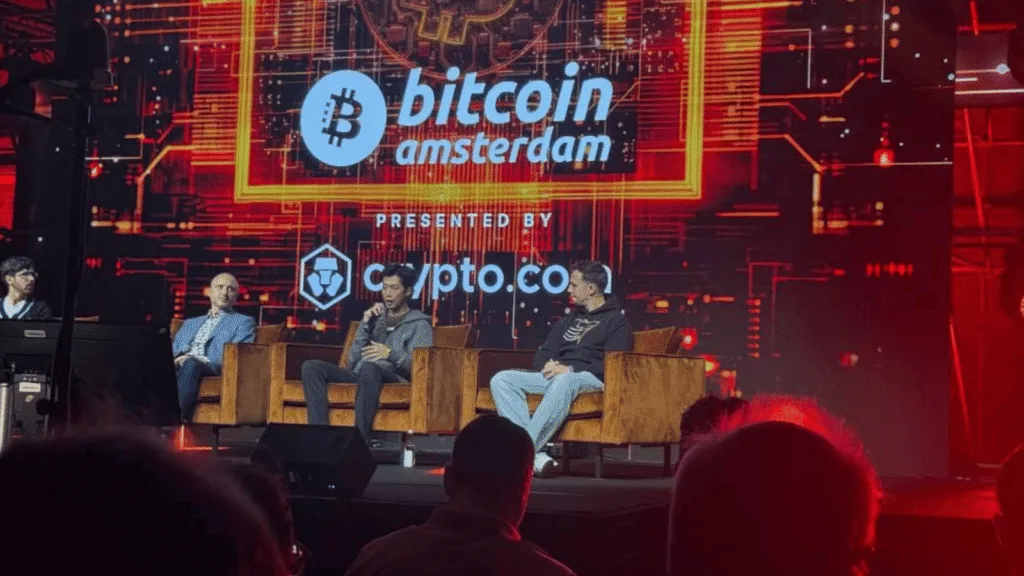



A stimulating discussion led by Gareth Jenkinson of Cointelegraph at this year’s Bitcoin Amsterdam Conference examined how Bitcoin is revolutionizing global crowdfunding by eliminating intermediaries, lowering prices, and opening doors for activists, creators, and humanitarian causes worldwide.
Three well-known figures in Bitcoin-native philanthropy and creator economies participated in the conversation, which was titled “Bitcoin and the Future of Crowdfunding”: Win Ko Ko Aung, Global Bitcoin Adoption Fellow at the Human Rights Foundation (HRF); Vladislav Dramaliev, Founder of BitHope.org; and Mick Morucci, CEO of Geyser.
Bitcoin as the ultimate funding rail
Jenkinson began the discussion by outlining the difficulties that traditional crowdfunding sites face, including exorbitant payment costs, stringent censorship regulations, and cross-border conflict. The discussion then shifted to how each issue is addressed by Bitcoin’s open, permissionless architecture.

According to all three presenters, Bitcoin’s low-cost, censorship-resistant, and global network makes it well suited for mission-driven fundraising. With features like Lightning-powered micro-donations and open on-chain tracking, Bitcoin gives artists and non-governmental organizations the freedom to solicit money without worrying about their campaigns being stopped or frozen.
According to Mick Morucci, Geyser is a Bitcoin-native platform that combines the communal spirit of Kickstarter with the sovereignty of Bitcoin. “We are financing the globe with Bitcoin,” he stated. He emphasized how Lightning micropayments transform backers from passive donations into collaborators by enabling them to instantaneously reward innovators across the globe.
Philanthropy without permission
The ten-year experience of BitHope.org using Bitcoin for social benefit was given by Vladislav Dramaliev. Since 2014, the foundation has made it possible for charities and NGOs around the world to accept Bitcoin payments; many of these organizations are underbanked or unbanked.
“Humanitarian operations are frequently blocked or delayed by traditional finance,” Dramaliev stated. “Donations made with Bitcoin are transparent, cross-border, and impervious to corruption.”
BitHope provides verifiable transparency by broadcasting all donations on-chain, ensuring that contributors’ money reaches the people who need it most.
A lifeline for the oppressed
From a human rights standpoint, Win Ko Ko Aung of the Human Rights Foundation emphasized how Bitcoin can save lives in areas where financial repression and authoritarianism are prevalent.
He cited examples from Latin America, Africa, and Myanmar where journalists and activists used Bitcoin to live when their bank accounts were frozen or local currencies crashed, saying, “Bitcoin is not just a tool – it is a lifeline.”
By providing a layer of security and anonymity to both contributors and recipients, HRF’s projects enable Bitcoin donations to reach those who would not otherwise have access to international financing.
Challenges and the road ahead
The panelists also covered the challenges that Bitcoin-based crowdfunding still faces, ranging from price volatility and ambiguous rules to onboarding and wallet security. However, as Bitcoin becomes more widely available due to Lightning Network acceptance, Nostr integration, and enhanced mobile user experience, optimism prevails.
“We are establishing the railroads for unstoppable finance open, worldwide, and censorship-free,” as Morucci stated.
The presenters see a time soon where sovereign Bitcoin rails will take the place of Patreon and GoFundMe, enabling people and communities to finance ideas, activism, and art without restrictions or boundaries.
The panel’s message was unambiguous: Bitcoin represents digital freedom, not just digital gold.