



March was looking decent for Bitcoin ETF investors, until this final week undid some of the goodwill.
Spot Bitcoin exchange-traded funds (ETFs), investment products that track Bitcoin’s price and trade on traditional stock exchanges, giving everyday investors exposure to crypto without holding it directly, posted $296.18 million in net outflows for the week ending Friday, breaking a four-week run of positive inflows. The reversal came after what had been a genuinely strong stretch of institutional buying.
Over those four prior weeks, the funds had collectively pulled in more than $2.2 billion, with weekly totals of $787.31 million, $568.45 million and $767.33 million in early March before slowing noticeably to $95.18 million in the week just before the outflows hit. That late deceleration, in hindsight, was probably the early warning sign.

What drove the selloff
The week’s damage was concentrated on Thursday and Friday, with the two sessions combined generating more than $396 million in total withdrawals. Friday alone accounted for $225.62 million, the single largest day of redemptions since March 3.
BlackRock‘s iShares Bitcoin Trust led the Friday selloff, shedding $201.67 million, with Bitwise and Ark Invest funds adding smaller but notable outflows of $18.60 million and $5.35 million respectively.
The broader context helps explain the timing. March 27 saw Deribit settle $14.16 billion in Bitcoin options, the largest quarterly expiry of 2026, wiping out close to 40 percent of all open positions on the exchange.
The max pain level sat at $75,000, well above where Bitcoin was actually trading, meaning most bullish bets didn’t pay out. Bitcoin fell roughly 5 percent in 24 hours to as low as $65,720 as the selling cascaded through the market.
Geopolitical pressure added to the unease. Iran threatened to block the Bab el-Mandeb Strait, a key Red Sea shipping gateway, on top of the Strait of Hormuz, which had already been effectively closed since late February. Oil climbed above $103, and a gold-to-crypto rotation that had been helping Bitcoin recover earlier in March reversed sharply.
Bitcoin traded in a range between $65,000 and $72,000 throughout the week as capital largely avoided making directional bets. Weekly trading volume across the ETFs fell to $14.26 billion, down from $25.87 billion earlier in the month.
The broader picture still holds
Despite the ugly final week, the bigger picture isn’t all that grim. Cumulative net inflows into spot Bitcoin ETFs since their launch remain at $55.93 billion, while total net assets across all products sit at $84.77 billion, down from over $90 billion a week earlier, but still a significant base.
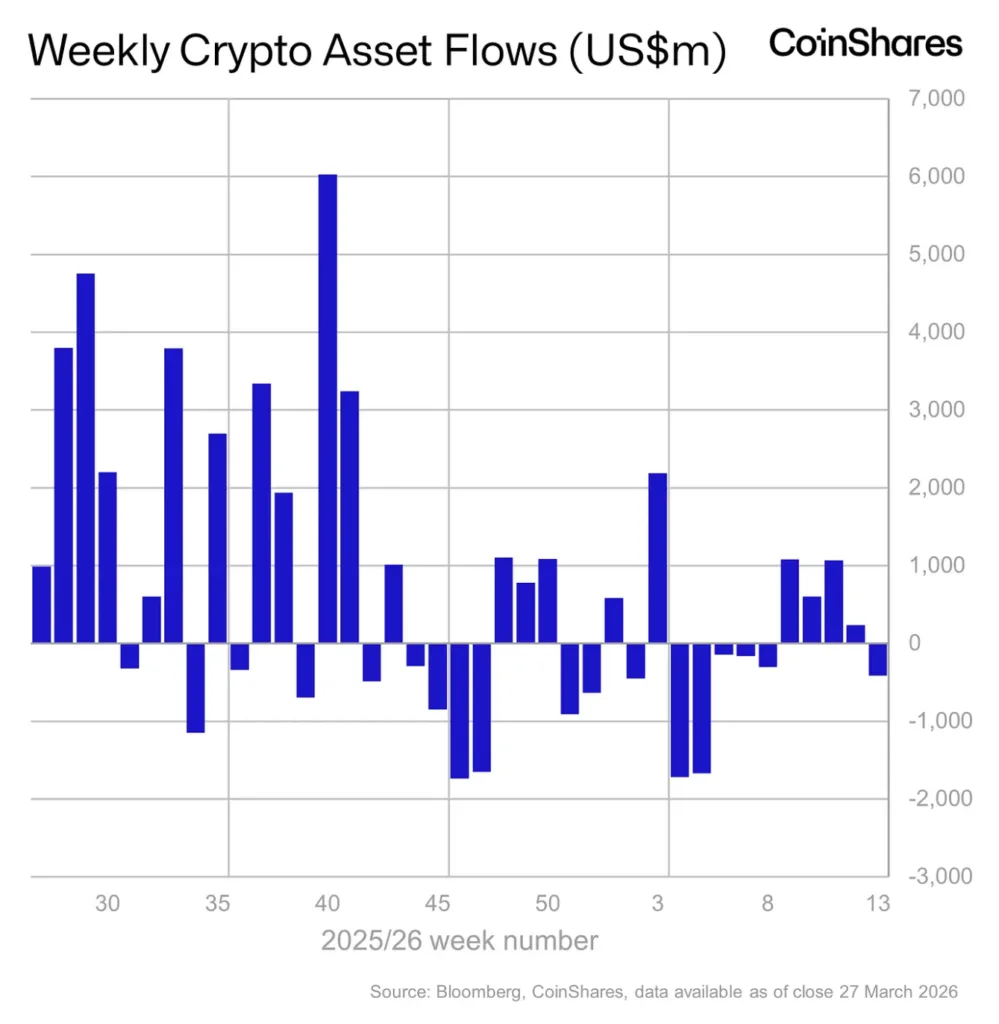
The global crypto fund picture tells a similar story. According to CoinShares’ latest weekly report, digital asset investment products worldwide recorded $414 million in net outflows, the first time in five weeks that global flows turned negative.
The report pointed to concerns over a prolonged Iran conflict, rising inflationary expectations, and a shift in rate outlook at the US Federal Reserve as the main factors weighing on investor sentiment. Assets under management across digital asset exchange-traded products fell to $129 billion as a result.
Ethereum products weren’t spared either. Spot ETH ETFs recorded $206.6 million in outflows for a second straight week. Solana followed with $12.3 million in outflows, while XRP stood out as one of the few assets to attract fresh money, pulling in $15.8 million.
The week’s numbers don’t suggest a collapse in confidence so much as a pause, investors stepping back as macro noise got louder. Whether that caution extends into April or fades as quickly as it arrived will likely depend less on anything happening inside crypto and more on how the geopolitical picture and rate expectations evolve over the coming weeks.