




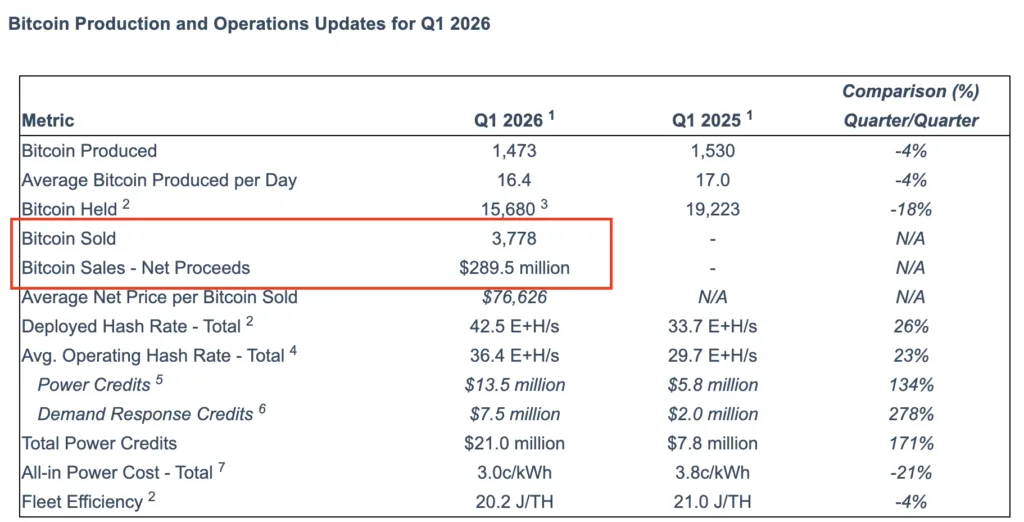
Riot Platforms, a major publicly traded Bitcoin mining company listed on the Nasdaq, unloaded 3,778 Bitcoin (BTC) during the first quarter of 2026, bringing in roughly $289.5 million in net proceeds.
This action represents a notable change in the company’s treasury approach, given that its total Bitcoin holdings were 15,680 BTC at the close of March. Even with this sale, the firm continues to be a substantial presence in the cryptocurrency arena.
Still, the move underscores a growing trend: mining companies are leaning more on their Bitcoin reserves to bolster their cash flow.

Less revenue pushes miners to sell Bitcoin
The revenue generated by bitcoin miners comes in the form of validating transactions on the network, which in return comes with a reward in the form of newly minted bitcoin.
Historically, a lot of bitcoin mining outfits have taken the “HODL” route, banking on the idea that their bitcoin holdings would eventually be worth more. But the day-to-day demands of running a bitcoin mining business have often pushed these companies to sell their bitcoin, rather than just sit on it. Riot’s recent sale, for instance, appears to be a pragmatic decision, not a frantic scramble for cash.
The fact that the sale raised around $289.5 million for the company means that the firm now has room to operate, invest in new mining equipment, as well as meet its daily expenses.
The mining business is a capital-intensive industry, and energy costs are one of the biggest expenses for companies. By selling a portion of their Bitcoin in cash, the company will be able to reduce financial risks and be in a position to run the business without hiccups, especially when the prices of Bitcoin are volatile.
Riot’s move stays in tandem with other market players
Notably, Riot is not the only publicly traded mining company taking such a move. Other publicly traded mining companies have collectively sold over 15,000 BTC in recent months. This is a sign of a larger trend within the industry. Rather than holding onto the cryptocurrency indefinitely, miners are becoming more judicious with their handling of the cryptocurrency.
This is a sign of the industry becoming more mature. The strategies that miners are taking are becoming more and more similar to traditional industries. The market is also a factor in the strategies that miners are taking. When the price of the cryptocurrency is high, miners are able to lock in a profit and create a cash reserve.
The difficulty level of the cryptocurrency is increasing due to the number of miners on the network. This is a sign that the price of the cryptocurrency is not as reliable. Having a cash reserve is a sign that the company is managing the risk effectively.
From a market perspective, a high sale of Bitcoins by miners at a particular time may sometimes spark concern over the possible negative impact of the sale. This is because when several companies sell a high amount of Bitcoins at a particular time, it may result in a high supply of Bitcoins.
Nevertheless, this depends on the demand for Bitcoins by other parties, such as institutional and retail investors. Sometimes, the high demand for Bitcoins helps to absorb the high supply of Bitcoins.
Although Riot reduced its amount of Bitcoins, it still holds a considerable amount of Bitcoins, thus enabling it to benefit if the price of Bitcoins increases in the future.
The move by Riot Platforms to sell its Bitcoins in the first quarter of the year indicates a shift in the overall perspective of the Bitcoin mining industry.
Rather than holding a lot of Bitcoins and waiting for the price of the asset to increase, several miners are shifting towards more realistic approaches towards managing Bitcoins.