


Bitcoin miners entered into 2026 with increased pressure as weaker Bitcoin prices, reduced hashprice, and high network competition marginally decreased across the industry.
CoinShares reported in its Q1 2026 report that the average cash cost to produce one Bitcoin by publicly listed miners increased to approximately 79,995 in the fourth quarter of 2025. That level pushed many operators close to breakeven.
The report said mining conditions worsened after Bitcoin pulled back from its early October peak near $126,000 to about $86,000 by late December.

At the same time, network hashrate stayed near record levels, which kept competition high and reduced returns for miners across the market.
Production costs rise as miner revenue weakens
According to CoinShares, the weighted average cash cost of every Bitcoin mining increased significantly during the last quarter in 2025. The company attributed that growth to decreased Bitcoin prices, reduced mining economics, and reduced revenue per unit of computing power.
The report referred to the quarter as the most difficult since the April 2024 halving suffered by miners.
James Butterfill, CoinShares director of research remarked that declining hashprice contributed towards the pressure. Hashprice, the indicative of miner revenue per petahash per second per day, declined to an approximate of $36 to $38 and then again to an approximate of $28 to $30 in the first quarter of 2026.
CoinShares pointed out that level pointed to more pressure ahead, especially for miners with older machines or higher power costs.
The report highlighted that current economics have already pushed part of the global mining fleet below profitability. CoinShares estimated that about 15 percent to 20 percent of miners now operate at a loss at recent hashprice levels. The firm said operators that run mid-generation hardware and pay around $0.05 per kilowatt-hour or more for electricity face the most pressure.
Moreover, CoinShares said miners with newer fleets still hold an advantage because efficient equipment can preserve margins even when revenue drops.
By contrast, miners with weaker fleet efficiency must rely on very low power costs to stay cash-profitable. That gap has narrowed the field and left only the most cost-efficient operators in a stronger position.
Lower prices and record competition push miners toward breakeven
The report showed Bitcoin’s price decline and steady difficulty growth combined to squeeze miners from both sides.
Revenue weakened as Bitcoin lost value, while network competition remained intense. CoinShares said near-record hashrate left many operators producing Bitcoin at or near breakeven.
That strain has already appeared in network data. CoinShares pointed to three straight negative difficulty adjustments in late 2025, the first such streak since July 2022. It also noted that Bitcoin mining difficulty fell about 8 percent on March 20, one of the sharpest drops this year. Lower difficulty reduces the amount of computing work needed to mine a block, which gives some relief to miners that remain online.
CoinShares said public miners have also reduced their Bitcoin reserves as margins tightened. According to the report, listed mining companies sold more than 15,000 BTC from peak treasury levels. It cited sales by Core Scientific, Bitdeer, and Riot, while MARA said on Thursday that it sold another 15,133 BTC.
Butterfill said a weaker price environment could force more operators to shut down unprofitable rigs.
He wrote, “If prices were to stay below $80k for the remainder of the year, we forecast the hashprice to continue to fall.”
He added that in such a case, “the hashprice would more likely flatline” as weaker miners leave the network and reduce competitive pressure.
AI and high-performance computing draw more mining firms
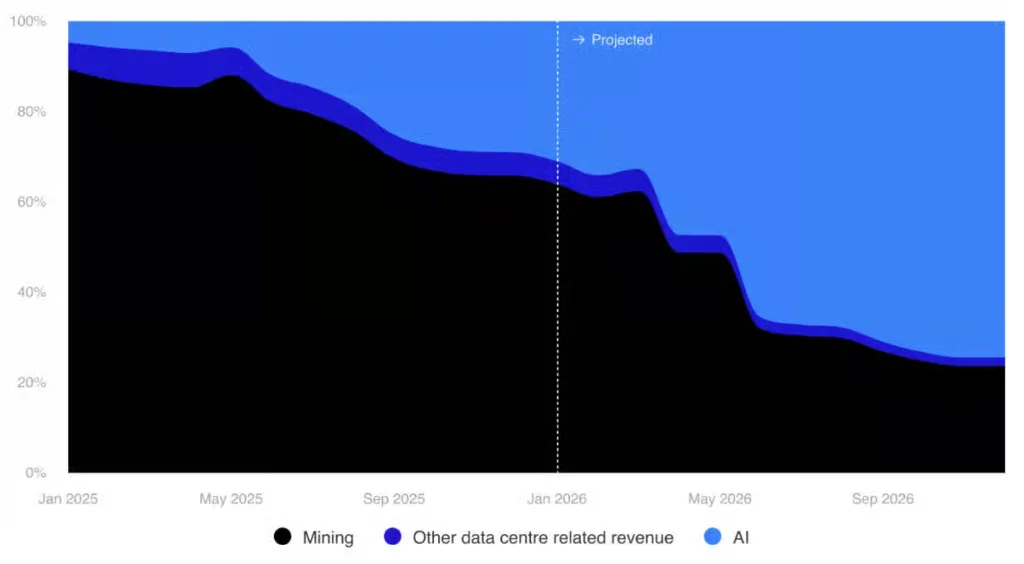
As mining margins tightened, CoinShares said listed miners accelerated their shift toward artificial intelligence and high-performance computing. The report said those businesses offer higher and more stable returns than Bitcoin mining, which has pushed several public miners to reposition themselves as data center operators.
Butterfill said listed miners could generate as much as 70 percent of their revenue from AI by the end of 2026, up from about 30 percent today. CoinShares also said the public mining sector has announced more than $70 billion in combined AI and high-performance computing contracts. The firm named IREN, TeraWulf, Core Scientific, Cipher, and Hut 8 among the companies moving deeper into that model.
The report said the shift is creating a wider divide between pure-play miners and firms building broader digital infrastructure businesses. Some miners still focus on Bitcoin production and energy strategies that fit mining better than AI workloads.
CoinShares said MARA remains more focused on mining and on energy sources that may not suit AI data center use as easily as they suit Bitcoin operations.
CoinShares also said the AI buildout is changing balance sheets across the sector. The report noted that several firms have raised large amounts of debt to fund expansion. It cited IREN with $3.7 billion in convertible notes, TeraWulf with $5.7 billion in total debt, and Cipher with $1.7 billion in senior secured notes.
CoinShares said that borrowing has changed the sector’s risk profile as miners chase new revenue streams outside Bitcoin production.
Recovery hopes remain tied to Bitcoin price and fleet efficiency
CoinShares said mining conditions could improve if Bitcoin price recovers. Butterfill wrote that it is “not an unrealistic assumption to see Bitcoin prices recover to $100,000,” a move that would lift hashprice to about $37 per PH/s/day. The report added that a return toward prior highs near $126,000 could push hashprice closer to $59.
Nevertheless, CoinShares reported that the recent decline in hashrate is not an indicator of a sector-wide collapse. It went to approximately 1,160 EH/s in early October, dropped to approximately 850 EH/s by early February, and again, approximately 1,020 EH/s, with which it ended 2025. The company claimed that hashrate would go as high as 1.8 zetahash by 2026.
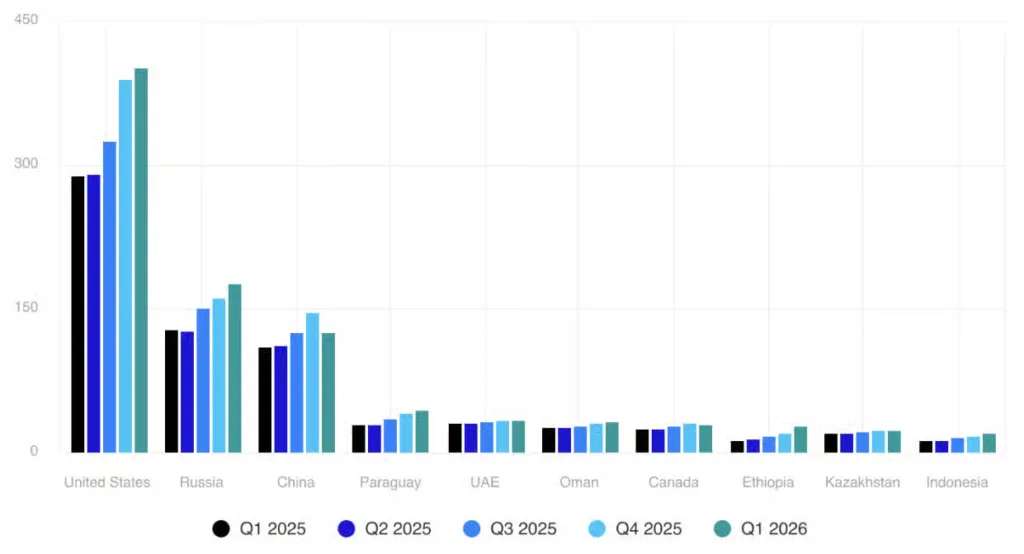
The report also pointed to changes in mining geography. CoinShares said the United States, China, and Russia now control about 68 percent of global hashrate. The United States gained about two percentage points of market share quarter over quarter, while Paraguay, Ethiopia, and Oman moved into the top 10 as miners searched for cheaper power.