




The microeconomic environment has changed and institutional investors have encountered it. A recent Citi study identifies a new strategy for modern wealth management. Strategist Alex Saunders believes that risk-adjusted returns are greatly enhanced by diversifying traditional hedges. Though gold will continue to be a staple, the introduction of Bitcoin would make it a more robust investment vehicle. The shift is a paradigm change in global banks’ perception of digital scarcity.
Modern portfolio theory often relies on fixed allocations between bonds and equities. However, recent inflationary pressures have exposed the weaknesses of the 60/40 model.
The Citi report serves as a technical manual for navigating this new volatility. It implies that the store-of-value category is expanding beyond its physical boundaries. With the inclusion of blockchain-based assets, managers can capture upside typically missing from traditional commodities.

The power of split allocations and Bitcoin
According to analyst Alex Saunders and the Citi research team, a 5% allocation to gold has historically improved portfolio efficiency. More importantly, dividing that allocation between gold and bitcoin produces better results, regardless of market cycles.
The paper examined portfolio behaviour under various market conditions. Saunders emphasised that a mixed allocation promotes higher returns when bonds benefit from positive trends while also serving as a buffer during periods of fiscal uncertainty or heightened inflation risk.
The analysis highlighted Bitcoin’s recent performance. Bitcoin increased by 9% in the last two months, while spot gold fell by 4%. According to Citi’s study, bitcoin outperforms gold when bond markets are under pressure, and having exposure to both assets helps balance gold’s defensive traits with bitcoin’s growth potential.
The hybrid strategy takes advantage of the differing volatility characteristics of the two assets. Gold offers security when the traditional market crashes or geopolitical conflict arises. Bitcoin, on the other hand, presents high growth opportunities during periods of high liquidity and technological booms.
Navigating bond markets with Bitcoin
The study particularly highlights performance during bond market fluctuations. Sovereign debt yields are subjected to colossal pressure, and digital assets tend to be prosperous. The Citi study found that Bitcoin frequently outperforms gold during periods of weak bonds. Such change in correlation is critical to fixed-income traders who seek substitutes.
Bitcoin’s status is moving beyond its “digital gold” image. With current world events, particularly the Iran crisis, the narrative surrounding Bitcoin has shifted to view it as a geopolitical asset rather than a high-risk technology holding or an inflation hedge.
During recent global instability, Bitcoin’s performance deviated from that of equities and gold, calling into question previously held beliefs about its risk-market correlation.
A crucial development is Iranian officials’ stated proposal to accept Bitcoin for oil shipment tolls through the Strait of Hormuz. This move exemplifies an emerging use case in which bitcoin is used for cross-border settlement, further separating the asset from its essentially speculative beginnings.
Bitcoin’s price action
Bitcoin is currently trading at $75,898, up 1.37% in the past 24 hours. Bitcoin (BTC) is exhibiting a buy technical sentiment. Currently, the Relative Strength Index (RSI) for BTC stands at 66, which suggests a Neutral condition. Meanwhile, the MACD (12, 26) indicator is at 1,605, providing a buy signal for short-term momentum.
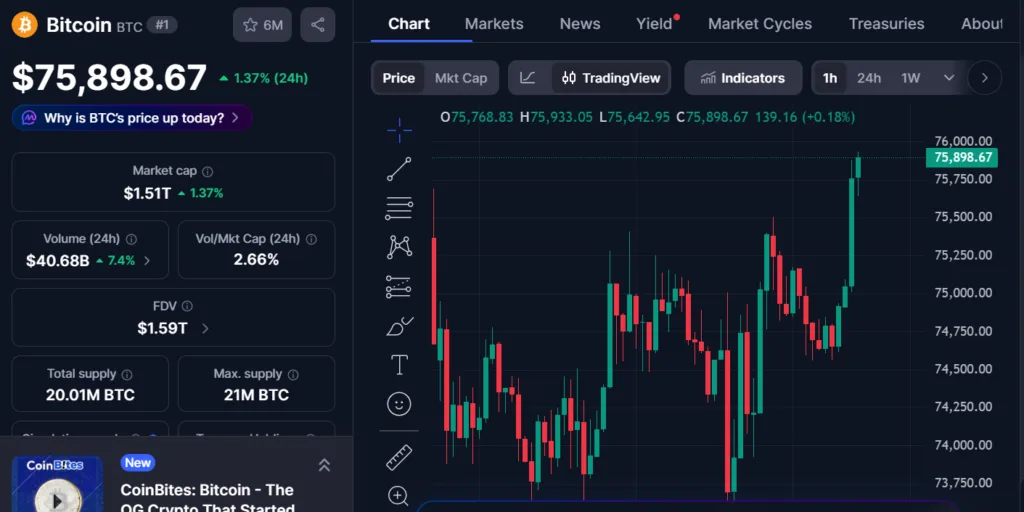
Bitcoin’s latest climb above $75,000 has had a significant impact on market mood. After falling to near $60,000 in February, BTC has risen by over 23%, sustaining its resilience even as traditional financial markets endure instability amid growing geopolitical concerns.
Traders are looking at the $75,000 to $76,000 price band as a key resistance level. Many market participants see a breakout above this level as a possible road to $80,000. A reverse, on the other hand, may bring prices back near the low $70,000s or even lower.
Indications from the derivatives market show that pessimistic sentiment persists despite the upswing. Funding rates on perpetual futures contracts have been negative for more than six weeks, indicating that shorts remain prevalent even as prices rise.