



Bitcoin proposal “The Cat” calls for the permanent removal of Ordinals and NFT data by consensus-level UTXO deletion. This has led to criticism from developers about issues of confiscation and network governance.
A controversial plan to permanently get away of Ordinals inscriptions and Bitcoin Stamps has sparked a lot of discussion among developers.
A soft fork at the consensus level would make millions of outputs the size of dust containing NFT data permanently unspendable. The name of this proposal is “The Cat.”

Claire Ostrom, who wrote the proposal, claims that its goal is to curb what she considers an unprecedented rise in Bitcoin’s UTXO set.
The UTXO database grew slowly from 2009 to early 2023, and by then it had roughly 80–90 million pieces.
In just one year, it had well over 160 million entries. Studies suggest that over half of all UTXOs now have less than 1,000 satoshis.
The Cat would use outside indexers like Ord and Stamps to find these outputs. Then, it would make them impossible to spend again and allow nodes entirely take them out of the UTXO set.
Greg Maxwell warns of confiscation and governance overreach
Greg Maxwell, a programmer for Bitcoin Core, was quite against the notion, saying it was a “total non-starter” and would be theft.
In response to the Bitcoin development mailing list, Maxwell said, “The proposal would intentionally and knowingly take millions of dollars.”
Maxwell dispute claims that spam filters don’t function. He said that the current setup already blocks most unneeded data storage, save for purposes that are more beneficial due to Bitcoin’s limits.
The well-known programmer also didn’t appreciate how long and convoluted the plan was. He said it should have just been a simple query about how to halt NFTs instead of a lot of technical writing.
He warned that using language models the wrong way could lead to ideas that are too hard to understand and waste everyone’s time.
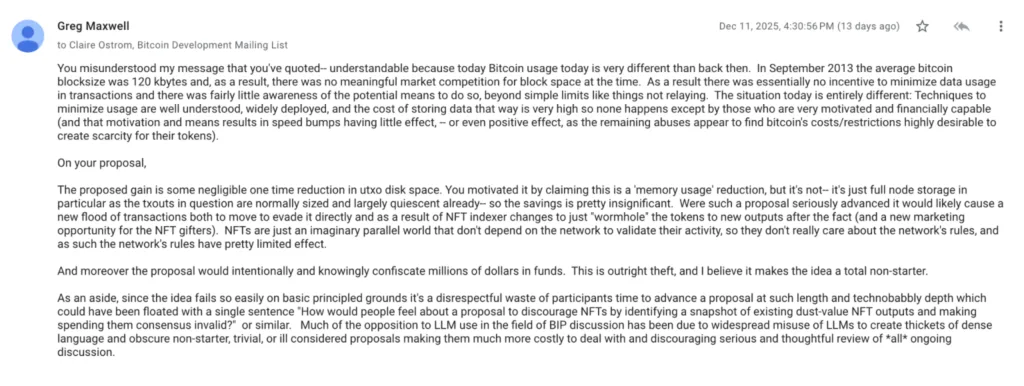
Source: Bitcoin Development Mailing List
Supporters argue UTXO pruning is necessary to control network bloat
Despite his disagreement with the idea of erasing UTXOs, Bitcoin Mechanic, a well-known anti-spam activist, enthusiastically supported the concept.
He said, “I don’t think it’s unfair for Bitcoin users to do this if they want to, since they have to keep the UTXO set up for good.”
Supporters of the plan say that 40% to 50% of the UTXO set is made up of spam outputs and very little dust.
Removing these would save up a lot of space on the disc, especially for nodes that have been cut back the most.
According to developer Nona YoBidnes, the strategy will convey a powerful message to discourage spam from happening again in the future.The purpose here is to get rid of spam. Nona commented, “The amount of spam doesn’t bother me, but the price does.”
But supporters admit that removing UTXOs that everyone agrees on has never been done before.
Bitcoin Mechanic remarked that it’s easy to change spam filters if they’re put up wrong, but removing the wrong UTXO would be a big problem.
The strategy takes care of this by requiring a lot of verification and encourages the community to review snapshots of the desired outputs on their own.
“Lynx” offers an alternative cleanup model
The “Lynx” suggestion by Matteo Pellegrini suggests an alternate approach. It doesn’t recommend targeting specific protocols; instead, it suggests regular cleanups that are related to Bitcoin’s halving timetable.
Every time the amount of UTXOs was cut in half, UTXOs that had been hanging around for four years and were valued less than 999 satoshis would never be able to be spent again.
Pellegrini argues that this threshold-based method keeps The Cat from using outside indexers and targeting that is exclusive for a given protocol.
“Lynx doesn’t need any outside indexers, doesn’t judge why a UTXO is small, and applies to all participants equally,” reads the proposal.
Maxwell also said no to Lynx, noting that dust limits aren’t consensus criterion and that outputs that are expected to be inactive don’t have a big effect on performance.
He argued that the email list should not allow any more suggestions to take currencies for a year, adding that this could undermine people’s belief in Bitcoin.