




Michael Saylor’s Strategy Inc. reported a $14.46 billion unrealized loss in the first quarter of 2026, according to an 8-K filing the company submitted on Monday to the Securities and Exchange Commission.
The setback came after Bitcoin fell hard during the quarter. The world’s largest cryptocurrency dropped about 24 percent in the first three months of the year, its weakest start since 2018.
As of 31 March, Strategy held 762,099 Bitcoin. Strategy spent $57.69 billion to buy those coins, at an average price of $75,694 per Bitcoin. The drop in BTC prices had a direct impact on its quarterly results.

The company uses fair-value accounting for its Bitcoin holdings. Under this method, Strategy must report the market value of its digital assets at the end of each quarter.
So, when the Bitcoin price falls below the company’s purchase cost, the gap is recorded as an unrealized loss in its financial results.
Still, by the end of March, the market value of Michael Saylor’s Strategy’s Bitcoin remained below its total cost. That gap led to the $14.46 billion paper loss the company reported in its SEC filing.
Tax benefit and valuation allowance
The company also reported a $2.42 billion deferred tax benefit related to the unrealized loss. A deferred tax benefit means Strategy may pay less in taxes in the future if it sells Bitcoin at a loss.
However, the company established a $1.73 billion valuation allowance against this benefit. This allowance shows uncertainty about whether the tax advantage will be utilized.
Strategy anticipates adding another $0.5 billion in valuation allowances for its software business, as the Bitcoin loss impacts its overall tax position.
As of March 31, Strategy said the carrying value of its digital assets stood at $51.65 billion.
Strategy kept buying Bitcoin after quarter-end
Despite the large paper loss, Strategy kept building its Bitcoin position. The company said it bought 4,871 Bitcoin between April 1 and April 5, spending about $329.9 million at an average price of $67,718 per coin.
After this purchase, Strategy’s total holdings increased to 766,970 Bitcoin. The company said it has spent a total of $58.02 billion on those holdings, with an average purchase price of $75,644 per Bitcoin.
The filing also said Strategy funded the latest Bitcoin purchases through proceeds from its at-the-market stock sales.
Strategy also raised fresh capital in early April. Between April 1 and April 5, the company sold 1,027,255 shares of STRC preferred stock and 593,294 shares of MSTR common stock.
These sales brought in about $174.6 million in net proceeds. Before that, from March 30 to March 31, Strategy raised another $299.3 million in net proceeds through its offerings.
The update shows that Strategy is continuing the same approach even as Bitcoin posted a weak quarter. Although the company reported a large unrealized loss as Bitcoin prices fell, it kept buying more of the cryptocurrency.
Fresh market debate has also kept attention on Strategy’s Bitcoin-heavy model. Critics such as Peter Schiff argue the company’s stock strength reflects investor demand more than Bitcoin’s actual performance.
Michael Saylor, however, disagreed with Schiff’s opinion and defended Bitcoin’s long-term value.
MSTR and Bitcoin prices drop
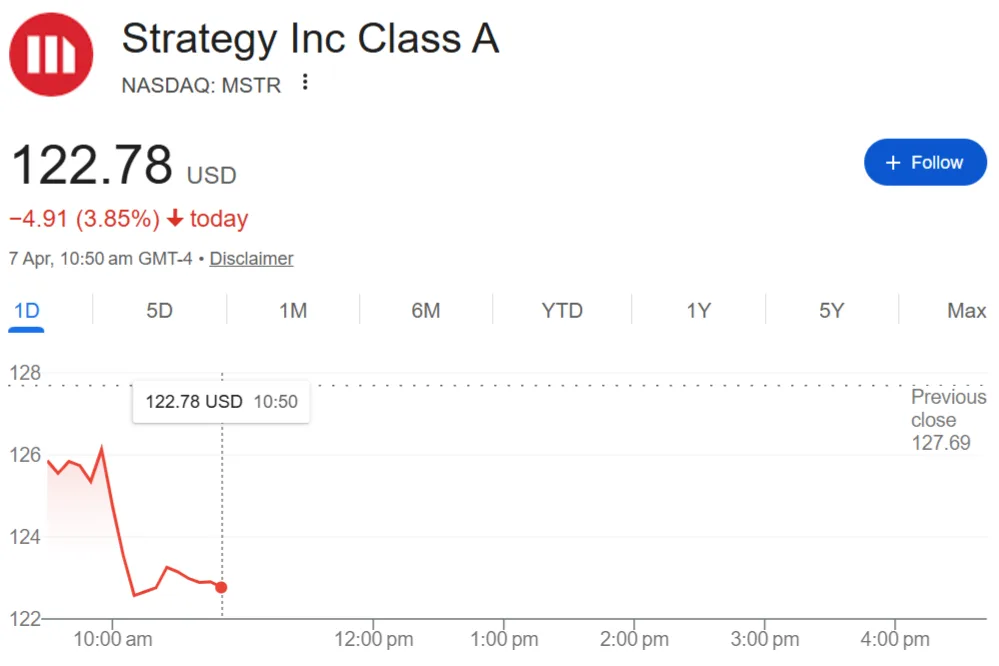
Usually, such a large loss would shake investor confidence. Strategy’s stock (MSTR) also dropped more than 3 percent to around $122.78 in the past 24 hours.
At the time of writing, Bitcoin was trading at $68,241, down 1.5 percent over the past 24 hours, according to the data from CoinMarketCap.
But there is still ambiguity within the crypto market. As per the report, Iran persisted with rejecting demands for opening up the Strait of Hormuz.
On the other hand, the market appeared to be more concerned about the prospect of de-escalation rather than potential risks.
Meanwhile, Bitcoin’s long-term holder supply has turned positive again, according to a Tuesday report from CryptoQuant.
CryptoQuant analyst Darkfost said this kind of shift has often come before stronger price moves in the past. However, he also noted that the market is not fully strong yet, as demand remains soft for now.
“This represents a positive shift in investor behavior, as it suggests that holding currently dominates over selling,” the analyst stated.