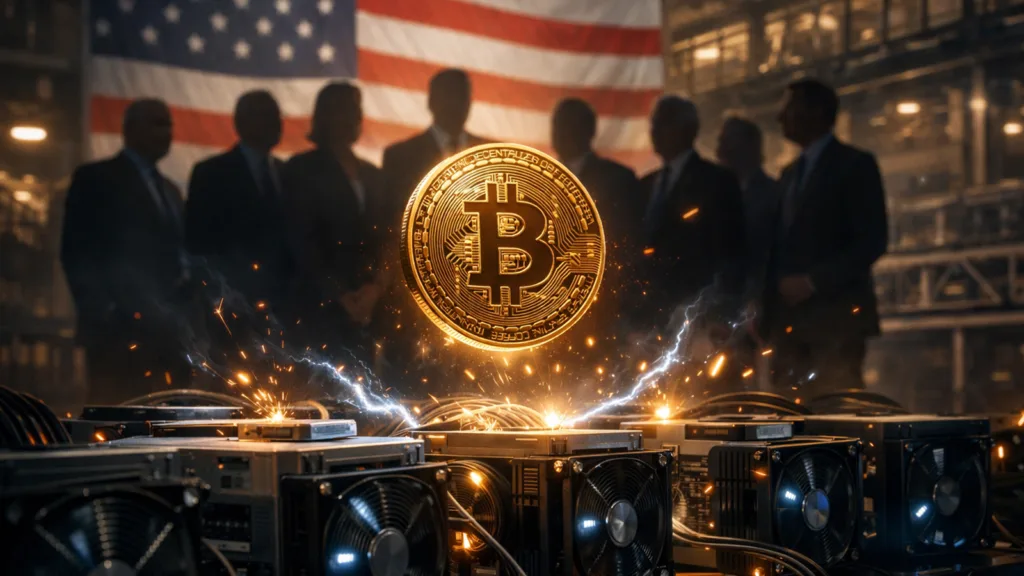



America mines more Bitcoin than any other country. It just doesn’t build the machines that do the mining, and that’s the problem two Republican senators are now trying to fix.
Senators Bill Cassidy of Louisiana and Cynthia Lummis of Wyoming introduced the Mined in America Act on Monday, a bill aimed at pulling more Bitcoin mining activity, and more importantly, Bitcoin mining hardware manufacturing, back onto US soil.
The bill also takes a step that crypto advocates have been pushing for since last year: formally writing President Donald Trump’s Strategic Bitcoin Reserve executive order into law.

At its core, the bill would direct the Department of Commerce to set up a voluntary “Mined in America” certification program for crypto mining facilities and mining pools.
To qualify, certified operations would be required to phase out mining equipment tied to companies linked to foreign adversaries, a thinly veiled reference to Chinese manufacturers, and shift toward domestically built hardware instead.
“Digital asset mining is a big part of our economy. We should be doing it here in America,” Cassidy said in a statement Monday.
The China problem nobody wants to talk about
The bill puts a spotlight on a contradiction that has been sitting uncomfortably in plain sight. The US currently accounts for roughly 38 percent of the Bitcoin network’s total computing power, more than double that of second-place Russia, making it the clear global leader in mining activity.
Yet 97 percent of the actual hardware running those mining operations is made by just two Chinese companies: Bitmain and MicroBT. That gap between operational dominance and manufacturing dependence is precisely what the bill is targeting.
Dennis Porter, CEO of Satoshi Action Fund, one of the bill’s backers, put it plainly: “America controls 38 percent of the world’s Bitcoin hash rate, but 97 percent of the hardware powering it comes from China. That is not leadership, that is a liability.”
The vulnerability appears to not just be theoretical. Starting in late 2024, US Customs and Border Protection paused shipments of thousands of Bitmain ASIC mining machines, the specialized computers used to mine Bitcoin, at US ports for several months, disrupting mining companies that had been waiting on hardware deliveries.
Luxor Technology, one of the affected firms, said the machines had been held up because they were mistakenly classified as illegally imported radio frequency devices. The whole episode made it hard to argue that relying on Chinese-manufactured hardware carries no risk.
What the bill does
Beyond the certification program, the legislation would direct the National Institute of Standards and Technology and the Manufacturing Extension Partnership, two existing federal bodies, to assist US manufacturers in developing mining hardware that is both “more secure and more energy efficient.”
Crucially, the bill is designed to work through existing federal programs rather than creating new spending authorities, which could make it an easier sell politically.
The Strategic Bitcoin Reserve component is arguably just as significant. Trump signed an executive order establishing the reserve in March 2025, directing the Treasury to hold Bitcoin seized through government enforcement actions rather than selling it.
The Mined in America Act would write that reserve directly into statute, giving it a legal foundation that an executive order alone cannot fully provide, and making it harder for a future administration to simply reverse it.
Lummis, who has been one of the most vocal crypto advocates in the Senate for years, framed the bill as part of a broader push to make the US the dominant force in digital assets globally. Whether Congress moves it forward quickly is another question, but as a statement of intent, it lands at a moment when the geopolitical dimensions of Bitcoin infrastructure are getting harder to ignore.