



Friday saw Bitcoin price drop and carry losses into the following session as the market pressure to sell-off the crypto market was felt by Bitcoin holders.
BTC fell to major support areas, and spot ETF flows remained negative, and technical indicators declined, as traders responded to increased uncertainty.
Bitcoin price drops
The overall crypto market cap dropped to $2.34 trillion as the market was wiped out by 3 percent per day losses of $80.21 billion. The trading volume was at $170.82 billion and this was above the previous sessions and indicated that the move was accompanied by active selling and not thin liquidity.

Bitcoin failed to hold $70,000 and then lost the $69,000 and $68,000 levels in quick succession. BTC traded at around $65,600 at press time, down almost 5 percent over 24 hours and 6 percent over seven days (per Coingecko’s data). With a circulating supply of about 20 million coins, Bitcoin’s market cap stood at $1.31 trillion.
Ethereum also moved lower and fell below $2,000, while many altcoins posted steeper losses. The broad decline hurt leveraged positions across the market. More than 120,000 traders were liquidated over the past day as downside pressure spread across major tokens.
The drop also reduced value across the largest assets in a short period. Bitcoin erased about $54 billion from its market cap in three hours, while Ethereum lost about $11 billion over the same stretch. The speed of the move added pressure to an already weak market tone.
Geopolitical tension and risk aversion weigh on BTC
The sell-off came as traders responded to new tension in the Middle East and reports tied to shipping risks near the Strait of Hormuz. The market also tracked reports that the United States was preparing to send more troops to the region. These developments added to concerns across risk assets, including crypto.
At the same time, reports of fresh BTC transfers from Bhutan added another source of pressure to sentiment. Traders often watch such transfers closely because they can raise fears of future selling. In a weak market, that kind of headline can add to short-term volatility even without confirmed sales.
Some market commentators linked the decline to a wider move away from risk. A post from analyst ᴛʀᴀᴄᴇʀ claimed that “investors started exiting risk-on assets into safe assets” after the regional situation worsened. That view matched the day’s price action, though social media posts should be treated with caution during fast market moves.
The market also faced pressure from a weaker macro tone. When traders expect tighter liquidity or more volatility across global assets, Bitcoin often trades like a risk asset rather than a hedge. That pattern appeared again as BTC sold off alongside the rest of the crypto market.
ETF outflows and trader fear add to the decline
Spot Bitcoin ETFs posted total net outflows of $171 million on March 26 ET, according to SoSoValue data. Spot Ethereum ETFs recorded $92.54 million in net outflows and extended their losing streak to seven straight days. These outflows showed that institutional demand stayed soft during the sell-off.
ETF flow data matters because it gives a daily view of demand from regulated investment products. When outflows rise during a weak market session, they can add to the view that buyers are stepping back. That does not set price direction on its own, but it can reinforce a bearish short-term setup.
Sentiment data also turned weaker. Santiment said retail mood had moved into “extreme fear” territory after Bitcoin fell to $65.6K for the first time since March 1. The firm added,
“Crowd FUD is a needed ingredient for a relief rally because markets move opposite to the crowd’s expectations.”
Another analyst, Michaël van de Poppe, said “Bitcoin shows weakness” and warned that a deeper correction into month-end would not be surprising. He added that he would remain interested in buying in the lower $60,000 region.
His view reflected the idea that traders may now watch lower support zones before expecting a stronger rebound.
Indicators show weaker momentum
The RSI (14) fell to around 40 and stayed below the neutral 50 mark. That reading showed fading momentum, but it had not yet entered oversold territory.
The RSI average stood near 50 and remained above the RSI line, which confirmed that short-term strength had weakened.
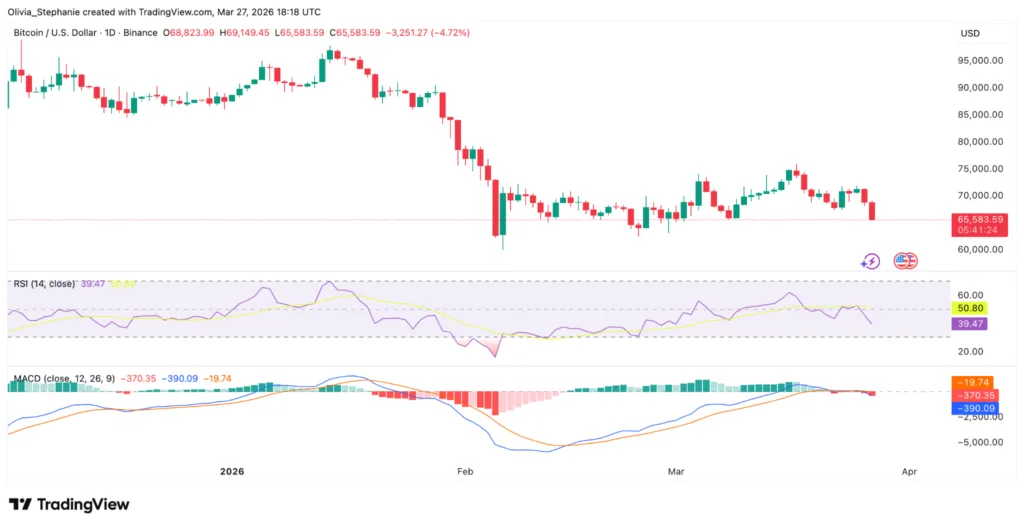
Meanwhile, the MACD also indicated weaker momentum. It was close to the zero line with the histogram pushing towards the negative direction to a value of -18.19.
This position indicated that the recovery that was experienced previously in March had lost momentum and that bearishness began to accumulate once again.