



Bitcoin traders are moving with more care as the Easter holiday period approaches, with new data from K33 showing a rise in short exposure and weaker trading activity.
The report links this mood to seasonal liquidity drops, recent price losses, and continued tension in the Middle East.
The market has also faced pressure from weak quarterly performance, steady negative funding rates, and fresh geopolitical headlines.

Even so, some data points show that crowded bearish positioning can appear near market turning points, which leaves traders watching both sentiment and liquidity.
Easter week often brings lower Bitcoin activity
K33 said Easter has often brought slower activity across crypto markets, even though Bitcoin trades every day. The firm noted that public holidays in major financial centers reduce participation in equities, bonds, and derivatives, and that lower engagement often spills into crypto trading as well.
Vetle Lunde, head of research at K33, wrote that Bitcoin has shown a clear pattern during Easter since 2019.
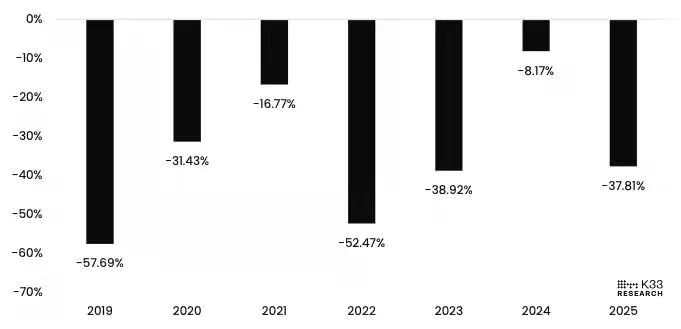
According to the report, Bitcoin’s seven-day trading volume has fallen below its yearly average during every Easter period in that time. The drop has ranged from modest pullbacks to much steeper declines.
The report also noted volatility has followed the same path during past Easter periods. K33 found that seven-day volatility readings have also come in below yearly averages during those holiday weeks.
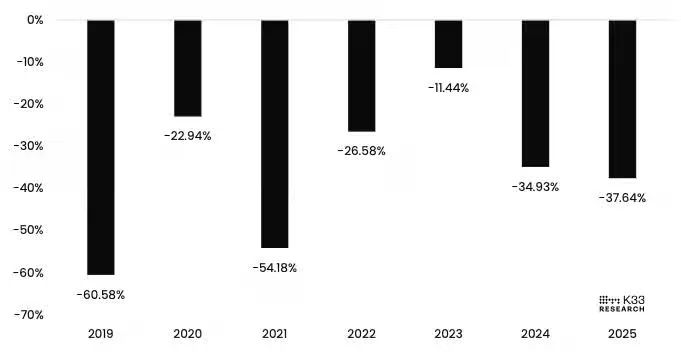
That pattern suggests traders may face a quieter market, with thinner liquidity and fewer strong moves unless an outside catalyst changes sentiment.
Moreover, the Easter week setup could reduce market participation as global holidays compress liquidity. Lower trading activity during Easter is not unique to crypto and has also appeared in traditional markets. That seasonal pattern has added to the cautious tone already visible in Bitcoin positioning.
Bearish positioning builds across the market
According to K33, defensive positioning has grown in recent days, with leveraged short Bitcoin exchange-traded funds holding exposure equal to 9,012 BTC. The report said that figure rose 22 percent over a short period and now stands as the second-highest level on record.
“Such jumps in short exposure typically reflect concentrated bearish positioning, and point toward aggressive caution from traders,” K33 stated.
That reading lines up with broader weakness across the market after Bitcoin posted a second straight week of losses and ended the first quarter deep in the red.
The report also pointed to funding data as another sign of caution. Annualized 30-day average funding rates have remained negative for 32 consecutive days, which shows that traders have continued to lean toward short positions in perpetual futures markets.
K33 noted that such long stretches of negative funding often appear when bearish trades become crowded.
Still, the firm added an important note to that trend. Lunde wrote that markets can reach a bottom when too many traders sit on the same side of the trade.
That does not guarantee a rebound, but it does show that bearish positioning has become heavy enough to draw attention from contrarian traders and analysts.
Spot market activity has also cooled. Average daily spot trading volume has dropped to about $2.7 billion, the lowest level since mid-February.
Lower spot activity, combined with strong short interest, has created a market structure where traders appear defensive but also alert to the chance of a sharp move if sentiment shifts.
Bitcoin faces pressure after a weak quarter
Bitcoin ended the first quarter of 2026 with a drop of 24 percent, marking its weakest first-quarter result since 2018. Bitcoin closed the quarter at $66,620, down from $87,508 at the start of the year.
That decline came after another weak quarter in late 2025. Bitcoin fell 23 percent in the fourth quarter of 2025, moving from $114,057 to $87,508.
Over the past six months, that leaves the asset down by roughly 41.6 percent, a sharp reset after earlier strength.
Data from SoSoValue showed that spot Bitcoin ETFs recorded $496.5 million in net outflows during the first quarter. March brought some relief with $1.32 billion in inflows, but that was not enough to fully offset the $1.8 billion in outflows seen during the first two months of the year.
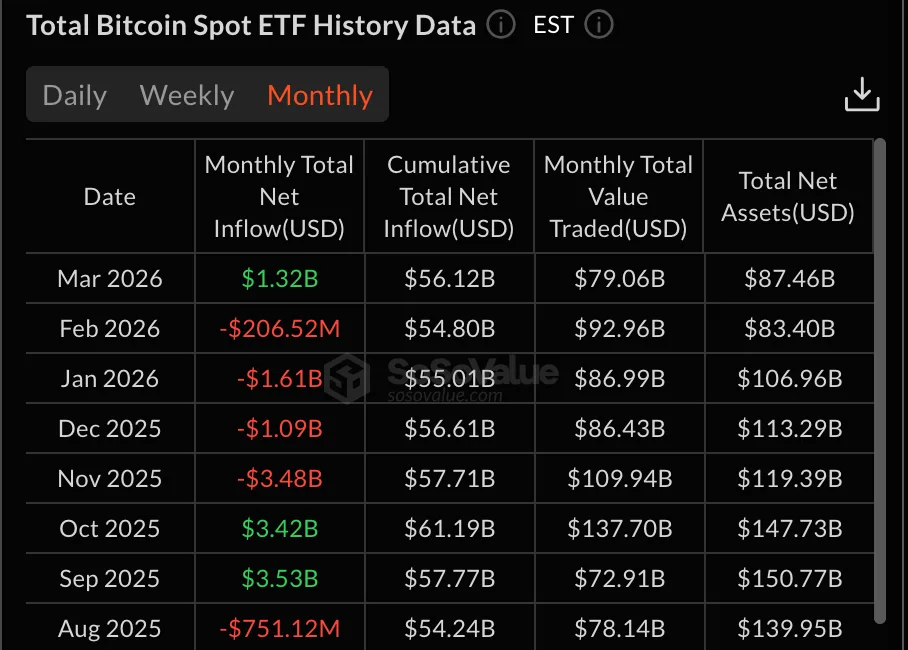
Even with that weak quarter, K33 said Bitcoin has still held up better than some major traditional assets during the recent period of war-related market stress.
Since late February, Bitcoin has risen 1.4 percent, while Nasdaq and S&P futures have fallen more than 6 percent, according to the report. Gold has also dropped during that period. That relative strength has kept Bitcoin in focus even as sentiment stays cautious.
Iran tensions keep Bitcoin on edge
The present trading atmosphere is primarily influenced by geopolitical tensions between nations. The recent events concerning Iran and the entire Middle East region have introduced new unpredictable elements to financial markets which also include crypto.
Traders have reacted to each new headline, which has kept short-term price action unstable even during slower trading sessions.
The Block reported that K33 linked recent weak price performance and Iran-led uncertainty to the rise in defensive positioning.
The report also mentioned new quantum computing warnings as part of the wider risk backdrop, though market focus has remained centered on liquidity, positioning, and geopolitical news.
The latest market moves also followed comments from U.S. President Donald Trump on the conflict with Iran. President Trump claimed Iran had requested an immediate ceasefire from the United States, while also saying the U.S. would continue military pressure until Iran opened the Strait of Hormuz to oil tankers.
Those remarks came ahead of an expected prime-time address, which added more attention to Bitcoin’s intraday swings.
Bitcoin briefly climbed to around $69,200 before losing momentum and moving back lower. Even with those swings, the asset stayed above $68,000 at press time.