


Bitfarms shares rose on Tuesday after the company reported a $284 million net loss for 2025 and laid out its shift toward AI and high-performance computing infrastructure.
The stock move came as investors focused on the company’s new direction, its large liquidity position, and its plan to lease data center capacity to major compute customers.
The development comes at a time when the company is moving away from its old Bitcoin mining model and toward a landlord-style business built around power-secured sites in North America.

Bitfarms also plans to rebrand as Keel Infrastructure, a move tied to its wider effort to reshape the business around AI and HPC demand.
Bitfarms pushes further into AI
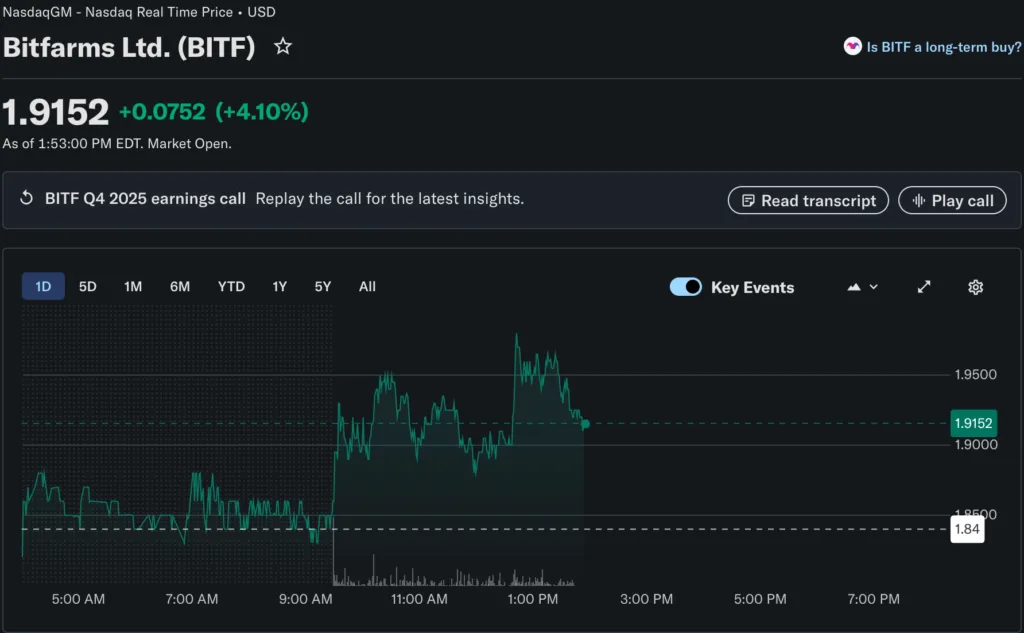
Bitfarms shares gained more than four percent after the company released its 2025 results and gave investors more detail on its transition strategy. The market reaction came even though the company posted a large annual loss and wider operating losses than the year before.
The company tied the loss to a year of restructuring, asset changes, and a shift in focus from Bitcoin mining to digital infrastructure for AI and HPC.
Management made clear that Bitfarms now sees its future in leasing power-ready sites to large customers rather than relying on mining revenue over the long term.
Chief executive Ben Gagnon described the shift as a major turning point for the company. He called it a “deliberate and consequential transformation” during the earnings conference call as Bitfarms moved to position itself for demand from hyperscalers and other large AI customers.
The transition also comes with a new corporate identity. Bitfarms said its redomiciliation from Canada to the United States is expected to close on or about April 1, 2026, after shareholder approval in March.
Once the process closes, the company will rebrand as Keel Infrastructure and later begin trading under the ticker KEEL on Nasdaq and TSX.
Revenue up, losses widen
Bitfarms reported $229 million in revenue for 2025, up 72 percent from the previous year. Even so, the company posted a $284 million net loss as expenses climbed and its digital asset exposure weighed on results.
Operating loss reached $150 million, compared with $28 million in 2024. Loss from continuing operations came in at $209 million, far above the $7 million posted a year earlier.
The company linked part of that change to lower Bitcoin prices and changes in the fair value of digital assets.
The company also reported general and administrative expenses of $78 million, up from $62 million in 2024. It tied that increase to higher headcount as it expanded in the United States and integrated the Stronghold acquisition.
Management also pointed to balance sheet strength as a key part of the transition story. As of March 27, 2026, Bitfarms had about $520 million in liquidity, made up of roughly $359 million in unrestricted cash and about $161 million in unencumbered Bitcoin.
Chief financial officer Jonathan Mir stated that the company has tried to tighten capital allocation and simplify its financial structure ahead of the next stage of development. He noted that the company repaid the remaining $100 million under its Macquarie debt facility in February.
”We are well capitalized to advance our sites through leasing, and we have the financial capacity to execute on the significant opportunities ahead,” Mir said.
North American site leasing model
Bitfarms said it is now focused on building out a 2.2 gigawatt development pipeline across North America. The sites named in its latest update include Panther Creek and Sharon in Pennsylvania, along with Moses Lake in Washington state. It also continues to develop assets in Québec.
The company announced the near-term goal is not immediate AI revenue at scale. Instead, management is focused on permits, engineering, commercialization work, and long-term lease agreements tied to these sites. Initial revenue linked to AI is expected as early as 2027.
Bitfarms described its future model as one centered on leasing infrastructure rather than operating Bitcoin mines as its main business. That approach would let the company supply powered sites to large compute customers, including hyperscalers, without taking on the same operating model that defined its mining business.
Gagnon remarked the company built its 2025 strategy around the belief that AI growth will need more top-tier infrastructure.
”Everything we built in 2025 — the sites, the team, the balance sheet — was in service of one thesis: that HPC/AI’s exponential growth requires top-tier infrastructure, and we intend to build to meet that demand,” Gagnon stated.
The company also mentioned it is seeing strong inbound interest from large counterparties looking for power-secured assets in key regions.
Gagnon added that Pennsylvania, Washington state, and Québec give the company access to three supply-constrained data center markets in North America.
Mining phaseout begins
Bitfarms is not shutting off its Bitcoin mining business at once. Management said the company will continue mining in the near term to generate cash flow while it prepares for a full exit from that legacy operation over time.
Gagnon commented the company expects to phase out mining and eventually sell both its mining equipment and Bitcoin holdings when market conditions support that strategy. He noted that any Bitcoin sales would be made “opportunistically… into strength,” showing that the company still plans to manage those assets with timing in mind.
The company’s broader repositioning fits into a pattern seen across the mining sector. Several Bitcoin mining firms have started shifting capital toward AI and high-performance computing facilities as they look for new sources of long-term revenue.
Bitfarms now joins that group more directly as it reduces exposure to mining and pushes deeper into infrastructure leasing.
On Jan. 2, the company said it would move away from Latin America as part of that reshaping process. Its Latin American assets are now classified as sold or held for sale, while continuing operations refer to its North American portfolio.
That change supports Bitfarms’ plan to center the business around large-scale infrastructure assets closer to its new growth strategy.