



Solana is gearing up for a major network redesign known as Alpenglow, billed as the most significant upgrade to Solana’s consensus mechanisms since its launch. Asset manager VanEck calls it a transformational step that will make the network faster, more stable, and easier to run, according to its September recap report.
Under Alpenglow, one can expect faster transactions. Confirmation time should drop from ~12 seconds to ~150 milliseconds. The upgrade also plans to simplify validator costs by replacing recurring on-chain vote fees with a periodic ticket.

It also promises to reduce inter-node communication overhead so validators don’t waste bandwidth. Then there are plans to boost per-block capacity by ~25%. Also in the works are new token formats that greatly reduce compute burden, and a new broadcast layer (Rotor) to improve data propagation.
SOL’s run has lagged behind BTC & ETH
Despite the technical momentum, SOL hasn’t run up nearly as much as Bitcoin or Ethereum in this cycle. One reason is volatility, as SOL tends to swing more wildly, which dampens confidence from institutional investors. Also, BTC and ETH have seen powerful tailwinds from massive ETF inflows and broader adoption narratives, which SOL hasn’t benefited from to the same extent.
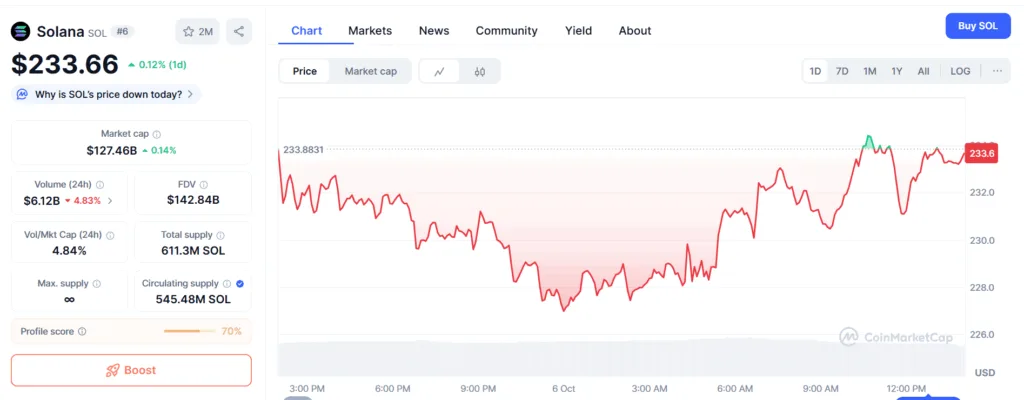
Moreover, analysts say SOL’s prior highs of ~$250 range will be hard to breach without strong macro or narrative catalysts. Some others argue that Solana’s performance is being held back until upgrades like Alpenglow prove to be reliably stable. At the time of publishing, SOL was trading rather flat at $233.62, but up 12% in the week prior.
The architectural upgrades could reshape Solana’s position in the blockchain hierarchy. The upgrades could make it a more compelling platform for DeFi apps, gaming, tokenization, and high-frequency protocols.