



Crypto’s links to human trafficking and child abuse circles have seen a staggering rise of 85 percent in 2025, highlighting the age-old issue of digital assets’ involvement in illicit crimes.
A new report by Chainalysis found that cryptocurrency is increasingly being used to facilitate human trafficking–related payments across several illicit sectors.
The investigation tracked transactions connected to escort services, labor recruiters tied to Southeast Asian scam compounds, and networks distributing child sexual abuse material.

It found hundreds of millions of dollars in crypto transactions across the services it discovered which shows how big the money flows are that are linked to exploitation.
Further, it highlights that, even as blockchain technology provides investigators with transparency, criminal groups are still exploiting digital assets for cross-border payments, making the movement of funds quicker and operations across jurisdictions easier without traditional banking barriers.
Chainalysis: Illicit networks use mix of bitcoin and altcoins
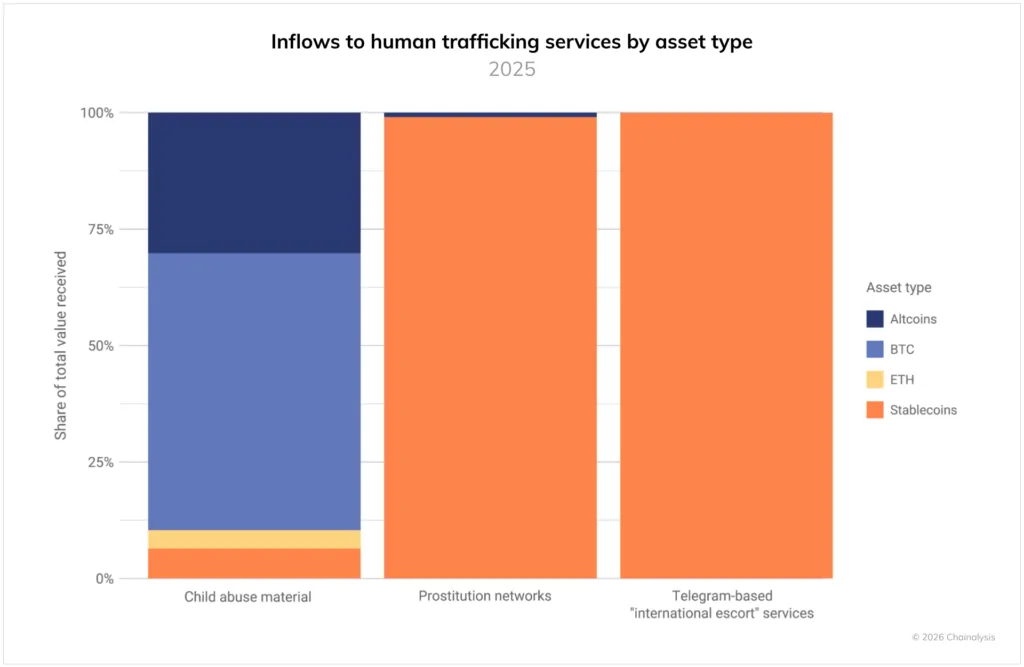
Chainalysis found that these illicit networks aren’t just using one type of crypto-payments ranging from Bitcoin and other major tokens to stablecoins, which were especially popular because their value stays relatively steady.
Many transactions were organised through Telegram groups and Chinese-language money-laundering networks that offered escrow-style systems to make sure payments went through smoothly.
The biggest transfers were tied to international escort networks on Telegram, with nearly half topping $10,000.
The report shows how criminals are using encrypted messaging apps and digital currencies to move large amounts of money across borders quickly and secretly, often without the usual financial oversight.
Southeast Asian trafficking networks see global crypto inflows
It also emerges in the report that the trafficking networks in Southeast Asia have become highly global, for instance, crypto payments are coming in from North America, Europe, and Australia. It showcases the magnitude of the operations.
CSAM (Child sexual abuse material) networks are also increasingly adopting subscription-based models, becoming more akin to sadistic online extremism communities, which indicates that their activities are becoming even more organized and far more ideologically driven.
According to investigators, the perpetrators have utilized the U.S.-based digital structure in a focused manner, which showed their level of technical sophistication and careful planning of operations.
Crypto’s link to illicit crime face scrutiny
People have often criticized cryptocurrency for making it easier for criminals to move money outside of regular bank checks. Recently, there have been concerns about its use in ransom payments and early investments related to Jeffrey Epstein that were not well received.
Chainalysis, a company that analyzes blockchain data, says that the same technology can also be used to fight crime. Blockchain transactions leave a digital trail that investigators can follow to find trafficking networks and suspicious activity. Cash transactions do not.
The company explained that law enforcement and compliance teams can use better monitoring tools and work together more closely across borders to stop crypto’s involvement in child abuse and trafficing.
Authorities could find illegal flows more easily and shut down payment networks more effectively than with traditional financial systems alone by taking advantage of blockchain’s built-in transparency.