



Cryptocurrency markets recorded heavy activity in the first three months of 2026. According to a new CoinGlass report published on Friday, total trading volume reached $20.57 trillion during the quarter.
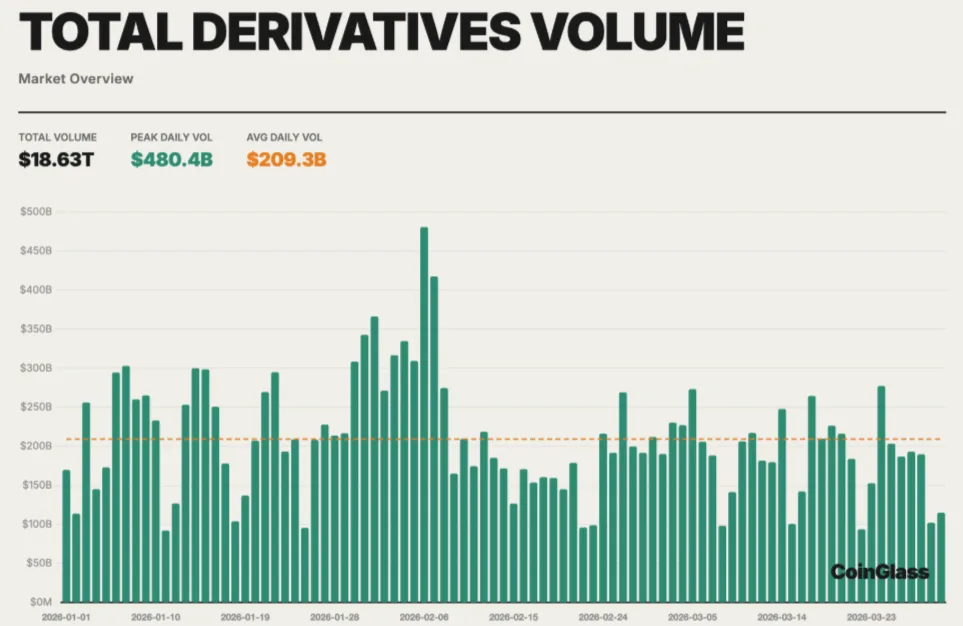
Most of that came from derivatives trading, which stood at $18.63 trillion. In comparison, spot trading totaled $1.94 trillion.
As a result, derivatives volume was about 9.6 times higher than spot trading. The data indicate that many traders still preferred contracts that let them bet on price moves without directly buying the underlying cryptocurrencies.

CoinGlass said trading volumes peaked in January and then moved lower in February and March.
In January alone, spot trading volume reached about $704.7 billion. Meanwhile, derivatives volume climbed to $6.73 trillion.
However, by March, total market activity had dropped to its lowest level of the quarter. That shift followed the sharp deleveraging seen in the fourth quarter of the previous year.
Derivatives remained the center of market activity
The report showed that traders continued to lean more on derivatives as market conditions stayed uncertain.
During the first quarter, the spot market averaged about $21.8 billion in daily trading volume. On the other hand, derivatives averaged about $209.3 billion per day.
Spot trading also fell faster than derivatives. From January to March, spot volume dropped from about $704.7 billion to $542.0 billion.
That marked a decline of 23 percent. Even so, the broader crypto market remained highly active. At the same time, derivatives continued to dominate overall trading activity.
Binance led across the biggest exchange metrics
Among exchanges, Binance kept its lead in the first quarter. According to CoinGlass, the exchange recorded about $4.90 trillion in derivatives trading volume during Q1. That gave it a 34.9 percent share among the top 10 exchanges.
Binance also led in other key areas. Its average daily open interest stood at about $23.9 billion, which represented a 29.9 percent share. In addition, its average user asset reserves reached about $152.9 billion.
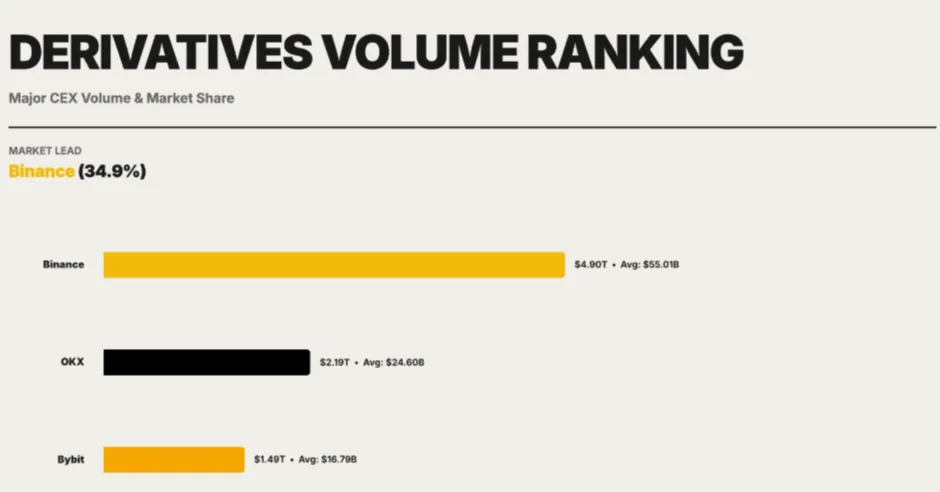
The report said Binance stayed far ahead of its rivals in the first quarter. Its derivatives trading volume was about 2.2 times higher than OKX’s.
At the same time, its average open interest was also about 2.2 times larger than Bybit’s. Its lead was even stronger in user asset reserves. In fact, OKX was the only other exchange with more than $10 billion in reserves.
According to CoinGlass, this shows Binance’s strength was not limited to one metric. Instead, it remained strong across trading volume, liquidity, open interest, and capital retention.
The report also showed a clearer ranking among major exchanges. In derivatives trading volume, the top five platforms were Binance, OKX, Bybit, Gate, and Bitget.
In spot trading, Binance still held the top position. However, the competition below it was much closer. Gate, Bybit, Coinbase, and OKX ranked near each other, showing a more balanced race in the spot market.
“Binance remained the clear leader in volume, OI, depth, and reserves, while Hyperliquid showed that on-chain derivatives are now part of the mainstream conversation,” CoinGlass stated in its Friday post on X.
On-chain platforms also started gaining ground
CoinGlass also noted that decentralized derivatives platforms are gaining more visibility in the market. During the first quarter, Hyperliquid recorded about $492.7 billion in derivatives trading volume.
It also averaged around $6 billion in open interest, which placed it among the top 10 exchanges tracked in the report.
Even so, its overall scale remained much smaller than major centralized platforms. For example, Binance, OKX, Bybit, and Gate still handled far larger volumes during the quarter.
Overall, the Q1 data showed a market that stayed active but leaned heavily toward derivatives as traders looked for flexibility in a cautious environment. Spot trading remained important, but derivatives clearly drove most of the quarter’s volume.
There are a number of factors that may lead to such changes in Q1. The lack of market clarity and diminished confidence made investors reluctant to purchase cryptocurrencies on the spot market.
Additionally, the increased volatility led many to engage with derivative assets. Inflation, interest rates, and geopolitical tensions also kept traders cautious.
Tokenized real-world asset trading has been growing steadily too. According to RWA.xyz, the market reached a record high of $27.65 billion.
Over the past 30 days, there has been a growth of four percent and a value that exceeds four times last year’s $6.6 billion level.
Meanwhile, the International Monetary Fund said tokenization could reduce friction and improve transparency in finance. But the IMF also warned that the tokenization may create risks for financial stability.