



Something unusual is happening in crypto right now, and depending on who you ask, it’s either a sign of the market maturing or a warning that the next big move hasn’t started yet.
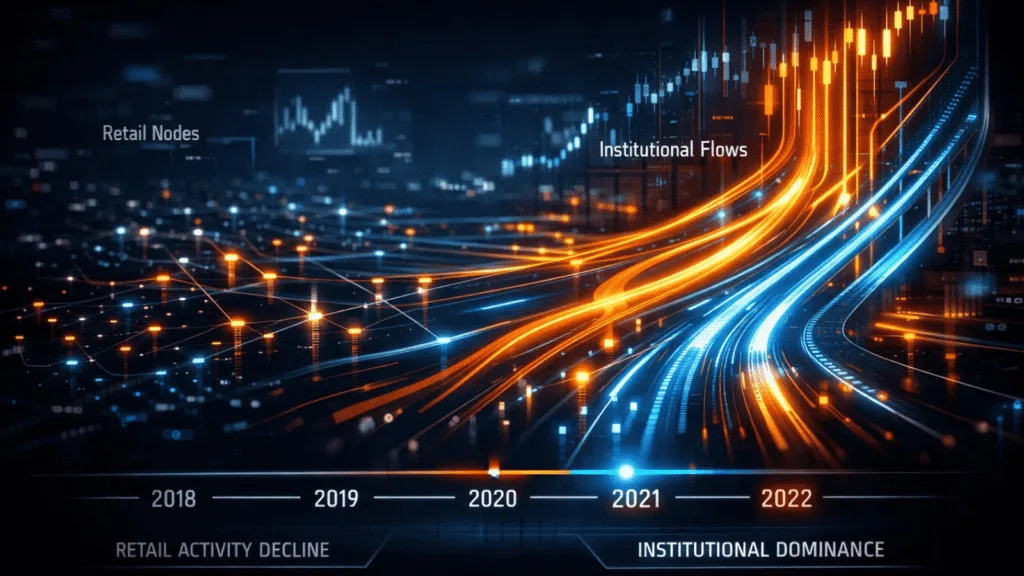
Exodus CEO JP Richardson made the case for the former on Sunday, posting an observation that’s been circulating through the crypto space since: institutions have quietly stepped up their participation in digital assets this year, even as the retail investors who typically fuel crypto bull runs have largely disappeared from the scene.
“This might be the first cycle in crypto history where institutions are in a bull market, and retail doesn’t even know it,” Richardson wrote on X. It’s a fascinating claim and the data points he cited make it harder to dismiss than it might first appear.

The institutional footprint is growing
Richardson pointed to a string of developments over the past few months that, taken individually, might seem incremental, but together suggest a meaningful shift in how traditional finance is engaging with crypto.
The stablecoin market capitalization hit an all-time high this year. Morgan Stanley launched a Bitcoin ETF. Charles Schwab, one of the largest brokerage platforms in the US with tens of millions of retail customers, opened a waitlist for spot Bitcoin trading. Franklin Templeton announced a dedicated crypto division.
And Fannie Mae, the government-sponsored mortgage giant, began accepting Bitcoin-backed mortgages. None of those are the kind of moves a sector makes when institutions are stepping back. These are commitments, some of them requiring regulatory approvals, corporate board decisions, and long-term product development cycles. They don’t happen quickly, and they don’t get reversed easily.
The comparison Richardson drew to previous downturns is the most interesting part of his argument. “In 2018 and 2022, institutions pulled out with retail. This time, they accelerated,” he said.
In past cycles, institutional interest in crypto was still largely speculative and thin. When sentiment turned, they left alongside everyone else. What’s different now, the argument goes, is the infrastructure, the products that are live, and the commitment is structural rather than opportunistic.
That dynamic, if it holds, would represent something genuinely new which is basically a market with a demand floor that doesn’t evaporate the moment price momentum fades.
Retail has stepped away and there’s a reason
On the other side of that picture, retail investors have been largely absent. Michaël van de Poppe, a crypto analyst and founder of MN Fund, put it bluntly in a post on the same day: “It’s super clear that retail isn’t interested in crypto.”
His explanation was about basic economics. “Almost everyone has a hard time paying their bills on a monthly basis,” he wrote, pointing to the ongoing cost-of-living crisis and inflationary pressures that have left household budgets stretched thin across most developed economies.
You can’t trade crypto on money you don’t have. That’s the reality for a significant portion of the retail investor base right now. Oil above $100 a barrel, elevated food prices, and the general economic hangover from years of inflation have quietly but effectively priced a large segment of retail out of discretionary investment, crypto or otherwise.
CryptoQuant analyst Darkfost added a hard number to the picture, noting that retail activity in Bitcoin hit a nine-year low earlier this month. Inflows from small accounts holding less than 1 BTC reached a record low on Binance.
“Retail investors are clearly absent from the market,” he said, adding that some may have rotated out of crypto entirely and into equities and commodities, which have also posted strong returns recently.
The result is a market that looks structurally different from anything seen in prior cycles, institutional accumulation happening steadily while retail interest sits near historic lows..
Sentiment is fragile, but not broken
Near-term, the mood is cautious. CoinEx chief analyst Jeff Ko described current sentiment as “fragile and heavily macro-driven, especially by oil, the dollar, and inflation expectations.”
The US-Iran conflict has weighed heavily on risk appetite, pushing oil prices above $100 per barrel and keeping the Federal Reserve on hold rather than cutting rates. That combination, inflation risk plus geopolitical uncertainty, is exactly the kind of environment that historically pushes money toward safety rather than speculation.
“At this stage, the move still looks more like a macro risk premium overwhelming the near-term bid than a genuine deterioration in crypto appetite,” Ko said. That’s a careful way of saying the selling is coming from people who are managing risk in a difficult macro environment.
Ko added that he was more constructive over the medium term, noting that he doesn’t expect oil prices to stay elevated given the underlying supply and demand fundamentals. If the Iran conflict de-escalates and Trump said this week he hopes to resolve it within two to three weeks the macro ceiling on crypto sentiment could lift fairly quickly.
The broader question Richardson is really raising is whether a retail-less bull market is a contradiction in terms. Historically, crypto’s biggest moves have been driven by retail FOMO, the fear of missing out that sends millions of small buyers rushing in at the same time, creating the parabolic runs the market is known for. If retail is genuinely out of the picture this cycle, the upside may be steadier but slower. Deeper liquidity, lower volatility, but without the usual rally fireworks.
Van de Poppe’s conclusion was that this institutional cycle “will take longer.” That may well turn out to be right. And for anyone accustomed to crypto moving at retail speed, longer might feel a lot like sideways, at least until the cost-of-living pressure eases enough to bring small buyers back into the picture.