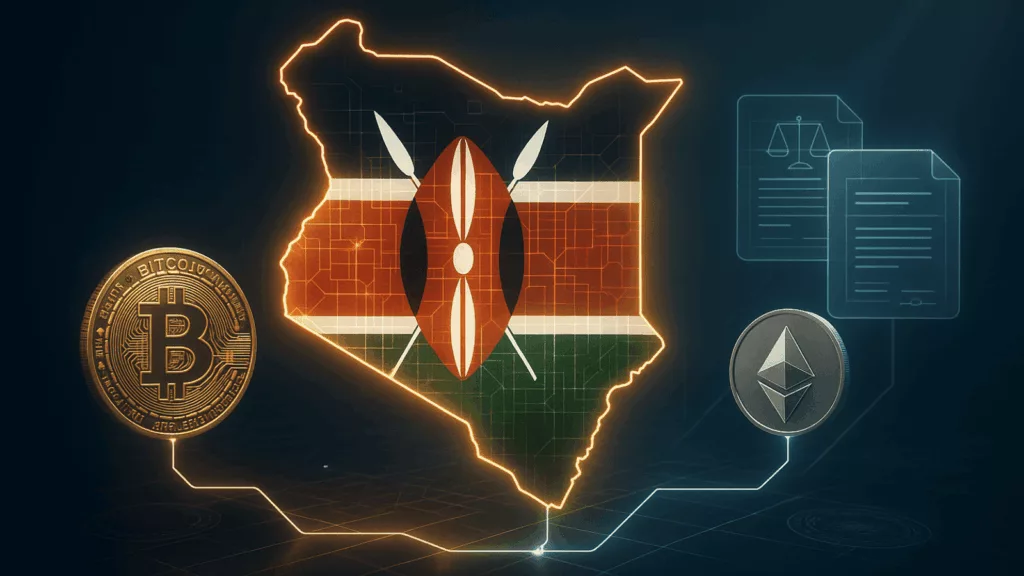



Kenya has officially established its first legal framework for the cryptocurrency sector, marking a historic milestone for digital finance in East Africa. The Virtual Asset Service Providers (VASP) Bill, 2025, passed by parliament on Oct. 13, now awaits President William Ruto’s formal assent.
The law mandates that all crypto service providers, including exchanges, wallet operators, and other blockchain-based businesses, must obtain a license to operate in the country. Oversight responsibilities will be jointly handled by the Central Bank of Kenya (CBK) and the Capital Markets Authority (CMA) a coordinated structure aimed at ensuring accountability and consumer protection.
This is a landmark moment for Kenya’s financial ecosystem. It provides clarity, promotes innovation, and protects consumers from fraudulent digital schemes.

New licensing and operational standards for VASPs
The framework clearly defines a Virtual Asset Service Provider as any company limited by shares, either incorporated in Kenya or registered as a foreign entity under Kenyan law, that offers crypto-related services under license.
Licensed VASPs must meet several operational requirements:
- Maintain robust protections for client assets and keep funds in local bank accounts.
- Secure insurance coverage for customer holdings.
- Adopt conflict-of-interest policies and preserve detailed transaction records.
- Comply with Anti-Money Laundering (AML) and Counter-Financing of Terrorism (CFT) laws.
Both the CBK and CMA will have broad powers to inspect, supervise, and sanction noncompliant operators, ensuring alignment with international financial integrity standards.
Crypto adoption grows from the ground up
Kenya’s regulatory breakthrough coincides with a growing grassroots crypto economy. In Nairobi’s Kibera, one of Africa’s largest informal settlements, a community-led Bitcoin circular economy has processed over 2,000 microtransactions, demonstrating real-world use cases for decentralized finance.
Local innovations such as Machankura, a USSD-based Bitcoin payment platform, enable users with basic mobile phones to transact without internet access. Meanwhile, crypto integrations with M-Pesa, Kenya’s dominant mobile money system, are creating a hybrid ecosystem that bridges traditional and digital finance.
Kenya joins Africa’s crypto regulatory pioneers
Once signed into law by President Ruto, Kenya will join South Africa, Nigeria, and Mauritius as one of the few African nations with comprehensive crypto legislation. The framework positions Kenya as a continental leader in blockchain innovation, balancing consumer protection with progressive policy.
This new regulatory clarity is expected to attract foreign investment, stimulate local fintech development, and strengthen Kenya’s digital economy as part of the broader African crypto transformation.