
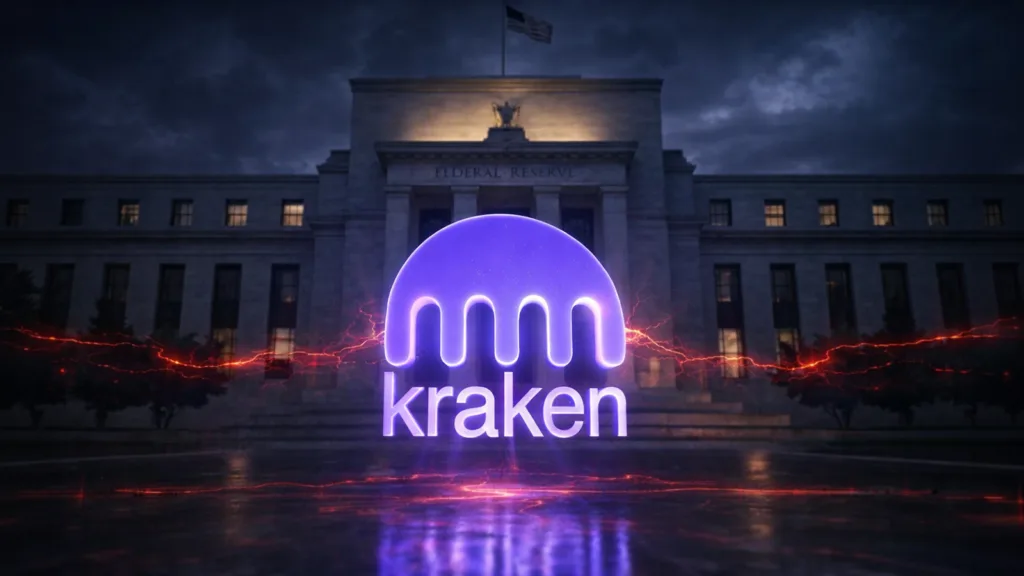



Crypto exchange Kraken has obtained a master account with the U.S. Federal Reserve Bank. This development represents an important milestone in the integration of digital assets businesses within the existing American financial structure.
Although the acquisition has been accompanied by certain conditions to mitigate any risks that might result, government agencies and other stakeholders have expressed fears that the approval could create vulnerabilities, especially in case more such decisions were to be made in the future.
Established in 2011 in Wyoming, Kraken has developed into one of the largest crypto exchanges in the world, providing its services to customers of all types.

Kraken’s recent achievement is indicative of the rapid transition of the crypto space from its current status of a fringe financial world to that of a mainstream player in international finance.
First-ever Fed access for crypto firm granted on limited basis
In the last month, Kraken was the first crypto firm that managed to get access to the Federal Reserve master account, which is considered by many as a watershed moment in the industry. The account was issued by the Federal Reserve Bank of Kansas City and has the status of a “limited-purpose” account for a year’s term only.
While it is known that the account was approved, information about operational rules that will be applied while using the account has not been revealed yet.
Fed master accounts can be called the lifeblood of the American banking system. They make it possible for commercial banks to keep their reserves with the central bank and transfer money within the Federal Reserve payment system.
Being able to operate within the payment rails provides much more flexibility than using correspondent banks. Therefore, access to Fed accounts is considered an asset for crypto firms.
Yet, the decision soon came under intense scrutiny from legislators and representatives of the banking industry who were worried about the threat to stability in the entire system. One of the main detractors was Maxine Waters, the ranking Democrat in the House of Representatives’ Financial Services Committee.
Waters called into question the process of granting permission for Kraken’s reserve account and demanded detailed explanations of the restrictions applicable to such an account. The lawmaker suggested that the decision could have been inconsistent with the general set of procedures concerning access to central bank services.
The issue of the limited purpose of the approved account remains one of the key ones. The inability to identify clearly what sort of transaction limitations there are, for instance, or whether liquidity or operational issues play a role in the assessment can make it hard to evaluate the systemic risks in a proper manner.
For their part, regulatory agencies claim that the designation helps limit the potential impact and observe the operation of the entity.
Wider Fed access for crypto could reshape banking competition
Banking industry representatives have also voiced their concern regarding the precedence of the ruling. The implications of multiple cryptocurrency firms getting the same access to Federal Reserve facilities would bring significant changes to the competitive landscape.
Currently, traditional banks act as middlemen in transactions conducted by crypto firms. The latter use banks for custody services and transactional facilitation. The possibility for crypto firms to have a direct link to the Fed’s payment system means a reduction in the dependence on those services.
Though competition is an important consideration, several experts note that there is more at stake than just a loss of market shares. Specifically, regulators point out that cryptocurrency firms have business models that differ significantly from those of traditional banks. For example, digital assets are known to be extremely volatile, which may result in increased liquidity risks.
Finally, the possibility of a contagious effect should not be overlooked. A moment when one of the major cryptocurrency firms finds itself with liquidity problems may mean that the Fed’s payment rails will accelerate money transfers even further.
Consequently, the regulator will be concerned about making sure there are sufficient measures in place that will shield the banking sector from any possible spillover effects.
On the other hand, those who support the measure claim that having a controlled relationship with a regulated crypto company may enhance monitoring and transparency. In effect, bringing the crypto firm into the regulated financial market can give a greater level of control for the regulators in terms of transactions and risks.
In a sense, the approach will make it easier for the regulators to understand the activities going on and make sure that there is not much dependency on less regulated financial tools.
The year-long trial period of the limited-purposed account can prove the theory of the matter.
For one thing, the regulators will get to examine how well this tool works during the trial period.
Simultaneously, the resolution of the issue demonstrates the growing tendency among many governments to explore ways to incorporate digital asset companies into the current financial system instead of excluding them from it.
In order to do so, it is crucial for the United States to maintain its reputation as a reliable country and, at the same time, to provide the environment for innovations.
The possibility of providing access to the Federal Reserve systems under strict supervision might serve this goal, yet a series of additional issues emerge due to the process.
In case the collaboration proves itself to be highly effective and efficient in terms of risk management and control over operations, more crypto companies might try to establish connections with central banks.
On the contrary, in case any risks arise from the cooperation between the two, the regulatory framework might get even tighter, and no one else would get access to such services.
Therefore, Kraken’s breakthrough Federal Reserve master account might work both as an advantage and a test case.
The move marks a step towards cooperation on behalf of regulators with the cryptocurrency sector in a new way, but it is also an indication that caution must be exercised as financial networks become increasingly interdependent.
As regulatory bodies continue to weigh the pros and cons, the ongoing discussion about Kraken’s ability to interact with the Fed is bound to impact future financial regulation.