




Canary Capital is pushing further into crypto investment products with a new filing tied to the PEPE meme coin. The firm, on Wednesday, submitted an S-1 registration statement to the U.S. Securities and Exchange Commission (SEC) for a proposed spot PEPE ETF.
If approved, the fund would let investors get exposure to PEPE through a regular brokerage account. That means they would not need to buy the meme coin directly or handle its storage on their own.
What is PEPE and how would the ETF work?
PEPE is a meme token that runs on the Ethereum (EHT) network. It was launched in April 2023 and takes its name from the well-known Pepe the Frog meme.

It is very different from Bitcoin (BTC) and Ethereum because PEPE does not have its own blockchain.
Its price mainly depends on hype. Social media attention, online trends, and community interest play a big role in whether it rises or falls.
The proposed Canary PEPE ETF is designed to track the price of PEPE as closely as possible. If approved, the fund would hold the token directly and calculate its daily value using a pricing benchmark.
The benchmark would track PEPE’s price using data from major crypto exchanges. Instead of relying on a single trade or one platform, it would use a 60-minute average price in U.S. dollars to get a more balanced view of where PEPE is trading.
Put simply, if PEPE rises, the ETF should rise too. If PEPE falls, the ETF would likely fall as well. The only difference is that the fund’s returns could be slightly lower because of fees and other operating costs.
Investors would be able to buy and sell the ETF on a U.S. stock exchange, just as they trade regular stocks.
The fund would group its shares into large blocks of 10,000, called baskets. Big financial firms, known as authorized participants, could then buy or redeem those baskets using either cash or PEPE.
Canary Capital would serve as the sponsor and manage the fund’s day-to-day operations. The ETF would charge an annual fee, and the firm has also said it will cover certain ordinary expenses, up to $150,000 per year.
Small ETH holdings cover PEPE transaction fees
Because PEPE is an ERC-20 token, it needs small amounts of ETH for transaction fees.
The filing says the fund may keep a small amount of Ethereum, up to 5 percent of its assets, only to pay transaction fees when moving PEPE on the blockchain. It is not part of the main investment plan.
The fund also would not use risky tools like leverage or complicated derivative products. Instead, it is designed to stay simple and mainly track the price of PEPE.
Several important details are still missing in the filing. Canary has not revealed which exchange will list the ETF, what ticker it will use, who will provide the pricing benchmark, who will act as custodian, or what the sponsor fee will be.
The filing also uses strong warning language, saying the shares are highly speculative and that investors could lose all of their money.
The filing states, “The shares are speculative securities. Their purchase involves a high degree of risk and you could lose your entire investment. You should consider all risk factors before investing in the trust.”
Meme coin ETF demand still looks weak
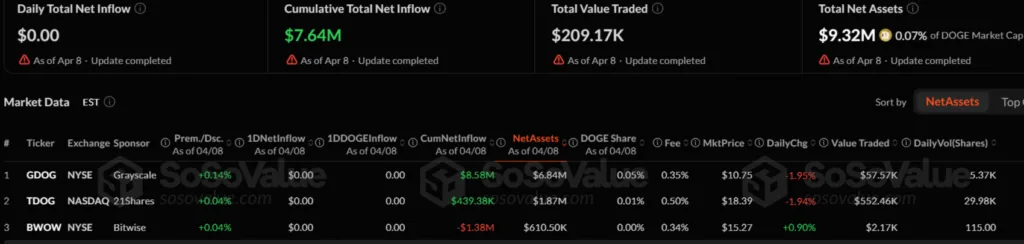
The filing comes at a time when interest in meme coin ETFs still looks weak. In the United States, Dogecoin remains the only meme coin with active spot ETF products.
Funds from Grayscale, Bitwise, and 21Shares are already trading on major exchanges, but total inflows were only about $7.64 million by 8 April. Trading volumes have also stayed low, which suggests many investors are still not fully convinced.
Until now, the crypto ETF market has mostly been driven by spot Bitcoin and Ethereum funds.
Canary Capital has been steadily building out its crypto ETF lineup.
The firm previously filed for a Mog Coin ETF last November and has also submitted applications tied to other digital assets, including Pudgy Penguins and Axelar.
However, market reaction to the PEPE filing has been quiet. PEPE’s price showed little movement following the news, trading near $0.000000352 with a slight decline over 24 hours.
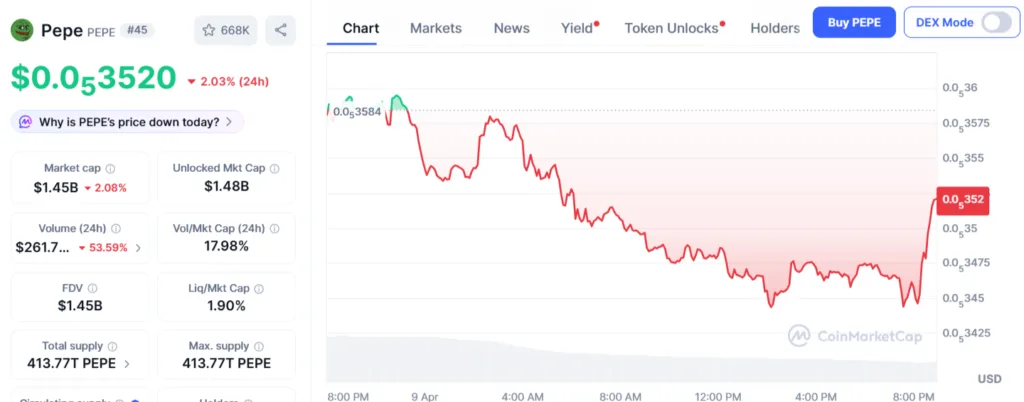
That lack of reaction suggests investors are still cautious about meme coin products, even as firms continue to test new ideas in the ETF space.
Eric Balchunas, a senior ETF analyst at Bloomberg, questioned the logic behind a PEPE ETF. “What is the investment thesis for $PEPE?” he wrote.
His point is simple because PEPE is a meme coin, so if the hype dies down, the price will likely drop. Moreover, its low price makes it less attractive compared to other ETFs.