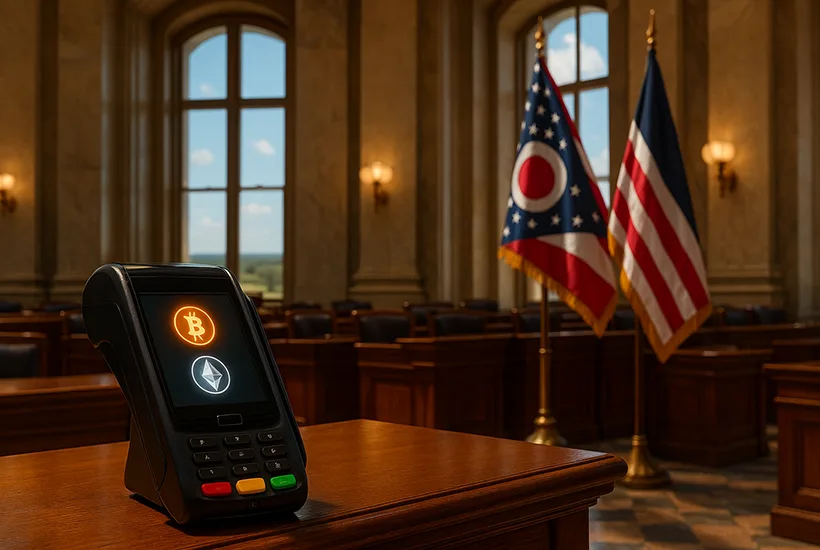


The Ohio State Board of Deposit unanimously approved Wednesday, a proposal to accept cryptocurrency payments for state fees and services. The move paves the way for the state’s effort to let Ohio residents pay for state administrative services with Bitcoin and other digital assets.
The announcement was made in Columbus at the Ohio Statehouse and confirmed via a press release from Ohio Secretary of State Frank LaRose. LaRose, who had championed the initiative along with State Treasurer Robert Sprague, praised the move and described it as placing Ohio “at the forefront of the emerging digital economy.”
Today, the State Board of Deposit unanimously approved a vendor to facilitate the acceptance of cryptocurrency payments for state fees and services.
With hundreds of thousands of transactions going through my office each year, I want to commend the board for taking bold action… pic.twitter.com/QQz0oxoeHP— Frank LaRose (@FrankLaRose) September 24, 2025

In April, LaRose and Sprague pushed for the authorization to accept crypto payments; by May, the board had already given conceptual approval pending vendor selection. Under the new system, digital-asset payments made by users will be converted almost immediately into U.S. dollars, so the state does not retain volatile crypto holdings.
What this means for Ohio?
People from Ohio, especially businesses, can now pay fees, licensing, and other state services using crypto, a convenience especially appealing to tech-savvy users and companies in the blockchain space. Because the vendor will convert funds to dollars, Ohio avoids holding crypto on its balance sheet, skipping volatility and custodial risk. All this signals that the state is open to modernizing revenue collection mechanisms.
Strategic crypto ambitions beyond payments
The payment approval fits into a broader pro-crypto legislative push in Ohio. Earlier this year, the Ohio Blockchain Basics Act passed the House; it prohibits local governments from banning cryptocurrency use and exempts small crypto transactions (under $200) from capital gains tax. LaRose also supports House Bill 18, which would create an Ohio Strategic Crypto Reserve, funded from portions of investment earnings.
Ohio’s step is among the more ambitious at the state level; however, they aren’t the only one. Louisiana made headlines in September 2024 when it became the first U.S. state to accept cryptocurrency for government services. Detroit announced that starting mid-2025, residents will be able to pay taxes and other city fees using crypto via a secure infrastructure like PayPal.