


The U.S. Securities and Exchange Commission (SEC) has issued its first clarification on Web3 classifications this week. In an official release published on Tuesday, the SEC said that GENIUS Act-regulated stablecoins and Non-Fungible Tokens (NFTs) do not qualify as securities in the U.S.
The Web3 sector that constitutes crypto assets, NFTs, decentralized domain names, and other similar blockchain tools, has long remained plagued with unclarity around categorizations as commodities or securities — both of which are differently regulated in the U.S. as well as in other parts of the world.
This week, SEC chairperson Paul Atkins announced that digital tools and digital commodities do not fall under the securities class. These include digital IDs, Web3 domains, and functional crypto system-linked assets like BTC, ETH, SOL, XRP, and DOGE among others.

In the U.S., equities, debt instruments, derivatives, and tokenized versions of traditional stocks and bonds are categorized as securities. Essentially, a security in the U.S. is a financial instrument that represents an ownership position.
“This interpretation will provide market participants with a clear understanding of how the Commission treats crypto assets under federal securities laws,” Atkins said. “It also acknowledges that most crypto assets are not themselves securities.”
The SEC has been indicating for a while that while some Web3 assets can be seen as securities, many can exit that status and become a commodity if their networks goes functional and remains decentralized.
Among several differences in how securities and commodities are differently regulated in the U.S., one stands as a highlight. While securities regulations focuses on getting public companies to disclose their debts and risks, commodities rules aims to prevent market manipulations and frauds for investors engaging with raw things like gold or BTC, where no particular company is in-charge.
Commodities as a category in the U.S. includes natural resources, agricultural products, and livestock. The class of digital commodities is still being carved but it will constitute of digital assets that derive value from market supply and demand.
The Commodities and Futures Trading Commission (CFTC) is the federal agencies that regulates the commodities in the U.S.
Michael Selig, the chairman of the CFTC, also commented on SEC’s clarification this week calling it a “joint action”.
“Chairman Atkins and I are committed to fostering a regulatory environment that allows the crypto industry to flourish in the United States with clear and rational rules of the road. Today’s joint agency action reflects a shared commitment to developing workable, harmonized regulations for the new frontier of finance,” Selig noted.
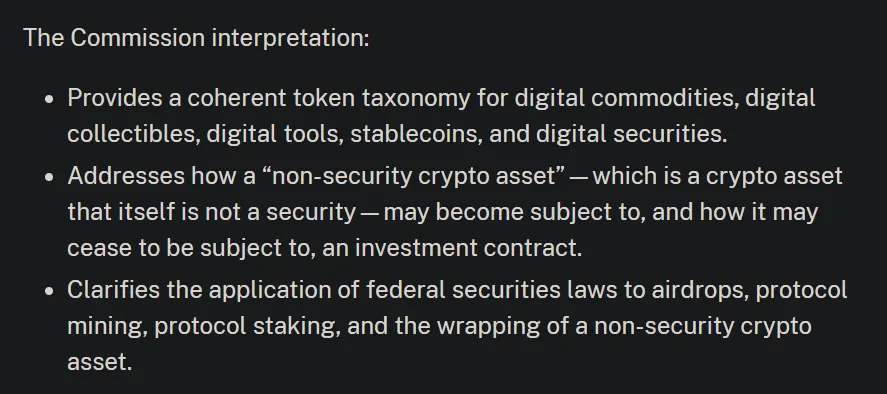
Source: SEC newsroom
The development comes at a time when the U.S. is eagerly awaiting its crypto market structure bill, also known as the CLARITY Act. The legislation aims to establish the CFTC as the principle regulatory body for the crypto sector and limit SEC’s involvement.
While the CLARITY Act is currently stalled in the Senate, the SEC and the CFTC took the decision to issue a joint crypto interpretive release this week.