



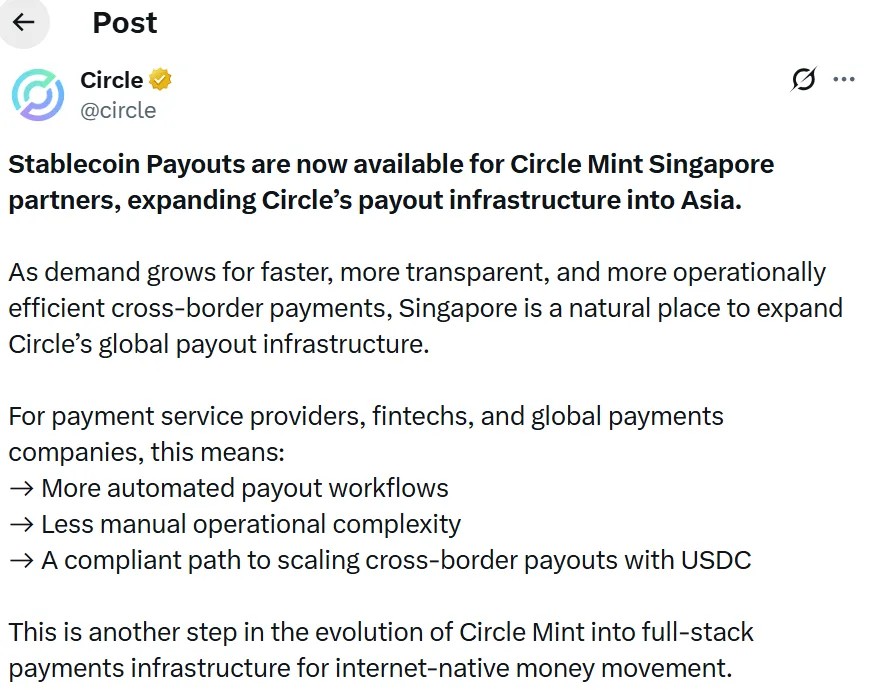
Circle is taking strides to increase its presence in Asia by offering a new product called Stablecoin Payouts through its Circle Mint solution in Singapore. The news came up on Tuesday and is in line with Circle’s strategy of building a global payments ecosystem by making use of its stablecoin USDC.
Circle’s initiative is indicative of the fact that companies today are in dire need of an efficient method to send money overseas, given that existing international money transfer processes are time-consuming or expensive.
In essence, the newly launched payment facility enables companies linked to Circle Mint Singapore, the company’s institutional platform used for minting and redeeming USDC tokens, to perform international transfers using stablecoins rather than exclusively using traditional banking services.

With such an innovative approach to payments, businesses will be able to process their transactions efficiently without having to worry about delays caused by intermediaries, while they could also monitor the movement of their money throughout the transaction process. Through direct USDC payouts, Circle wants to promote stablecoins as more than just an alternative cryptocurrency and make them a practical solution for financial management purposes.
Expansion comes as Singapore witnesses rise in digital asset adoption
Singapore has emerged as a natural point of departure for such an expansion because it is known to be one of the best regulatory havens for digital asset companies in all of Asia due to its comprehensive regulation of such projects and effective control by the MAS.
A Circle subsidiary is already present in the city-state with an operational license, making it possible for the company to develop its services in the Asia-Pacific region. In today’s environment, many firms based in Asia are looking for payment providers that work within defined regulations.
From an industry perspective, the launch marks the ongoing transition of stablecoins from a novelty technology into a major element of financial systems. In traditional cross-border payments, a number of intermediaries, currency exchanges, and other steps are involved in making an international transaction.
The settlement time can take multiple days because of such factors. Stablecoins such as USDC provide a new paradigm of international payments with fast processing time and no intermediaries in between.
Circle aligns with growing blockchain payment demand
The company’s development coincides with the growing interest in blockchains and cryptocurrency as means of payment in Asia. Governments, as well as commercial banks and other financial institutions in Asia, have begun considering whether blockchain-based payments could make some aspects of their work easier.
The move allows the firm to provide assistance in these processes without violating any regulations or standards set by the authorities.
It seems that the company continues its focus on complying with all requirements and regulations. In contrast with previous waves of innovation, when the main aim was quick expansion, the contemporary context gives priority to regulation, transparency, and risk management.
Thus, Circle demonstrates that blockchains and cryptocurrencies may work under certain conditions and in accordance with existing regulations. This statement is primarily directed toward large companies who wish to benefit from innovative technologies but do not want to face possible risks and problems.
Looking forward, Circle’s move to penetrate Asia implies that stablecoins will increasingly be considered a key part of the international payment discussion rather than a niche competitor operating on the periphery. As international business grows in size and seeks more efficient methods of settling transactions, services such as Stablecoin Payouts may change the dynamics of international money movement.
From Circle’s perspective, establishing itself in Singapore is not only about tapping into new opportunities but about positioning itself for a future where USDC and other stable coins are a standard part of international commerce.