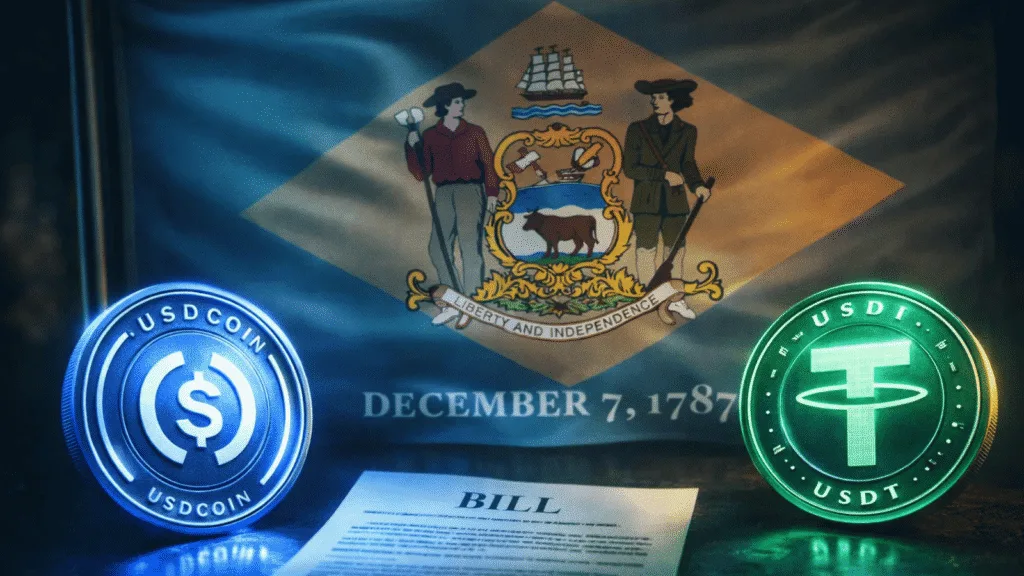



Delaware lawmakers on Monday unveiled two new bills to modernize the state’s financial laws. Senator Spiros Mantzavinos and Representative Bill Bush introduced Senate Bill 16, the Delaware Banking Modernization Act, along with Senate Bill 19, the Delaware Payment Stablecoin Act.
Delaware sets 1:1 reserve rules for stablecoin issuers
The Delaware Payment Stablecoins Act would create a legal path for companies that want to issue payment stablecoins or provide digital asset services in the state. Under the bill, every permitted issuer must keep reserve assets backing outstanding stablecoins on a 1-to-1 basis by fair value. Simply put, if a company issues one dollar-backed stablecoin, it must hold one dollar or an approved equivalent in reserve.
The bill allows safer reserve assets such as U.S. cash, money held at a Federal Reserve Bank, certain insured deposits, short-term U.S. Treasury instruments, and tightly controlled overnight repurchase agreements. The proposal also says reserve assets cannot be freely reused or pledged in risky ways, except in narrow cases set by the law.

Bill adds licensing, redemption, and transparency requirements
Senate Bill 19 would create a licensing system for stablecoin issuers and digital asset firms serving Delaware residents. The proposal also sets strict redemption rules. Issuers would need to publish a public redemption policy and complete redemptions within two business days under normal conditions.
Any fee change would require at least seven days’ notice. Companies could not pause redemptions on their own unless the order comes from the Commissioner, the Federal Reserve, or a court.
The bill also pushes for stronger transparency. Issuers would need to publish a monthly report showing stablecoins in circulation, reserve assets backing them, and any change in the reserve mix. Under the bill, companies with more than $50 billion in outstanding stablecoins would face an annual GAAP audit.
Delaware also added a strict rule for reserve shortfalls. If reserves drop below the required level, the issuer must notify the State Bank Commissioner the same business day and stop issuing new stablecoins.
If the problem is not fixed within 15 business days, the company will have to start selling reserve assets in an orderly way and redeem outstanding stablecoins. The bill also aims to keep Delaware’s framework closely aligned with the federal GENIUS Act, which could help state-chartered firms qualify under future federal rules.
Delaware’s SB 16 to Update Banking Rules for Digital Assets
Meanwhile, the Delaware Banking Modernization Act would update Delaware banking law by adding clear definitions for digital assets and virtual currency. The bill would also give the State Bank Commissioner more authority.
It would also make clear that digital assets can be treated like personal property under state trust laws. That means state-chartered banks and trust companies could hold and manage digital assets for customers. Bush said the law needs updating because banking and payments have changed a lot over the past 40 years.
Both measures are still in the early stages and will need more approval before they can become law. The next step is a review by the Senate Banking Committee, after which the bills would move to the full Delaware Senate for debate.
Lawmakers also said another bill is on the way. The upcoming proposal, called the Delaware Money Transmission & Virtual Currency Modernization Act, would focus on stronger consumer protections and clearer licensing standards for companies working in money transmission and virtual currency services.