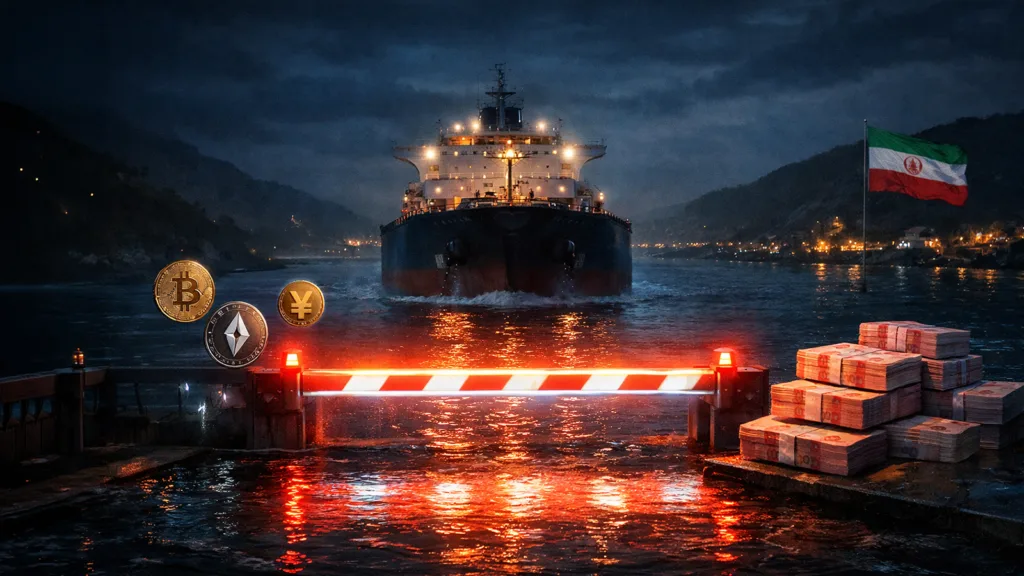



The Strait of Hormuz has become something nobody in global shipping expected to deal with, a geopolitical toll road controlled by Iran’s Revolutionary Guard Corps, where the price of passage is negotiated in Chinese yuan or stablecoins, and the wrong country’s flag on your hull means you don’t get through at all.
According to Bloomberg, Iran’s Islamic Revolutionary Guard Corps, the IRGC, has established a structured toll system for the Strait of Hormuz, the narrow waterway through which roughly 20 percent of the world’s oil and liquefied natural gas normally passes. Ships from countries Iran considers friendly can apply to transit; those from nations it views as hostile face either interdiction or simply never receive passage clearance.
The process, as described by multiple people with direct knowledge of the negotiations, is more formalized than most people realize. Vessel operators seeking passage must contact an intermediary company linked to the IRGC and submit extensive documentation, vessel ownership, flag registration, cargo manifests, crew lists, and AIS tracking data.

The IRGC then runs background checks to confirm the ship has no ties to the US, Israel, or other countries Tehran considers enemies. Iran has a ranking system from one to five for nations, with ships from more favored countries getting better terms.
For oil tankers, the starting price in negotiations is typically around $1 per barrel of cargo, paid in yuan or stablecoins. Once a deal is reached, the IRGC issues a permit code and route instructions.
As the vessel approaches the strait, it broadcasts the passcode over its VHF radio and is met by a patrol boat that escorts it through, close to the coast through a stretch the shipping industry has taken to calling “the Iranian tollbooth.”
The Yuan, the crypto, and why the dollar isn’t an option
The choice of payment currency here is deliberate and loaded with meaning. China is now the buyer of over 80 percent of Iran’s seaborne oil exports, and yuan-denominated payments bypass the US-controlled financial infrastructure, specifically SWIFT and the dollar-based systems that would otherwise leave those transactions exposed to American sanctions.
China’s Cross-Border Interbank Payment System, known as CIPS, has been logging notably higher transaction volumes through March, which analysts say tracks with reports of Iranian oil payments and tolls settling in yuan.
The crypto option adds another layer. Stablecoins, cryptocurrencies pegged to the value of a hard currency like the dollar, offer a way to transact without touching traditional banking systems at all.
Ship owners and operators face difficult legal questions about whether paying these tolls exposes them to sanctions violations, and the crypto route offers no insurance protection, a significant concern in an industry where nearly everything is underwritten by Western insurers like Lloyd’s of London. But for some operators, the choice between paying in stablecoins and sitting at anchor for weeks while missiles pass overhead is not a hard one.
At least two vessels have already completed transits and paid fees in yuan, with one transit brokered by a Chinese maritime services company acting as intermediary. Meanwhile, Lloyd’s List has tracked 26 vessel transits through the IRGC toll system since mid-March, suggesting the arrangement is already operating at some scale.
Nearly 2,000 vessels are currently waiting on both sides of the strait, and only a fraction of pre-war transit levels have been observed. Iran wrote to the International Maritime Organization stating that ships from non-hostile nations may receive safe passage, provided they comply with Iranian security requirements. Ships from Malaysia, China, Egypt, South Korea and India have been allowed through so far.
The legality of the toll remains sharply contested. International maritime law, specifically the UN Convention on the Law of the Sea, enshrines the right of transit passage through international straits, prohibiting coastal states from interfering.
Iran signed the convention in 1982 but never formally ratified it, which Tehran uses as the basis for its argument that it isn’t bound by those provisions. Most international law experts disagree, but with enforcement requiring naval action, that debate has limited practical weight for the moment.
Iran has reportedly made formalizing its control over the strait one of its conditions in preliminary ceasefire discussions with the US, essentially seeking to turn Hormuz into a permanent revenue source, much like the Suez Canal operates for Egypt. President Trump said on Tuesday he hopes to end the conflict within two to three weeks.