



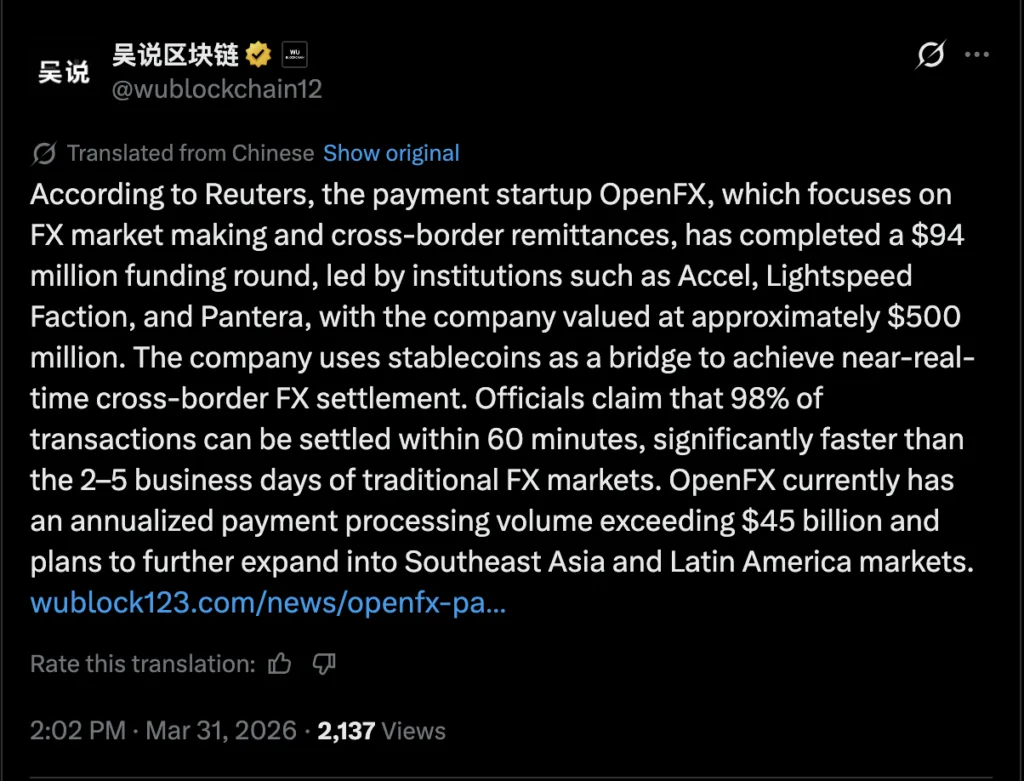
OpenFX has raised $94 million in a Series A round as it pushes deeper into cross-border payments and foreign exchange infrastructure.
The funding will support expansion in Southeast Asia and Latin America, where the company sees demand for faster and lower-cost money movement.
According to a press release, the New York-based firm said it uses stablecoins as a settlement rail between traditional banking systems and digital infrastructure.

OpenFX said the model helps institutions move funds across borders faster, with more than 40 trading pairs and most transactions settling in under 60 minutes.
OpenFX grows cross-border role
OpenFX said the funding round included Accel, Atomico, Lightspeed Faction, M13, Northzone, and Pantera. The company described the round as a step toward building more liquidity across global payment corridors used by fintech firms, remittance providers, neobanks, and payroll platforms.
The company said annualized payment volume rose from $4 billion to more than $45 billion as demand increased for faster international settlement. OpenFX also named MoneyGram, Yellow Card, and alfred among the platforms using its network for cross-border transactions.
Founder and chief executive Prabhakar Reddy said the foreign exchange market still relies on old settlement systems.
“The global FX market processes more than $200 trillion annually, yet the core settlement infrastructure remains largely unchanged from decades ago,” Reddy noted.
As per Reddy, institutions still face delays when moving money across borders through traditional rails.
“Institutions should not have to wait multiple business days to move capital across borders. We built OpenFX to deliver real-time, institutional-grade liquidity that reduces risk, lowers costs and allows capital to move as efficiently as the businesses behind it,” he noted.
Stablecoins Drive OpenFX Model
OpenFX was founded in 2024 by FalconX co-founder Prabhakar Reddy. The company said it connects banking systems with digital payment infrastructure and uses stablecoins as an intermediate step for FX conversion and settlement.
The firm believes this approach helps reduce waiting times in cross-border transfers, where settlement often takes two to five business days under legacy systems. It also added that businesses still face high conversion costs and often keep large sums in pre-funded nostro accounts to support international payments.
OpenFX highlighted that more than $4 trillion in working capital remains tied up in these accounts worldwide. The company said the contrast between traditional transfers and digital asset transfers has become harder for institutions to ignore, especially when blockchain-based settlement can happen in minutes.
The company said over 98 percent of transactions on its network settle in less than 60 minutes. It also said the platform gives institutions access to liquidity across more than 40 trading pairs, with pricing built for firms moving large sums across borders.
New funds back Asia, LatAm push
OpenFX said it will use the new funds to expand in Southeast Asia, where domestic real-time payment systems already handle local transfers well but cross-border movement remains slower. The company named India’s UPI, Singapore’s PayNow, and Thailand’s PromptPay as examples of advanced local systems that still operate beside cross-border friction.
The company also said it plans to strengthen its Latin American corridors. It pointed to growth in Mexican peso, Brazilian real, Colombian peso, and Argentine peso trading pairs as stablecoin-based payments continue to grow in the region.
OpenFX already operates in the United States, the United Kingdom, the United Arab Emirates, and India. The latest funding gives it more room to deepen operations in markets where businesses want alternatives to correspondent banking chains and slower settlement schedules.
The company said its focus remains on institutional users rather than retail customers. Its target users include fintech companies, remittance firms, payroll platforms, and other businesses that need to move money across borders on a regular basis.
Investors back stablecoin FX rails
Investors in the round said they see stablecoins playing a larger role in global payments.
M13 general partner Latif Peracha said, “It is undeniable that stablecoins are transforming global money movement,” while describing OpenFX as a platform built around real-time settlement and capital efficiency.
Northzone partner Sanjot Malhi said OpenFX is building enterprise-grade infrastructure that links foreign exchange markets with stablecoin rails. Atomico founder and chief executive Niklas Zennström compared the company’s role in payments infrastructure to what cloud platforms did for software development, while Pantera Capital managing partner Paul Veradittakit said the firm is working on a more seamless system for moving money globally.
The funding round also arrives as stablecoins draw more attention from large businesses and financial firms. Ripple chief executive Brad Garlinghouse recently described stablecoins as crypto’s “ChatGPT moment” for corporate adoption, pointing to growing interest among finance leaders exploring payment use cases.
Industry data has also added to that trend. Stablecoins processed more than $33 trillion in volume last year, while Bloomberg Intelligence estimated those flows could grow at an 80 percent annual rate and reach $56.6 trillion by 2030.
Those figures have helped support the view that stablecoins are moving beyond trading and into broader financial infrastructure.
Even so, OpenFX enters a market that still faces policy and banking hurdles. Stablecoin rules differ across major markets, and companies building payment products must still manage licensing, compliance, and access to banking partners as they scale.