


Payment processing company PayPal announced on Tuesday the rollout of its native stablecoin PYUSD to over seventy countries, marking a deeper integration of stablecoin technology in its core product.
The update follows the exit of Alex Chriss and the appointment of Enrique Lores as CEO and President of PayPal in February.
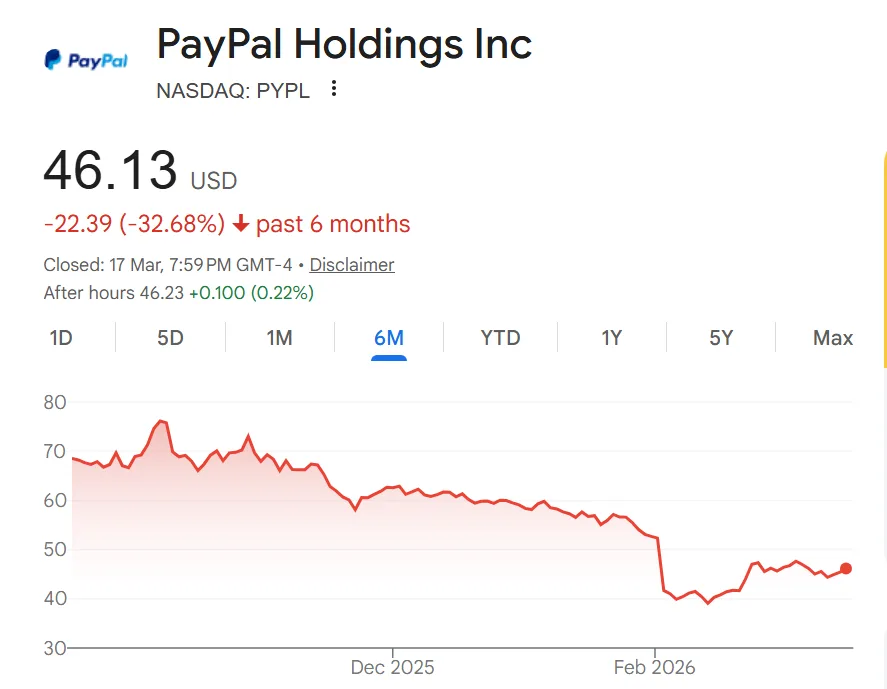
PayPal now looks to secure a turnaround after losing nearly a third in share value over the past six months and posting Q4 earnings that did not match up to market expectations.

According to the announcement, users in the following countries will now be able to access the PYUSD stablecoin:
- Colombia
- Costa Rica
- Dominican Republic
- Faroe Islands
- Greenland
- Guatemala
- Honduras
- Panama
- Peru
- Singapore
- United Kingdom
- United States
Source: Google Finance
The official press release says users will now be able to make transactions globally at a lower cost due to the use of stablecoins.
“Consumers and businesses around the world are looking for faster, more seamless ways to transact globally and the current system still charges too much, takes too long, and settles on timelines that were designed for a different era,” said SVP May Zabaneh.
“We are working to change that. Enabling PYUSD in users’ accounts across 70 markets gives people faster access to their funds, lower-cost ways to send money across borders, and a more direct path to participating in the global economy, and that is what drives commerce forward for everyone.”
At the time of writing, PayPal shares were trading at $46.13.
The PYUSD stablecoin was launched in 2023. It currently has a market capitalization of roughly $4.1 billion and is considered one of the bigger stablecoins in the cryptocurrency market. It is the 25th largest stablecoin by market capitalization.
“With more than $4 billion of PYUSD already in circulation and access now expanding across 70 markets, PayPal is clearly using its existing global distribution to make PYUSD a more serious payments and transfers layer,” said digital assets consultant Lavneet Bansal
“Payment rails are the usual systems that move money, like PayPal, banks, and cards, while blockchain rails let that same value move as a digital token over crypto networks. That matters because when PYUSD moves outside PayPal to compatible wallets and platforms, it can settle much faster than traditional cross-border payment flows and, on lower-cost networks, can also reduce some of the friction and fees involved,” he also said.