




A quiet revolution has been happening at checkout counters around the world. People are paying for groceries, flights, hotel rooms and everyday purchases with stablecoins, and the numbers have grown so fast that March 2026 just set an all-time record.
On-chain data tracked by PaymentScan shows that crypto card spending crossed $584.5 million in March, surpassing the $600 million threshold for the first time in history when accounting for total tracked volume, and marking a 211 percent jump compared to the same period last year.
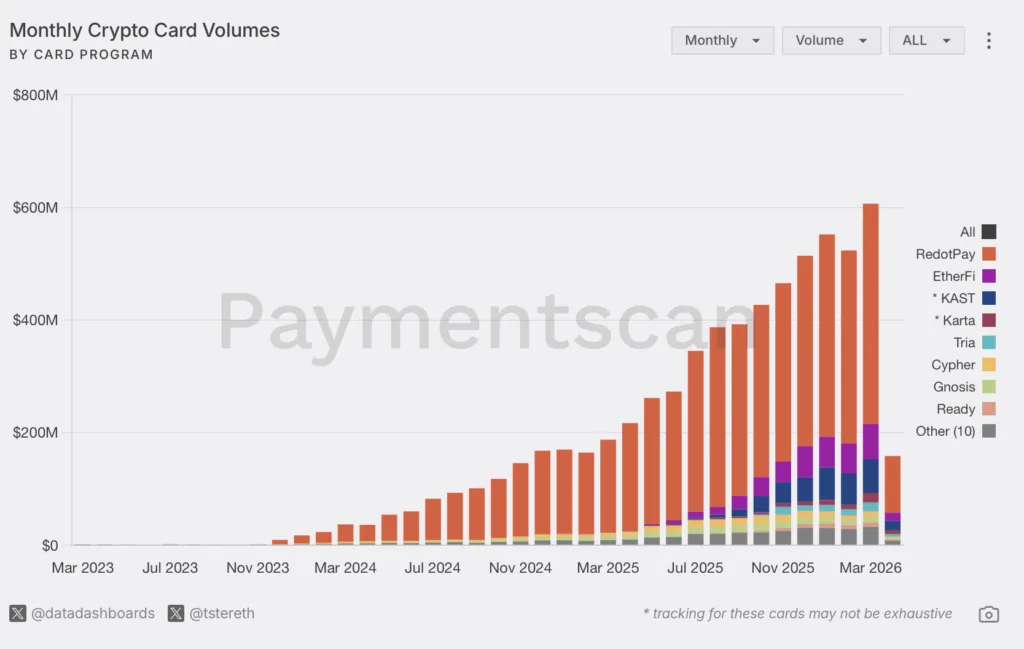
That’s a trend that has been compounding since early 2023, when monthly volumes hadn’t even cleared $1 million. Three years later, the category has grown by more than 500 times.

According to Artemis Analytics, the broader crypto card market, which includes cards from major centralized exchanges like Binance, Bybit and Coinbase whose transactions are not fully visible on-chain, is estimated to have long surpassed $1.5 billion in total monthly volume. The on-chain figures, while record-breaking, capture only a subset of actual spending activity.
The story of how this happened is simpler than it sounds. Crypto cards work like regular debit cards. Users load stablecoins onto a card, usually USDT or USDC, and when they tap to pay, the card converts those holdings into local currency in real time at the point of sale. The merchant receives ordinary fiat. The user never has to think about crypto at all. It’s the stablecoin layer made invisible.
RedotPay and the Visa stranglehold
One company dominates the on-chain figures more than any other. RedotPay, a Hong Kong-based stablecoin payment card with over 5 million users across more than 100 countries, accounted for roughly $391 million of March’s tracked volume, more than half the entire on-chain total.
RedotPay allows users to spend Bitcoin, Ethereum, USDT and USDC at more than 130 million merchants globally and run on both virtual and physical Visa cards. The Visa angle here is quite significant. Among the payment networks tracked by PaymentScan, Visa holds a commanding 97 percent of on-chain crypto card volume.
Mastercard accounts for just 3 percent. Visa locked in early partnerships with crypto-native infrastructure providers, giving it a structural advantage that has proven difficult to close. Visa’s stablecoin-linked card spending reached a $3.5 billion annualized run rate by the fourth quarter of 2025, representing a 460 percent year-over-year increase.
Behind the scenes, much of this activity runs through infrastructure players like StraitsX, a Singapore-based company that acts as a Visa BIN sponsor, essentially the licensed intermediary that allows other companies to issue Visa cards without holding a full banking license.
StraitsX processed nearly $30 billion in cumulative stablecoin transactions as of early 2026, powering card programs for partners including RedotPay. The model is built around the invisibility that the user sees a card payment, not a blockchain transaction.
USDT still leads, but USDC is closing in
On the stablecoin side, the old hierarchy is intact but showing cracks. USDT, Tether’s dollar-pegged token, still accounts for 62 percent of tracked crypto card volume, with USDC at 27 percent. At first glance, that looks like a comfortable lead for USDT. But the trajectory matters more than the snapshot.
Artemis found two countries where USDC approaches parity with USDT in card spending, India, where USDC represents 47.4 percent of stablecoin volume, and Argentina at 46.6 percent. In most other markets, USDT dominates by a wide margin.
These two countries are notable because they are also among the fastest-growing crypto adoption markets globally. India became the largest crypto market in Asia-Pacific by inflows, with $338 billion in the twelve months ending June 2025.
The broader stablecoin picture reinforces the USDC momentum. Stablecoin transaction volumes surged 72 percent to $33 trillion in 2025. USDC led the way with $18.3 trillion in transactions, while USDT recorded $13.3 trillion, a reversal of what most people would have predicted two years ago given USDT’s dominant market cap.
And in adjusted transaction volumes tracked by Mizuho, USDC overtook USDT for the first time since 2019 in the early months of 2026, prompting the Japanese bank to raise its price target on Circle stock.
Part of what’s driving USDC’s card-layer gains is regulatory structure. Visa and Mastercard’s native stablecoin settlement rails, where the card network settles directly in stablecoins rather than fiat, support only a small set of regulated tokens: USDC, USDG, PYUSD and EURC.
USDT is notably absent from these rails due to regulatory uncertainty, which means that even though USDT dominates consumer-level card funding, it doesn’t benefit from the same backend settlement infrastructure that USDC does. As the settlement layer and the spending layer converge, that gap could matter more over time.
The real scale is likely much bigger
One thing worth remembering when looking at the $600 million figure is that it’s almost certainly an undercount. PaymentScan tracks only crypto protocols with publicly verifiable on-chain data.
Cards issued by Binance, Coinbase, Bybit and other major exchanges don’t appear in these numbers because those transactions clear through centralized systems that aren’t fully visible on-chain. Total monthly volume including exchange cards is estimated at well over $1.5 billion, more than double what PaymentScan captures.
Still, even the on-chain figure crossing $600 million is a milestone worth noting. In May 2023, the same data set hadn’t recorded $1 million in a month. The first time it crossed $10 million was January 2024, the same month spot Bitcoin ETFs debuted on US exchanges.
By September that year, it passed $100 million. The compounding since then has been relentless, and if the trajectory holds, the question is no longer whether crypto card spending becomes a mainstream payment method, but how quickly.