
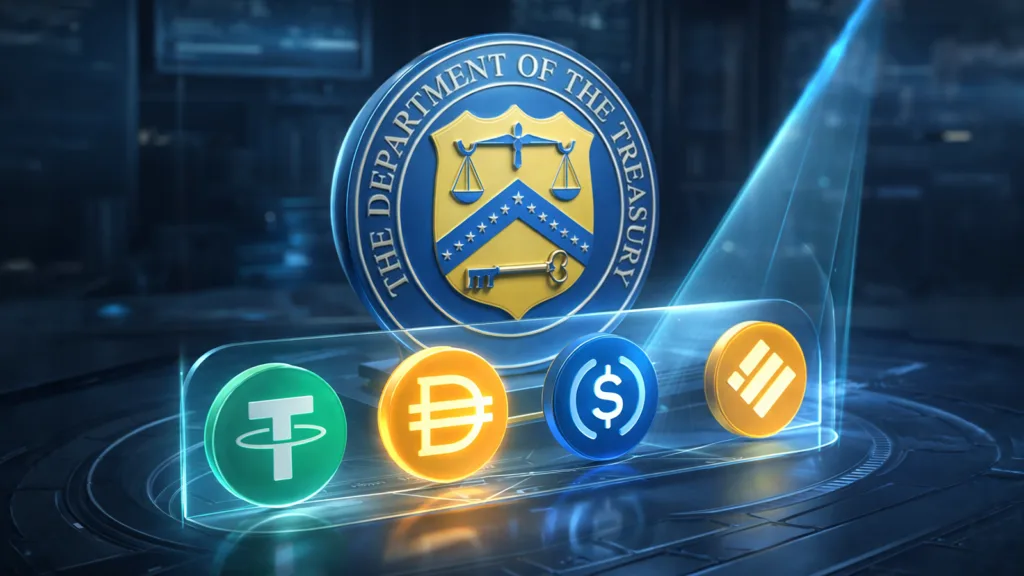



The U.S. Treasury is working on a new proposal that would lay down requirements for stablecoin issuers to identify and curb potentially unlawful transactions.
The plan would bring issuers closer to the same compliance structure used across the wider financial system, with rules focused on money laundering, sanctions screening, and suspicious activity controls.
Treasury prepares new stablecoin compliance rules
The U.S. Treasury is expected to introduce a proposal that sets out how stablecoin issuers must handle illicit finance risks under the GENIUS Act. The measure is being prepared through a joint effort by the Financial Crimes Enforcement Network and the Office of Foreign Assets Control.

Under the draft approach, stablecoin firms would need systems that can identify risky activity and act on it. Those systems would need to stop, freeze, or reject transactions when there are signs that a transfer may breach U.S. law or sanctions rules.
The proposal marks a major step in turning the GENIUS Act into working policy. The law created the first broad federal framework for payment stablecoins, but regulators still needed to spell out how issuers would meet those obligations in daily operations.
According to the proposal summary reviewed by CoinDesk, regulators want stablecoin issuers to act more like other financial firms that already operate under anti-money laundering and sanctions rules. That means stablecoin businesses would need internal systems that are not only active on paper but also effective in practice.
Treasury Secretary Scott Bessent framed the coming rules as a way to protect the U.S. financial system without slowing lawful activity in the stablecoin market. His position suggests the department wants tighter controls while still leaving room for licensed issuers to expand their payment businesses.
Moreover, the proposal is expected to go through a public comment process before any final version takes effect. That stage would allow issuers, industry groups, and other market participants to respond to the draft before the Treasury moves ahead.
FinCEN and OFAC lay out issuer duties
The planned rule would place clear duties on stablecoin firms. On the FinCEN side, issuers would need anti-money laundering programs that can detect flagged activity, stop listed transactions, and focus more resources on higher-risk users and transfers.
That means firms would need to do more than basic screening. Their compliance teams would have to examine customer activity, monitor patterns, and identify where the highest risks sit within their business.
The draft also expects issuers to review their own records when FinCEN identifies a person or entity tied to an investigation. That requirement would make stablecoin firms active participants in tracking suspicious financial activity linked to crime, terrorism financing, or other unlawful conduct.
The proposal also points to cases involving parties described as “primary money laundering concerns.” In those situations, issuers would need to support government action by checking their own systems for relevant activity and taking the necessary internal steps.
OFAC’s part of the proposal would deal with sanctions controls. Stablecoin issuers would need risk-based safeguards for activity in both primary and secondary markets. Those safeguards would need to identify and reject transactions that may violate U.S. sanctions rules.
That would place more pressure on issuers to maintain strong monitoring across the full life of a stablecoin transaction. It would also require closer attention to blocked parties, restricted areas, and customer links that may raise sanctions concerns.
At the same time, the draft leaves room for firms to design controls that match their own business model. According to the summary, the Treasury takes the view that financial institutions are often best placed to assess the risks within their own operations. That approach gives issuers some flexibility, but only if their systems work.
The same draft also gives firms a clearer sense of how enforcement may be handled. It suggests that a company with a sound compliance program should not face action unless there is “a significant or systemic failure” in the way that program is maintained.
New rules build on the GENIUS Act
The Treasury proposal would serve as one of the main building blocks in the rollout of the GENIUS Act. That law is due to take full effect by 2027, but U.S. regulators have already started defining how the stablecoin market will be supervised before then.
Earlier this year, the Office of the Comptroller of the Currency published its own draft procedures for issuers under its oversight. As we reported yesterday, the Federal Deposit Insurance Corp. followed with a largely similar proposal. Together, those moves show that federal agencies are now filling in the details of the new regime.
The direction is becoming clearer. U.S. authorities are not treating stablecoin issuers as a separate category outside traditional financial controls. Instead, they are moving them into a framework that looks much closer to mainstream payment and banking oversight.
That shift comes at a time when stablecoins are gaining a larger role in both crypto trading and payment activity. It also comes as companies move to secure charters, partnerships, and regulatory standing before the market becomes more tightly structured.
Several major issuers are already in focus. Tether, Circle, Ripple, and World Liberty Financial are among the firms watching how the new rules develop. These businesses have waited for a federal framework that can define both market access and operating standards.
The Treasury draft makes clear that compliance will sit at the center of that framework. Firms will need more than the right to issue a token. They will also need the ability to monitor transactions, act on suspicious activity, and respond when authorities request information.
Stablecoin firms face closer review as scrutiny grows
The timing of the proposal reflects a wider regulatory concern about how stablecoins interact with the broader financial system. U.S. officials have long warned that digital assets can be used for money laundering, sanctions evasion, and other unlawful purposes if firms do not maintain strong controls.
Furthermore, that concern has kept stablecoin issuers under steady review as their tokens move across exchanges, wallets, and payment networks.
The new proposal shows that Treasury officials want issuers themselves to carry more of that burden rather than leaving it mainly to trading platforms or banking partners.
Recent developments in the sector add to that pressure. World Liberty Financial, which manages the USD1 stablecoin, has drawn fresh attention this week after reports that its AB DAO partner was involved in a project with possible ties to Cambodia’s Prince Group. U.S. authorities have previously investigated and sanctioned figures connected to that case.