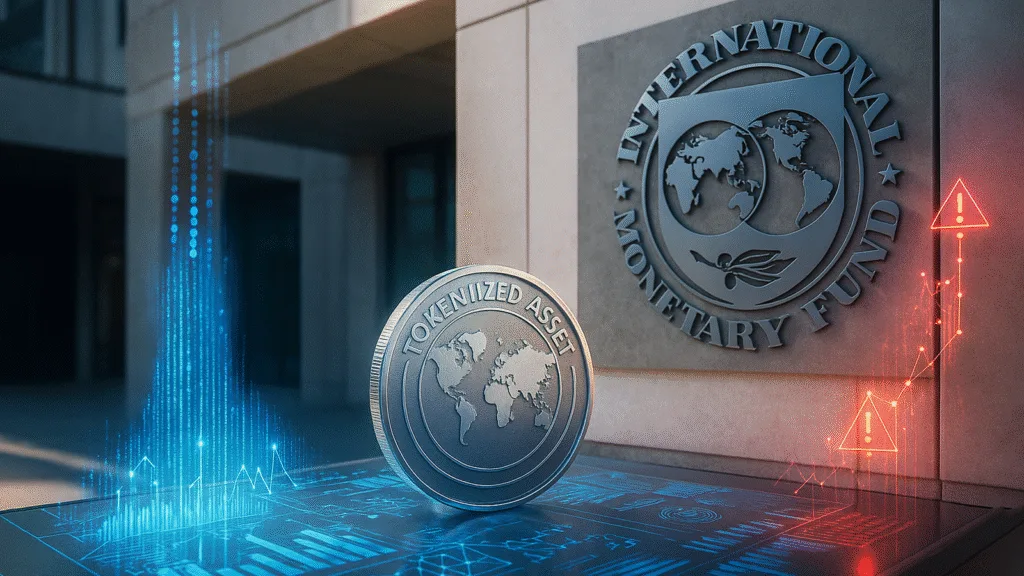



The International Monetary Fund (IMF), that has maintained a scrutinised approach towards cryptocurrencies for the longest, has predicted a bright future for tokenized assets.The IMF has referred to tokenization as the next step in the evolution of finances as we understand today – that will give traditional money a programmable twist.
Tokenization can be defined as the process of representing ownership rights of physical assets into blockchain-based digital tokens. This process, analysts say, improves the liquidity element of physical assets, without compromising on their structural or value-based integrity.
Over the weekend, the IMF released a blog authored by senior economist Itai Agur, detailing its stance on tokenization. In the post, Agur essentially said that tokenization can automate the present roles of middlemen like registrars making the financial markets cheaper and more time efficient.

“Financial innovators aim to cut intermediation costs by bringing the immediacy of exchanging physical tokens to the digital world. The challenge is that when transacting parties don’t meet face-to-face, they cannot see the assets they are trading before completing an exchange,” Agur said.
He went on to explain that programmability provides codes that lock the funds from the buyer and assets from the seller that are then exchanged at the same moment.
IMF’s take on what tokenization can improve
For market participants, the IMF said, tokenization can create a transparent record keeping system by logging details of tokenized physical assets and their tokenized versions onto blockchains – where data storage is immutable.
Agur pointed out that tokenization can simplify the process of switching brokers and facilitate instant transfers of assets through just a click. This significantly slashes the trading cost by eliminating excess expenses on maintaining intermediaries.
“On a token ledger, payments are made directly to the token holders, automating the role of registrars and putting them out of a job,” Agur explained.
For tokenization to work smoothly, however, the IMF stressed that token ledgers created by different entities should be able to work together and not fragment the financial system.
“It is possible to design ledgers so that they can talk to each other, but this interoperability requires planning and coordination. This is why policymakers want to make sure that tokenized systems stay open, connected, and stable,” the blog noted.
IMF’s risk warning on tokenization
While tokenizing can improve the liquidity and engagement efficiency of physical assets, the IMF pointed out that it could also make way for complex financial products to enter into the markets. Owing to the programmability feature of the tokenized assets, the IMF warned that it could ease instant execution of automated trading rules – making the market riskier and more volatile.
“Financial crises often unfold like falling dominoes, with one failure setting off the next,” Agur wrote. “On a token ledger, chains of programs can be written on top of each other, acting like a programmed set of falling dominoes during a crisis.”
Additionally, the IMF economist claimed that tokenization can easily build up debt with investors or institutions using tokens as collateral to borrow funds – wherein if a token loses value, it could trigger a loss-spell across the system, causing financial harm to the investors.
The IMF also spotlighted that tokenization should be defined as a “hybrid” between fintech and physical properties because it said physical assets cannot be fully digitalized and actually require physical care to maintain their value.
“Speed, complexity, and risky debt have all contributed to previous financial crises—and tokenization adds to all of them. As with any innovation, digital tokens should be handled with care,” Agur cautioned.
Fortune Business Insights estimates that the global tokenization market is projected to hit the valuation of $3.95 billion in 2025 and surge over $12.83 billion by 2032.