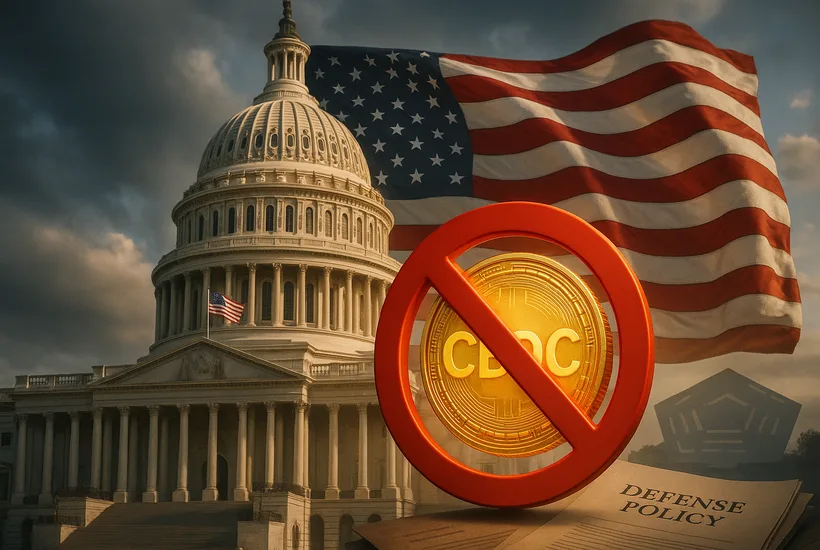



The U.S. House is in the process of setting the country’s defense policy for the year of 2026. As part of the proposed National Defense Authorization Act (NDAA), the House has recommended banning the Federal Reserve from issuing a dollar-backed central bank digital currency (CBDC). It appears that the U.S. is taking a different route to ensure that a CBDC is kept off its financial system after the anti-CBDC legislation garnered conflicted opinions from the Congress last month.
At a time when the U.S. is taking active measures in regulating the digital assets sector with a supportive approach, its government’s stance on CBDCs has remained rather negative.
In the past U.S. President Donald Trump had said that CBDCs, that are virtual representation of the fiat currency, could become a mode of financial surveillance by the Federal Reserve — hindering people’s privacy.

The suggestion to ban any creation of a CBDC by the House of Representatives only assets President Trump’s idealogy. It seems rather evident, that the U.S. wishes to keep its defense spending guarded with privacy, which could be compromised if a CBDC is created and adopted — because transactions processed via CBDCs would leave a permanent and unchangeable blockchain record.
This move of adding the anti-CBDC clause in the NDAA had been in the works for months now, House Majority Whip Tom Emmer had shared in July.
“Attaching our Anti-CBDC Surveillance State Act to the NDAA will ensure unelected bureaucrats are NEVER allowed to trade Americans’ financial privacy for a CCP-style surveillance tool,” Emmer had posted on X.
During the historic “Crypto Week” held in the U.S. last month, the stablecoin-focussed GENIUS Act and the crypto market structure defining CLARITY Act were smoothly voted in by the regulators. However, the Anti-CBDC Surveillance Act did encounter notable snags.
While the Trump-backed Republicans believe a CBDC could increase government oversight into people’s finances, the Democrats argue that banning CBDCs could hinder innovation and block the US dollar from maintaining its status as the world’s reserve currency.
The CBDC-opposing legislation is also seeing opposition from the Federal Reserve.
For now, it remains unclear if the bill would get an approval from the Congress. This is the reason why the U.S. government is now making its anti-CBDC agenda part of the defense policy, citing protection of military expenditure details and subsequently, the national security.