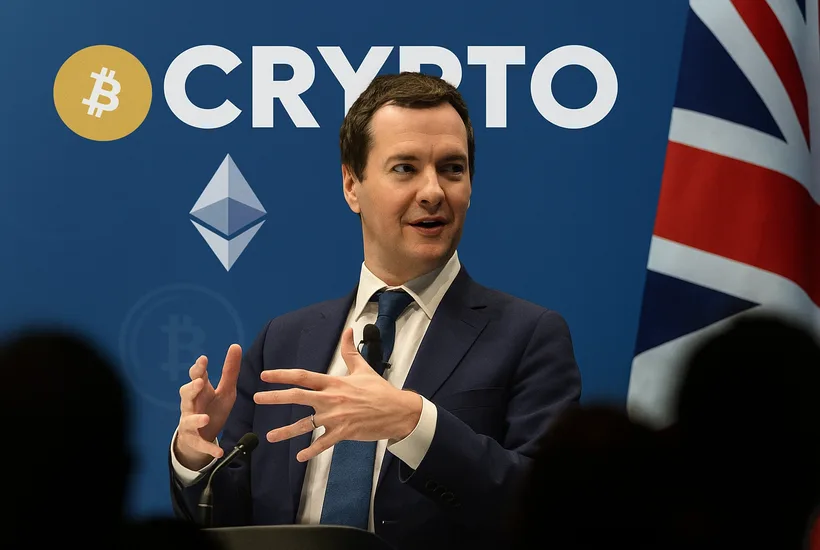


Ex-Chancellor George Osborne has sharply criticised the Labour government’s cautious approach towards cryptocurrencies. Speaking to the Financial Times, he said that Britain risks being “completely left behind” as more agile economies in the U.S., EU, Asia, Singapore, Hong Kong and Abu Dhabi surge ahead in building legal frameworks for crypto and stablecoin innovation.
Now part of Coinbase’s global advisory council, Osborne, argues that the current government is failing to seize a second financial revolution. He has compared the ongoing digital asset adoption to the 1980s Big Bang reforms, which elevated London into a fintech powerhouse.
He called on Chancellor Rachel Reeves to follow the example of U.S. Congress, enacting clear legislation rather than relying on regulators alone. Osborne dismissed the notion that regulatory caution could be blamed, calling it a “lame excuse” for inaction.

U.K’s stance on stablecoins
As for the UK’s current stance, Osborne notes that the Bank of England, led by Governor Andrew Bailey, has maintained a highly conservative position on stablecoins. Bailey insists that any pound-based stablecoins must be fully backed by interest-free central bank deposits, making commercial issuance unattractive. UK-issued stablecoins, as a result, remain virtually nonexistent, while US-dollar-pegged stablecoins dominate 99% of the global $250 billion market.
Evolving regulatory landscape
In April 2025, the Treasury published draft legislation (via amendments to FSMA) to bring qualifying cryptoassets and stablecoin issuance into the FCA’s regulatory perimeter. Consultation papers followed in May (CP25/14 and CP25/15), covering stablecoin backing requirements, custody rules, redemption rights, and prudential safeguards.
Proposals include 100% real‑world asset backing held in segregated trust, daily reconciliation, and consumer redemption rights. However, critics argue these stipulations may stifle UK‑based stablecoin issuance. The final rules are expected in 2026.