


Different reports give different opinions on protocol revenue, development, and financial accountability.
A governance fight inside the Aave ecosystem got worse after two in-depth reports gave different explanations of the protocol’s prior funding and contributions. This happened just before a vote on a planned $50 million package for Aave Labs.
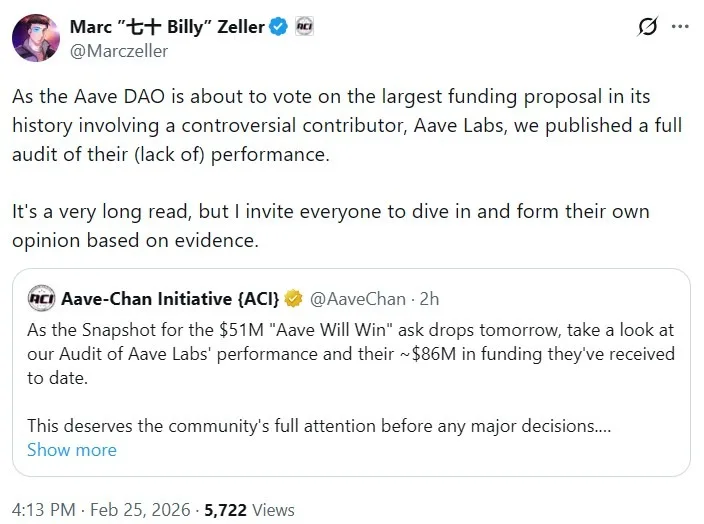
On Wednesday, Marc Zeller, the founder of the Aave Chan Initiative (ACI), released a “transparency report” that looked at Aave Labs’ prior funding and used a return-on-investment approach to look at past DAO awards. Aave Labs put out its contributions report a few hours ago, which talked about how the company has helped build the protocol since 2017.

The disagreement is over the “Aave Will Win” framework, which asks token holders to authorise funding for up to $42.5 million in stablecoins and 75,000 AAVE ($116.21) tokens. According to the plan and related forum posts, Aave Labs would send all money made from Aave-branded items to the Aave DAO treasury under a DAO-funded operating model.
The discussion has grown to include issues of responsibility, revenue attribution, and who is responsible for maintaining the protocol’s basic infrastructure, in addition to the amount of money being requested.
It comes after the recent news that BGD Labs, a key technical contributor, will stop working with the DAO on April 1.
Source: Marc Zeller
Diverging views on funding and value creation
Zeller’s article indicated that Aave Labs has raised about $86 million in its existence, including money from its initial coin offering (ICO) in 2017, venture funds, and DAO contributions.
He said that future DAO awards should be looked at using better disclosure requirements and measurable effects on income.
ACI, which is not a neutral party in the argument but does supply services to the Aave DAO, asked if governance votes should be split up to separate funding, revenue alignment, and V4 ratification.
Zeller said that decisions on funding should be based on clear reporting and performance goals.
In its contributions report, Aave Labs talked about how it helped design and ship Aave V1, V2, and V3. It also talked about elements that it says support the protocol’s existing business model, such as flash loans, the Safety Module, and Efficiency Mode.
Aave Labs said that tallying governance proposals or forum posts doesn’t show the complete range of research, development, security, and infrastructure work that needs to be done to keep a protocol used by millions of people running.
What tokenholders are voting on
Under the “Aave Will Win” proposal, Aave Labs would switch to a DAO-funded operating model and send all of its product-level revenue, including from aave.com and anticipated consumer-facing goods, to the DAO.
The proposal also asks for approval of Aave V4 as the protocol’s long-term technical base and describes plans for a new foundation to manage the Aave brand.
Some people in the community have already said they are worried about the size of the financial package and the fact that it includes 75,000 AAVE tokens, which give people the right to vote.
On February 13, critics asked for clearer definitions of revenue and more openness about governance holdings.