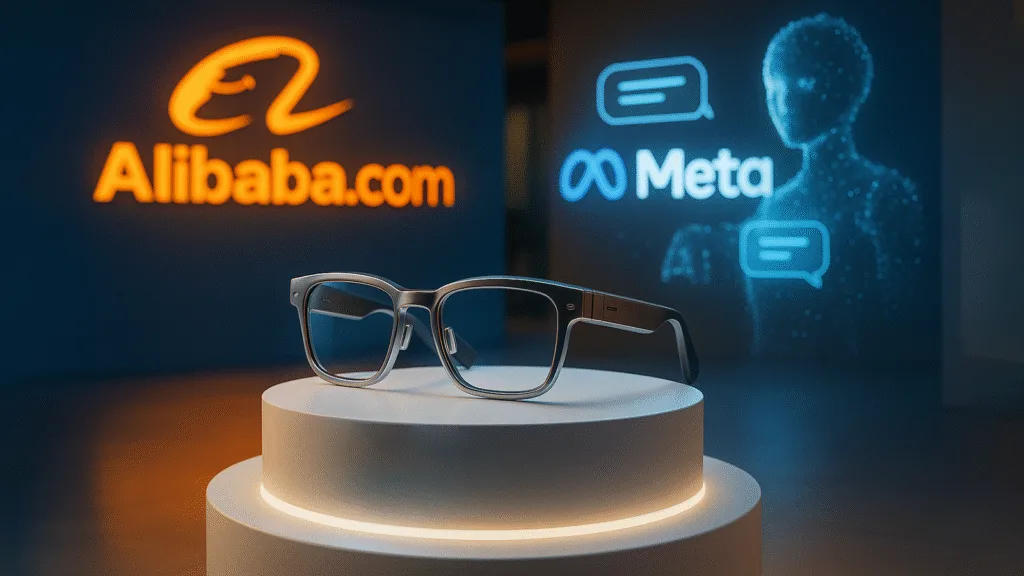



Alibaba is making waves by unveiling its new smart eyewear and AI chatbot, which is a direct challenge to Meta in wearable hardware and OpenAI in conversational AI. The Chinese tech conglomerate has set a price of 4,699 yuan, or about $660, for its Quark AI Glasses. Preorders will begin from October 24 via Tmall, and shipments are slated for December.
On the conversational AI front, Alibaba has introduced a ChatGPT-style assistant integrated within its Quark app, powered by the company’s own Qwen model family. The dual launch takes Alibaba from being just an e-commerce and cloud service provider toward direct consumer AI hardware and services.

Quark glasses vs Meta’s smart eyewear
Alibaba’s Quark AI Glasses emphasize seamless AI integration. With this, users can make hands-free calls, stream music, get real-time language translation, and receive meeting transcriptions, as this will be supported by the Quark assistant running on its internal Qwen models.
In contrast, Meta’s Ray-Ban smart glasses come with a more established hardware pedigree. They come with dual cameras, open-ear audio, touch controls embedded in the frame, and an evolving AI overlay. Recently, Meta added live translation, letting users translate conversations on the go.
Meta’s latest iteration, the Meta Ray-Ban Display, which was launched in September 2025, includes a built-in visual display in one lens, enabling visual output for maps, messaging, live translations, and camera viewfinder features. This retails at $799.
Inside the ChatGPT challenger
Alibaba’s new chatbot feature is built into its Quark app and powered by advanced Qwen3 models, including its recently released Qwen3-Omni, capable of multimodal inputs like text, image, audio, video, etc. The assistant supports both text and voice conversation modes. It offers functions such as image editing, photo-based problem solving, AI writing, and content generation.
Alibaba also recently launched Qwen3-Max, a flagship model with over 1 trillion parameters, positioning it as one of the most powerful models in its class. The company earlier pledged 380 billion yuan in investment into cloud computing and AI over three years. This is a clear indicator of its long-term commitment to this transformation.
With these new launches, Alibaba bundles hardware and software into a tightly integrated experience, attempting to rival Meta’s AR push and ChatGPT’s dominance in conversational AI. The timing of the launch comes just days ahead of the key Chinese shopping festival (Singles Day, 11 Nov), is sure to find many takers.
Alibaba’s shares climbed following the announcement, rising 1.7% on the Hong Kong exchange. The stock also saw gains during U.S. premarket trading.