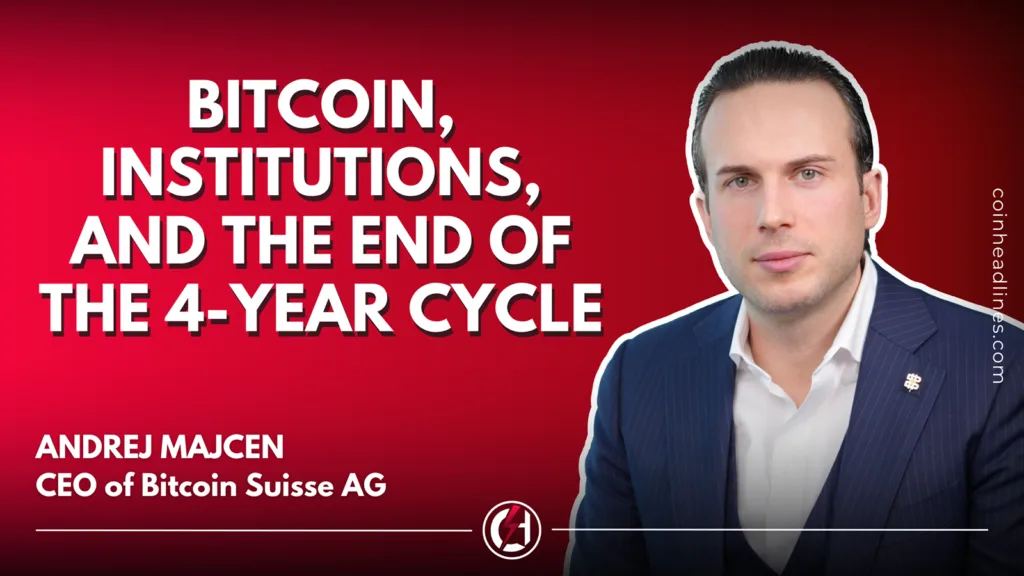



As digital assets become more common in the global financial system, the old rules that used to lead crypto markets are starting to fade. Andrej Majcen, the CEO of Bitcoin Suisse AG, stated, in an exclusive interview with Coin Headlines, that 2026 could be a big year for Bitcoin and the rest of the crypto ecosystem. He added that the market will be shaped less by halving cycles and more by geopolitics, regulation, and institutional power.
Bitcoin Suisse has been around since 2013 and has seen every stage of crypto’s growth, from a fringe experiment to a more mature asset class that is becoming more connected to traditional finance. Majcen’s view shows that he has a long-term view.
From niche asset to macro instrument
Majcen claims that compared to earlier cycles, the macroeconomic forces influencing cryptocurrency today are far more extensive. Along with growing geopolitical tensions, price action is now primarily driven by institutional adoption, political momentum, and regulatory clarity.

Majcen remarked, “Crypto is no longer its own little niche. It has become more closely associated with traditional financial markets and worldwide macro events as a result of institutional adoption.”
Crypto outlook 2026 report, which predicts more tests of all-time highs for Bitcoin and other significant cryptocurrencies, amply illustrates this change. Andrej Majcen is cautious, pointing out that many altcoins have suffered from capital outflows and fading narratives, even though they may see some upside.
He assumes that Bitcoin and a few other blue-chip digital assets will gain disproportionately from the next stage, and this is where the firm’s conviction is still strongest.
Is it the end of the four-year cycle?
The report’s potential weakening of Bitcoin’s customary four-year halving cycle is among its most striking themes. Majcen contends that although halvings used to rule market psychology, they are now up against more powerful forces.
He says, “governments, institutional investors, and even sovereign funds are influencing prices more than halving cycles.” He added that, “it’s important to consider whether those cycles were always solely about halvings or if they were more strongly associated with election cycles and more general macroeconomic trends.”
Crypto’s behaviour increasingly resembles risk assets as it becomes more integrated into global finance, at least temporarily.
Volatility, opportunity, and the Fed factor
Majcen believes that rather than stability, 2026 will be characterised by volatility. Bitcoin and cryptocurrency markets may benefit from anticipated interest rate reductions, a change in the US Federal Reserve’s stance from hawkish to more dovish, and the possible cessation of quantitative tightening. Geopolitical risks, however, continue to be unpredictable.
He warned investors to be ready for significant market swings brought on by international tensions, the release of economic data, and policy announcements, adding that “volatility equals opportunity.”
Bitcoin Suisse is cautiously optimistic and selectively bullish for the year despite these risks.
Regulation unlocks institutional capital
2026 could see the beginning of a new era in crypto. While the traditional cycles might be winding down, new ones are ready to break through.
According to Andrej Majcen, the most significant driver of institutional adoption is regulatory clarity.
Long-standing obstacles for institutional investors have been eliminated by frameworks like Europe’s MiCA and new US laws like the Clarity Act and the Genius Act.
“Institutions just won’t touch this asset class without regulatory certainty,” he stated. “Adoption is accelerating quickly now that certainty is approaching.”
Institutional-grade custodial solutions and Bitcoin ETFs are examples of regulated products that have been crucial in enabling conservative investors to obtain exposure without having to deal directly with cryptocurrency infrastructure.
Majcen thinks that rather than being a specialised approach, holding Bitcoin in a diversified portfolio could soon become the norm.
Bitcoin, gold, and trust in systems
The argument over Bitcoin’s potential as an inflation hedge is still ongoing as the correlation between cryptocurrency and traditional markets grows. Although Majcen concedes that gold has recently performed better in that area, he contends that Bitcoin offers something essentially different.
“Bitcoin’s correlation to traditional markets will decrease if trust in governmental systems weakens,” he stated. “Bitcoin is a hedge against centralised systems, not just against inflation.”
Compared to physical commodities, it is particularly well-suited to an increasingly digital and fragmented world due to its portability, digital nature, and sovereignty.
The UAE’s rise as a crypto powerhouse
Majcen noted that one of the world’s most active cryptocurrency markets is the UAE. The nation has established itself as a centre for fintech expansion, innovation, and regulatory experimentation since 2018.
He contrasted the UAE’s recent momentum with Switzerland’s slower pace, saying, “Different regulators competing with each other is actually very positive for innovation.”
Although Switzerland had an early-mover advantage, Majcen pointed out that countries like the US and the UAE are now leading the way, compelling international players to reconsider their strategies.
Simplicity over speculation
About trading strategy, Majcen gave newcomers and individual investors a clear piece of advice he said “stay away from complexity.”
“Don’t just follow advice without question. “Do your own research,” he said, advising investors to concentrate on assets they think will still be around in five years.
Majcen cautioned against chasing speculative tokens, making snap decisions, and engaging in frequent trading. He believes that poor discipline, not bad market conditions, is the main cause of retail losses.
He claimed that people “buy high, panic during corrections, and sell at the worst possible time.” “In high-conviction assets, a straightforward buy-and-hold strategy frequently outperforms intricate trading approaches.”
Majcen made it clear that Bitcoin has its own category, even though he declined to mention any specific altcoins.
He declared, “Bitcoin is not just another crypto asset.” “It is a substitute.”