



The six-month pilot program from the central bank brings together banks, market infrastructure providers, and Web3 firms to see how core UK markets could migrate onchain.
The Bank of England has started a new project to test how tokenised assets could be settled in British pounds using synchronised, atomic settlement. This is part of the bank’s attempts to modernise the UK’s real-time gross settlement (RTGS) infrastructure.
According to a bank statement, the Synchronisation Lab project will let 18 chosen companies test delivery-versus-payment and payment-versus-payment settlements between the Bank of England’s next-generation RTGS core ledger, called RT2, and external distributed-ledger platforms in a non-live environment without using real money.

The six-month pilot, which will start in the spring of 2026, is meant to test the central bank’s design choices for synchronised settlement, see how well central bank money and tokenised assets work together, and help plan for a possible future live RTGS synchronisation feature.
Broad industry participation across finance and Web3
The initiative, which was first announced in October, brings together 18 participants, including banks, fintechs, decentralized-technology companies, and market infrastructure providers, to test use cases that include tokenised securities settlement, collateral optimisation, foreign exchange, and the issuance of digital money.
Chainlink and UAC Labs are two of the Web3 participants who will try decentralised ways to coordinate synchronised settlement between central bank money and assets generated on distributed-ledger platforms. Companies like Ctrl Alt and Monee will focus on settling tokenised gilts and other assets through delivery rather payment.
Other players, such Tokenovate and Atumly, will test conditional margin payment workflows and digital-money issuance and redemption flows that work with RTGS settlement. There are also Swift and LSEG on the list.
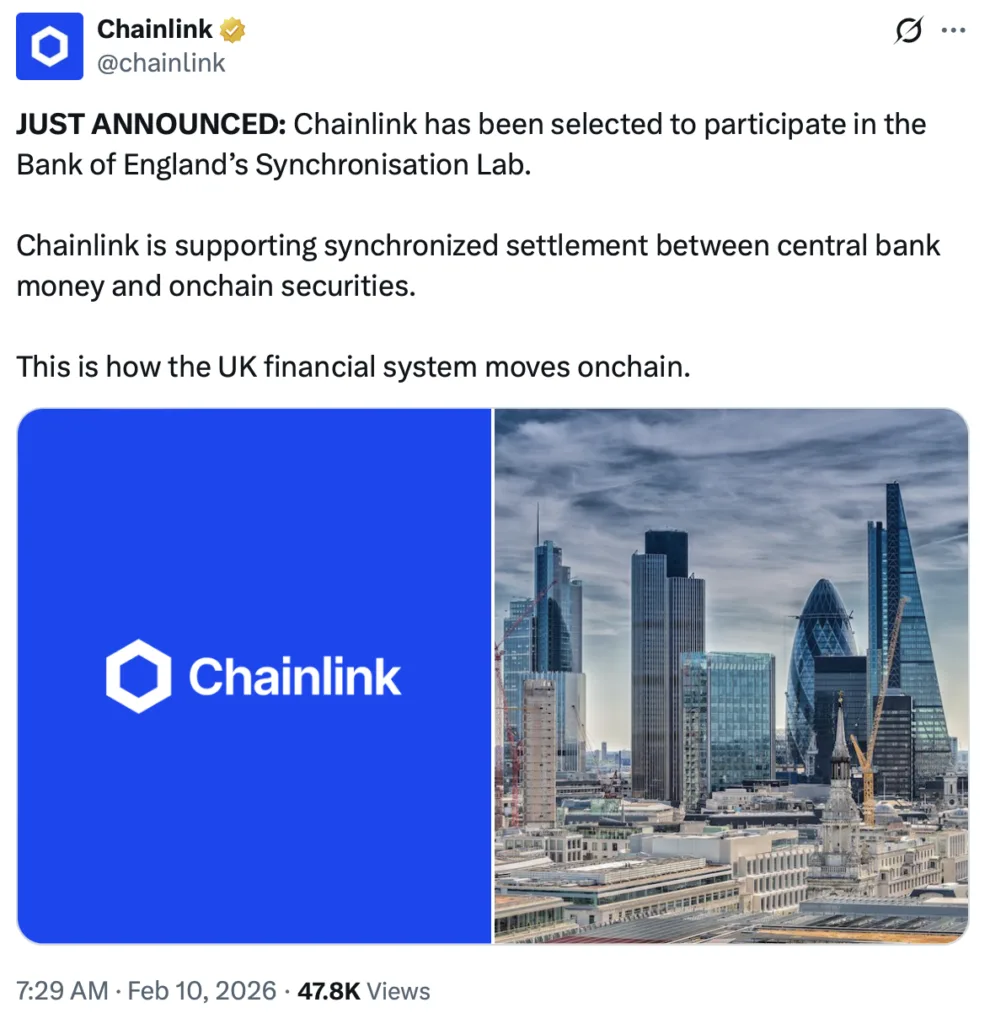
Source: Chainlink
Outcomes aimed at future RTGS development
The bank added that the lab initiative’s work will help improve the design of its RTGS synchronisation feature and support more development work. After the program ends, participants are expected to share their use cases and conclusions.
The Bank of England is just one of many central banks looking into how tokenisation, programmable settlement, and digital currencies could change the way they handle money and payments.
In May, the Federal Reserve Bank of New York and the Bank for International Settlements released research from Project Pine that looked at how smart contracts could help monetary policy in tokenised financial systems. This research included a prototype toolkit that would allow central banks to act more quickly and flexibly on programmable ledgers.
In October, the Monetary Authority of Singapore unveiled BLOOM, a project to improve settlement infrastructure so that transactions can be made with tokenised bank liabilities and regulated stablecoins.
CBDC trials continue alongside tokenisation efforts
Central banks have also been testing central bank digital currencies (CBDCs) in addition to tokenisation projects that focus on settlement and market infrastructure.
In July, the central bank of Australia started a trial of a wholesale digital currency employing stablecoins, tokenised bank deposits, and a pilot CBDC.
In November, the United Arab Emirates made its first government payment with a digital dirham. In January, mBridge, which is led by China, said it has handled $55 billion in cross-border CBDC transactions across different jurisdictions.