



Africa is rapidly transforming into a structured digital asset powerhouse with Cryptocurrency laws becoming clear for as many as eight countries. This evolving landscape has created a giant vacuum in institutional blockchain adoption with Ripple stepping up as an early leader in the emerging markets in the continent.
Regulatory transparency drives Ripple expansion
Eight African countries have already adopted crypto-specific legislation, with South Africa, Nigeria, and Kenya spearheading a continental push to reshape how digital assets operate in the world’s fastest-growing crypto sector. Between July 2024 and June 2025, Sub-Saharan Africa received more than $205 billion in onchain value, a 52 percent increase over the previous year.
Africa's digital asset moment is here, and regulation is leading the way → https://t.co/iC6HD0GqHj
$205B+ in onchain value.
52% YoY growth.
South Africa, Nigeria, Kenya, and Mauritius are all moving towards comprehensive crypto frameworks.
Clear regulation enables…— Ripple (@Ripple) April 7, 2026

Ripple (XRP) is positioned itself at the center of this regulatory wave, boosting RLUSD stablecoin availability through partnerships with Chipper Cash, VALR, and Yellow Card, as well as securing a custody agreement with Absa Bank.
Ripple applies these new structures to implement its enterprise solutions. The firm focuses on cross-border payments and institutional liquidity. Regulations are stable and minimise operational risks when a large-scale financial deployment is in place. Such environment promotes a new era of digital finance in Africa.
The move toward legalization is not just a trend. It is a calculated reaction to the great rates of crypto adoption on the continent. Digital assets are used by citizens to mitigate inflation of local currency. Governments have come to appreciate the fact that regulation is more protective than prohibition. As a result, Ripple has a friendly home of its regulatory financial technology.
The strategic deployment of RLUSD and XRP
The company is now introducing the RLUSD stablecoin to African markets. This dollar-pegged bond will solve the persistent shortages of foreign exchange experienced in the continent.
The RLUSD is a stable source of a connection between local and international markets. It enhances the utility of XRP that already exists in the ecosystem. Additionally, Ripple is piloting RLUSD in Singapore for faster trade settlements
In addition, the company is also increasing specialized custody. African banks need to have a good infrastructure that ensures that they can handle digital assets. Ripple gives the institutions the ability to store crypto. This growth fills the gap between conventional banking and decentralized finance.
The inclusion of RLUSD makes the settlement of complex international trades easy. Slow legacy banking systems can be a challenge to the local businesses. They are currently able to finalize transactions in seconds on blockchain rails. It is this efficiency that is behind the need to use Ripple technology in trade hubs.
Market Review: XRP strength despite volatility
The XRP price is expected to recover as the CLARITY Act’s new stablecoin rules favour RLUSD over USDC. The cryptocurrency is attempting to stabilise after falling to $1.31, down by 1.45 percent in the past 24 hours amid broad market losses.
XRP has remained under pressure since peaking near $2.40 in January. The proposed stablecoin structure may shift investor attention and affect competition in the sector.
Recent trading has shown XRP holding near critical technical support as investors consider macroeconomic and regulatory developments. XRP continues to move in a downward channel, with resistance near $1.35.
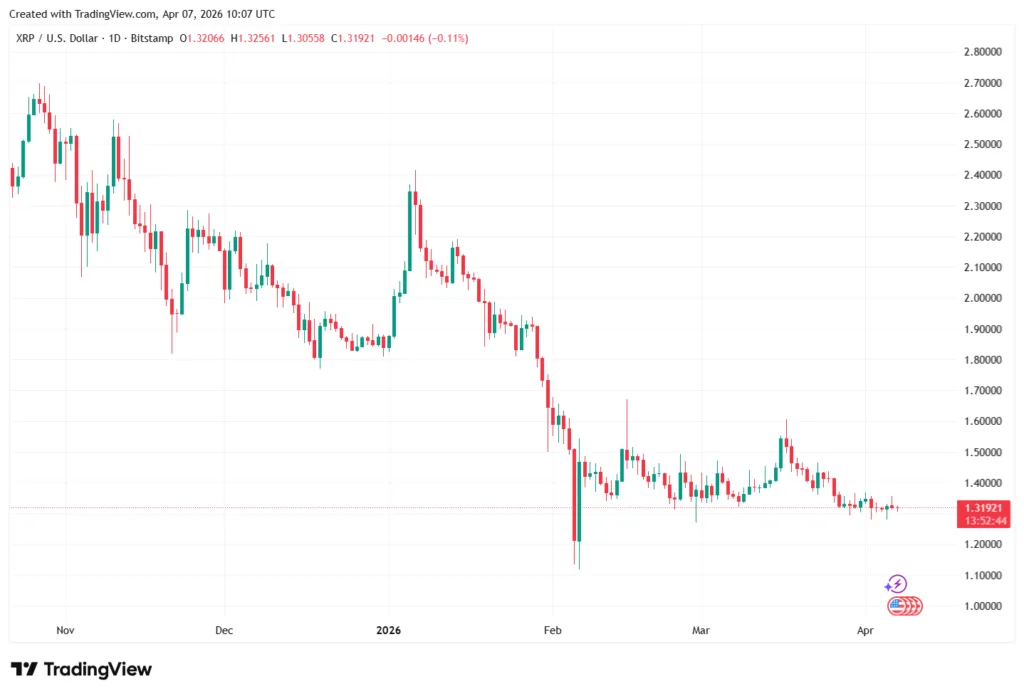
Furthermore, momentum indications indicate little buying power, as key signals remain below neutral levels. As a result, while selling pressure has lessened marginally, purchasers have yet to demonstrate great conviction in driving a long-term recovery.