



Binance is moving into prediction markets, and it’s doing it quietly, through the back door of its wallet app rather than as a standalone product launch.
The world’s largest crypto exchange by trading volume has confirmed it is currently beta testing in-app access to prediction markets inside Binance Wallet, with Predict.fun, a decentralized prediction market protocol built on BNB Smart Chain, serving as the primary provider.
According to an FAQ page Binance published Tuesday, users who update to the latest version of the Binance app, iOS 3.11.1 or above, and Android 3.11.2 or above, will find a Prediction tab at the top of the Markets page under the Exchange view.

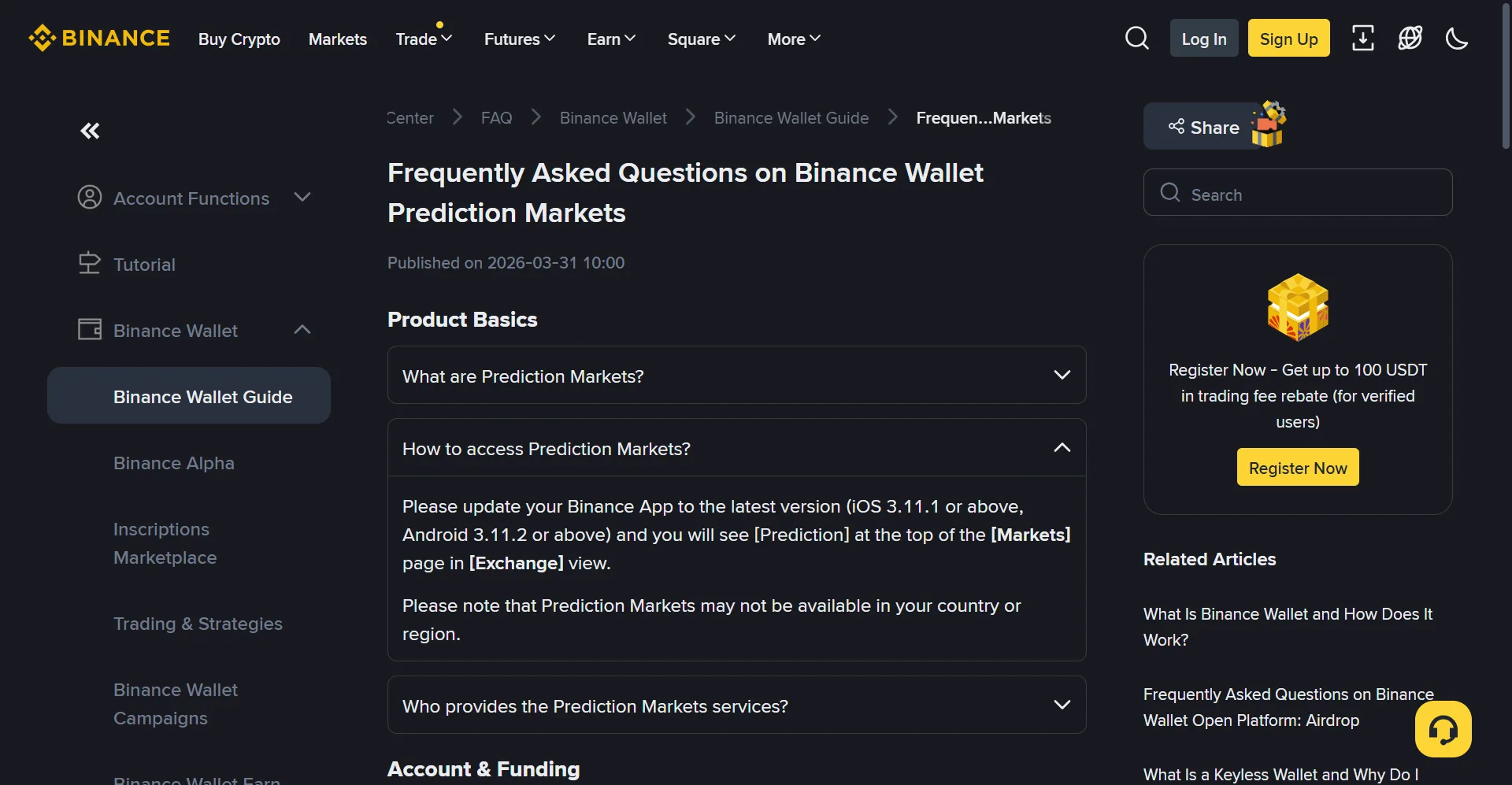
The feature is straightforward in concept: users trade yes-or-no shares on real-world outcomes, with each share priced between $0.01 and $0.99 depending on how likely the market collectively believes that outcome to be. When an event resolves, the winning side pays out $1 per share.
Importantly, Binance is not positioning itself as the market operator here. The exchange will aggregate prediction markets from third-party providers, with Binance itself not acting as a counterparty to any trade.
Users will need to set up a dedicated prediction account, separate from their regular spot and funding accounts, to access the feature. That structural separation is probably intentional, both operationally and from a regulatory standpoint.
What is Predict.Fun and why does it matter
Predict.fun is a protocol founded by Dingaling, formerly head of research at Binance and the founder of PancakeSwap, one of the largest decentralized exchanges on BNB Chain. It launched in December 2025 and has since processed over $1.7 billion in trading volume across roughly 125,000 users.
In March 2026, Predict.fun acquired rival Probable, a prediction market developed under PancakeSwap and investment firm YZi Labs, further consolidating its position as the leading prediction market protocol on BNB Chain.
The platform also offers something most competitors don’t: deposited funds earn yield through DeFi lending protocols like Venus while positions remain open, meaning users’ capital is working even while they wait for an outcome to resolve. On platforms like Polymarket, that capital would just sit idle.
The Binance distribution channel could be transformative for Predict.fun. Binance serves hundreds of millions of registered users globally, plugging even a fraction of that base into an in-app prediction market is a different proposition entirely from what Polymarket or Kalshi can currently reach.
A crowded space, getting more competitive
Binance’s move follows a broader push by major exchanges into prediction markets. Coinbase expanded its offering to US users in January through a partnership with Kalshi, while Crypto.com launched a standalone prediction market platform called OG in February, just days before Super Bowl LX.
The sector has grown sharply, monthly trading volume across prediction markets has surpassed $20 billion in 2026, up from $1.2 billion at the start of last year. In March, Kalshi posted roughly $10.98 billion in volume while Polymarket recorded $10.04 billion.
Binance’s approach, routing through a self-custody wallet rather than a centralized exchange product, may give it some flexibility in navigating the regulatory friction that US-based platforms like Kalshi and Polymarket are currently dealing with, including a congressional bill introduced in March that would ban sports and casino-style event contracts from regulated platforms.
The exact rollout timeline remains unclear, and availability will vary by country. But the obvious direction is that prediction markets are becoming a standard feature of the crypto exchange market, and Binance was never going to sit that out for long.