


Bitpanda launched a new blockchain called Vision Chain on Tuesday, to help banks, fintech companies, and asset managers across Europe handle tokenized assets in a more practical and regulated way.
Vision Chain is an Ethereum Layer-2 network built using the Optimism OP Stack. This structure allows it to handle transactions faster and more efficiently while still remaining connected to Ethereum’s wider network.
Vision Chain to connect tokenization with regulated finance
Vienna, Austria-based Bitpanda claims that this network is designed to support tokenized assets, stablecoins, and financial applications that need stronger compliance tools.

Many banks and financial firms have understood the value of tokenization for years, Bitpanda said. Most projects, however, stayed small because they were built in closed systems. At the same time, decentralized finance grew on open blockchains, but remained mostly separate from regulated finance and real-world assets.
Bitpanda claimed that Vision Chain is designed to bring these two sides closer together.
Bitpanda CEO, Lukas Enzersdorfer-Konrad, said, “Today, we still talk about digital assets, but in the future all assets will likely be digital. Tokenization is expected to redefine capital markets.”
The L-2 is designed to follow key European rules such as the Markets in Crypto-Assets Regulation (MiCA), Digital Operational Resilience Act (DORA) and the Markets in Financial Instruments Directive II (MiFID II).
Vision Chain sets up stablecoin fees
Vision Chain will use regulated euro-backed stablecoins for network and transaction fees, instead of relying on a more volatile crypto asset. This could make costs more stable and easier to manage for institutions using the network.
Fabian Reinisch, president of the Vision Web3 Foundation Board called the lauch of Vision Chain an important step in the foundation’s goal of building open and long-lasting infrastructure for onchain finance.
Reinisch added that the project is designed to match public blockchain technology with institutional needs and support a new wave of transparent and connected financial applications in Europe.
Meanwhile, Jing Wang, chief executive of Optimism, said Vision Chain shows that more institutions want blockchain infrastructure that meets their standards while still staying connected to Ethereum.
“We are proud to partner with Bitpanda and the Vision Foundation to bring regulated financial institutions onto Ethereum and strengthen Europe’s role in the global onchain economy,” Wang added.
In Europe, tokenized assets can make markets faster, easier, and more open. If Vision Chain succeeds, it can help financial firms use blockchain while following the law.
VSN coin becomes a core part of the Vision Chain
The network also uses its own token, called VSN. Bitpanda said it may use part of the network’s revenue to buy back tokens and remove them from circulation as activity grows.
The company also said developers building on the chain will receive grants to add real use cases for token holders. This gives VSN a bigger role in the wider Vision Chain ecosystem.
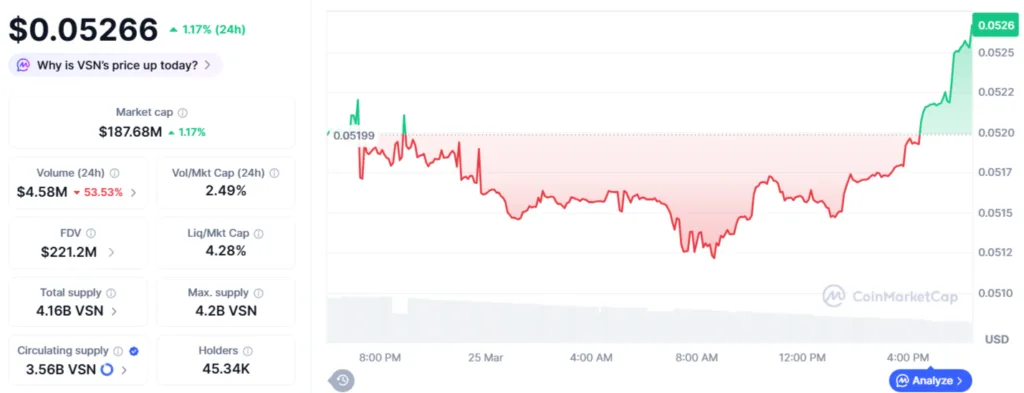
At the time of reporting, VSN was trading around $0.052. The token was up 1.17 percent over the past 24 hours, showing early market reaction to Bitpanda’s new blockchain project.