




A Coinbase official claimed that revisions to the GENIUS Act could make US dollar stablecoins less stable. This is because China is trying to bolster the digital yuan by letting wallets earn interest.
A high-ranking official at Coinbase said that modifications to the US stablecoin framework could hurt Washington’s chances in the global battle for digital payments. This is happening at the same time that China is trying to make its central bank digital currency (CBDC) more competitive.
Faryar Shirzad, Coinbase’s senior policy officer, wrote on X that the controversy over whether US-issued stablecoins can offer “rewards” under the GENIUS Act could make US dollar stablecoins less competitive around the world. He said that a recent declaration by China’s central bank shows that other financial systems are quickly working to make state-backed digital money more appealing.

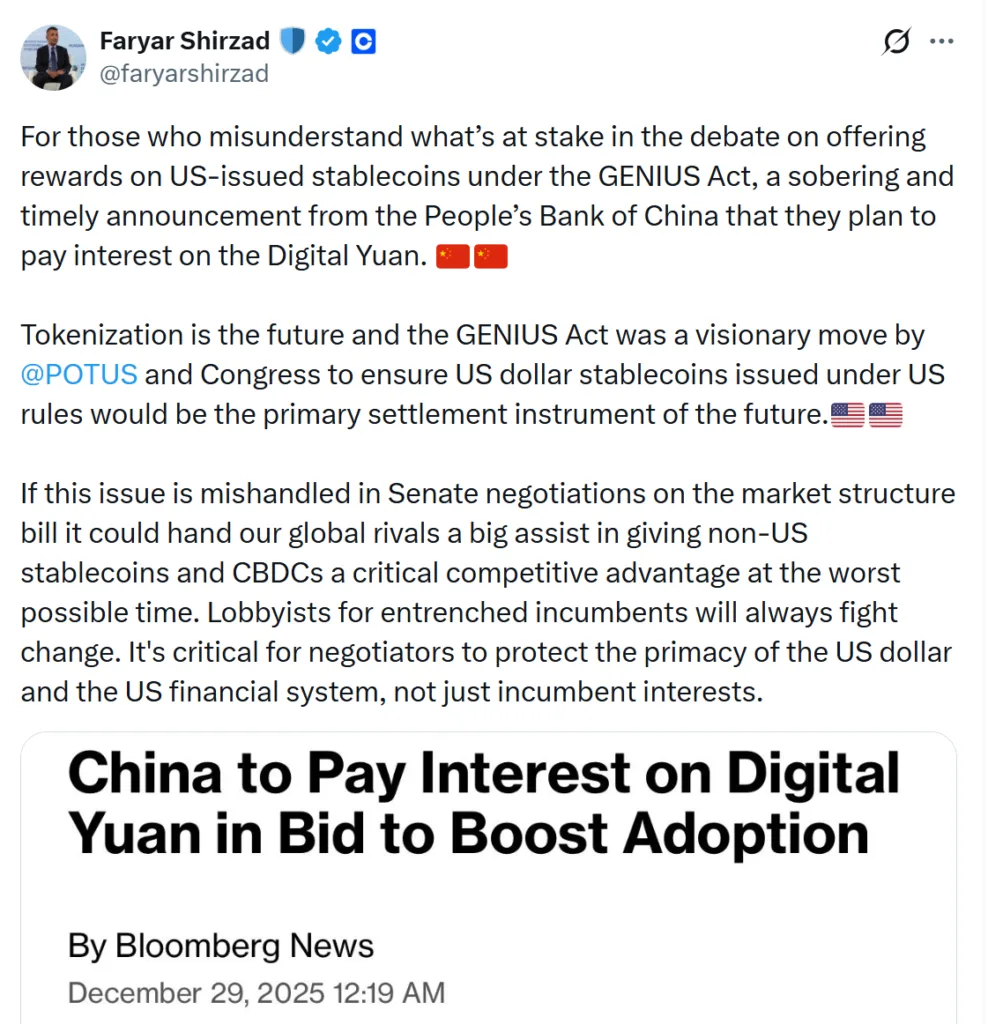
Source: Faryar Shirzad
China moves to strengthen the digital Yuan
This week, the People’s Bank of China, which is China’s central bank, laid out a plan that will let commercial banks pay interest on digital yuan wallet balances starting on January 1, 2026. Lu Lei, a deputy governor of the PBOC, said that the modification would make the e-CNY more than just a digital cash replacement and make it part of banks’ asset and liability management.
In the study, Lei added, “The digital RMB will move from the digital cash era to the digital deposit currency (Digital Deposit Money) era.” “It can be used to store value, measure monetary value, and make payments across borders.”
The GENIUS Act, which became law in June, set requirements for stablecoins’ reserves and compliance and made it illegal for issuers to pay direct interest. But the law lets platforms and third parties give prizes for using stablecoins.
Shirzad said, “If this issue is not handled well in Senate negotiations on the market structure bill, it could give our global competitors a big boost at the worst possible time by giving non-US stablecoins and CBDCs a big competitive edge.”
Bank lobbying rekindles industry tensions
The warning comes at a time when people in the business are worried about bank lobbyists wanting to revive the GENIUS Act. Max Avery, a crypto policy expert, stated in a post last week, “Now the banking lobby wants to reopen it.”
Avery said that banks make about 4% on reserves held at the Federal Reserve, but regular savings accounts usually pay almost nothing. He said that stablecoin systems threaten that business by letting users share some of the dividend.
Brian Armstrong, the CEO of Coinbase, said last week that any move to revive the GENIUS Act would cross a “red line.” He said that banks were pressuring Congress to limit stablecoin incentives to safeguard their deposit base. He stated that Coinbase would keep fighting against attempts to change the law and that he was startled that such lobbying was happening so publicly.
Armstrong also said that banks are wrong about the problem and that they will eventually try to offer interest and yield on stablecoins themselves when the chance arises. He called the present lobbying attempt “unethical” and said it will fail in the end.