



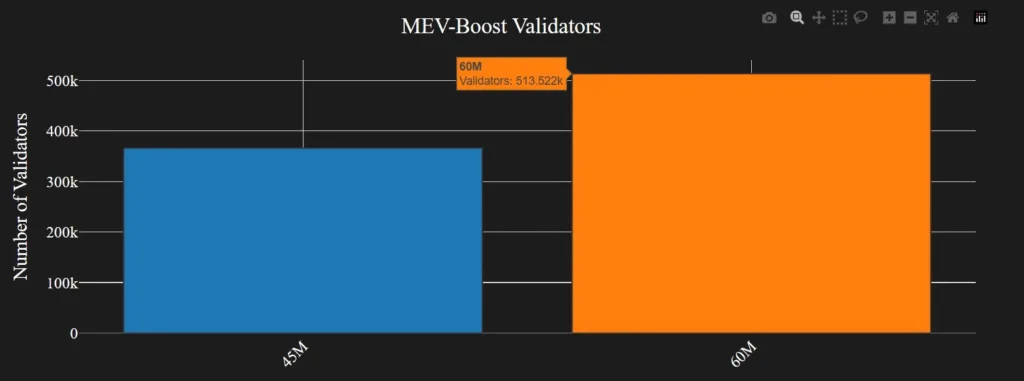
Ethereum has crossed a major execution-capacity milestone, with its mainnet block gas limit rising to 60 million the highest level since 2020. Data from Gas Limit Pics shows that more than 513,000 validators signaled support for the increase in November, meeting the threshold required for the protocol to automatically begin lifting the limit.
A higher gas limit allows each block to handle more work, including token transfers, swaps and smart contract executions. As validators moved from the previous 45 million ceiling to the new 60 million configuration, Ethereum’s effective block size expanded, lifting throughput across the base layer.
Source: GasLimit.Pics

Community-led push to increase block capacity
The rise in block capacity follows a yearlong grassroots effort known as Pump The Gas, created by Ethereum developers Eric Connor and Mariano Conti. The initiative encouraged solo stakers, client teams and community stakeholders to advocate for a higher gas limit as a way to ease congestion and reduce L1 fees.
The movement gained momentum in late 2024 as validator groups began signaling for a higher threshold. The increase comes just ahead of Fusaka, Ethereum’s upcoming network upgrade which entered the Hoodi testnet on Oct. 29 and is scheduled for mainnet release on Dec. 3.
Ethereum leaders say this is “only the beginning”
According to Ethereum Foundation researcher Toni Wahrstätter, the 60M limit marks a doubling of execution capacity within a year, and he emphasized that it represents the early stage of a broader scaling arc.
Ethereum co-founder Vitalik Buterin also supported the shift, saying he expects continued growth throughout 2025. Buterin suggested that future improvements will be more targeted, combining larger block capacity with refined fee structures that make inefficient operations more costly a way to scale without introducing new bottlenecks or network risks.