


FinChain, a blockchain network backed by Fosun-linked investors, is expanding further into Asia’s tokenized asset market. In an X post on Tuesday, the company said it had integrated Chainlink infrastructure to make its digital finance products safer and more reliable.
FinChain announced that the rollout includes three main Chainlink services, each targeting a separate need in tokenized finance.
Three core tools on offer
The first one is Chainlink’s Cross Chain Interoperability Protocol. As per FinChain, this tool would allow users and even institutions to securely transfer assets across blockchains.

This could help in increasing liquidity and even in making cross-border payments and settlements more efficient. This is important in Asia, considering that financial transactions often involve multiple systems and jurisdictions.
Another part of the rollout is Chainlink Proof of Reserve. According to FinChain, it allows live onchain checks of the reserves supporting FUSD and related tokenized assets.
In simple terms, it allows users to verify if a token is truly backed by the assets it claims to represent.
Third tool is Chainlink’s Automated Compliance Engine (ACE). This tool builds compliance rules directly into blockchain transactions.
For example, it can enforce transfer limits, perform identity checks, and screen transactions against sanctions lists. As a result, FUSD and other digital financial products can automatically follow local regulations during transfers.
Partnership with Chainlink supports the growth of onchain Finance in Asia
Lance Liu, FinChain’s Chief Technology Officer, said the move is not just a technical upgrade. According to him, it also supports the company’s wider goal of building a financial system with better security, transparency, and connectivity.
Meanwhile, Niki Ariyasinghe, Vice President for Asia-Pacific and the Middle East at Chainlink Labs, said the partnership could help support the growth of onchain finance across Asia.
“Chainlink’s interoperability, data, and compliance standards deliver FinChain the critical capabilities required to support the financial institutions in Asia. FinChain is committed to advancing the next generation of digital assets and transforming the financial landscape in Asia, and Chainlink is happy to help make that a reality,” Ariyasinghe added.
FinChain pointed out that the timing matters as Asia sees rising demand for compliant blockchain systems handling real financial assets.
FinChain’s Chainlink integration could help attract more institutional interest in tokenized finance across Asia, it expects.
If this process is smooth, it may help build trust, facilitate asset movement, and increase compliance. In due course, this may encourage banks and regulated entities to take a closer look at blockchain-based financial products.
Chainlink has become a key part of the growing tokenization market. Major financial institutions and market infrastructure providers, including SWIFT, UBS, SBI, Fidelity International, ANZ, DTCC, Euroclear, J.P. Morgan, Mastercard, and Brazil’s central bank, are using its technology in projects tied to moving more assets onchain.
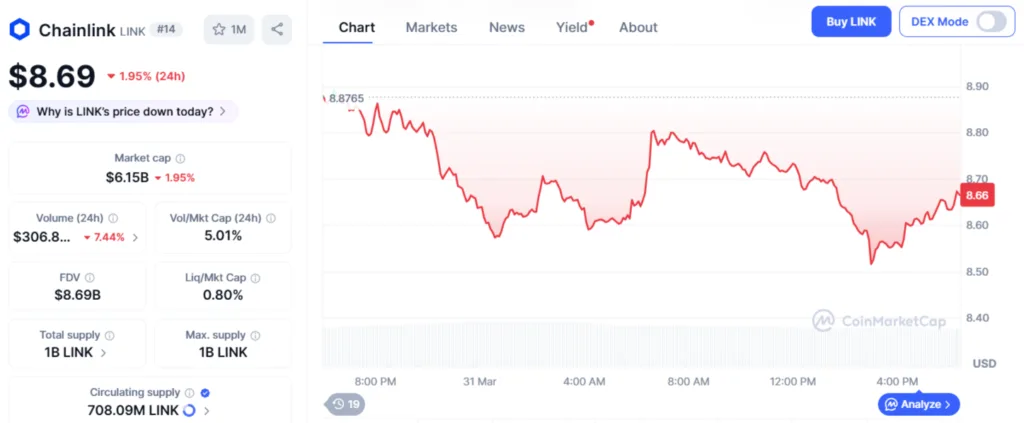
Despite the strong announcement, LINK did not react positively in the market. At the time of writing, Chainlink’s token was trading at $8.69, a decrease of 1.95 percent over the past 24 hours.
Meanwhile, trading activity dropped 7.44 percent to $286 million, while its market capitalization stood at $6.15 billion.