


Gate announced the launch of Gate Layer, a new Layer-2 network built to deliver ultra-fast transaction throughput and greater scalability, the company said on Thursday. Along with the Layer 2 network, it has also optimized the GT token economy and ecosystem mechanism.
What is Gate Layer and what are its core features?
Gate Layer is constructed on the OP Stack and is fully Ethereum Virtual Machine (EVM) compatible, enabling dApps and smart contracts to migrate with minimal friction. Gate’s design claims throughput of 5,700+ transactions per second, with block times of about 1 second.

The Gate Layer will also sharply reduce transaction costs, processing one million transfers for under $30. Gas fees on Gate Layer are substantially lower than other Layer 2 networks like Base, Atribium, etc., making it more accessible for everyday users to participate in Web3. To maintain robust security, Gate Chain (Layer-1 settlements) will be used, while GT staking will help contribute to the additional consensus support.
Creating a comprehensive on-chain ecosystem
Gate has also integrated cross-chain capability via LayerZero, enabling asset flow between Ethereum, Polygon, BNB Chain, Solana, and more. The move is part of Gate’s broader “All in Web3” ambition, in which it plans to host protocols like Perp (for perpetual trading), Gate Fun (a no-code incubator for token launches), and Meme Go (a meme-token cross-chain tracker).
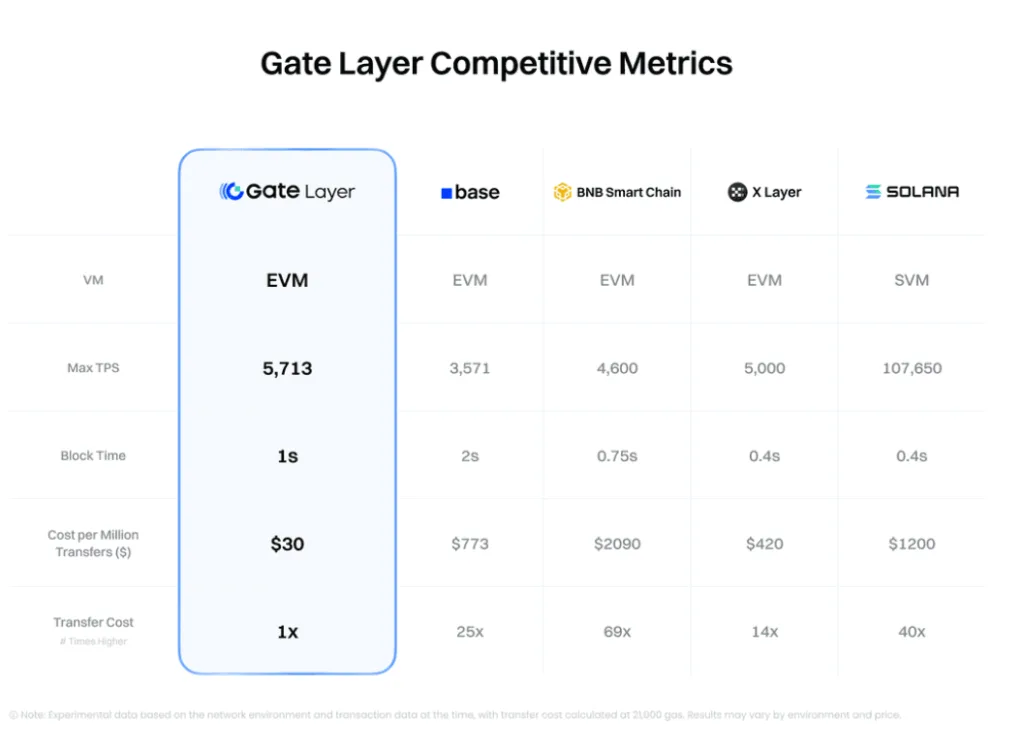
Source: Gate.com
Revamping GT tokens’ utility
Under the upgrade, GT becomes the exclusive gas token on Gate Layer, which must be used for on-chain operations, gas fees, contract deployment, and NFT minting. Gate retains and intensifies its deflationary model, which means that part of the transaction-based fees are burned (akin to EIP-1559), and scheduled quarterly burns remain in place. To date, Gate claims over 180 million GT have already been burned, representing more than 60% of the initial supply.
By launching its own high-performance L2, Gate seeks to capture more on-chain activity, reduce dependence on external networks, and retain fees and liquidity within its ecosystem. The idea is to offer developers a high-throughput environment with lower cost barriers.