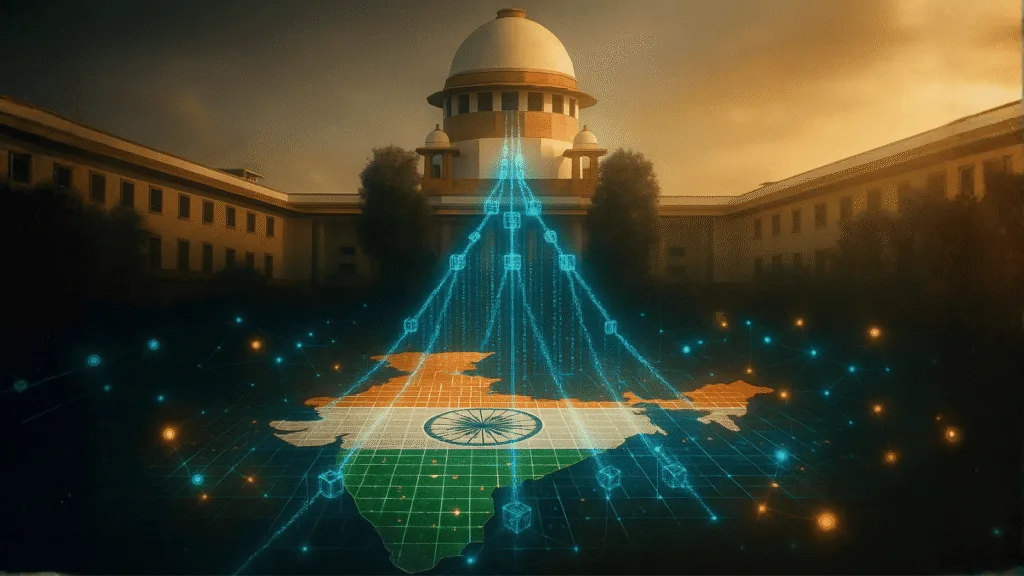



India’s Supreme Court has suggested adopting blockchain-based land registration systems to resolve long-running issues surrounding property titles and record verification. A Bench of Justices PS Narasimha and Joymalya Bagchi directed the Law Commission of India to study how blockchain technology can be used to restructure the property registration process.
The remarks came during a matter concerning a title dispute, where the bench noted that India’s present land record framework is fragmented, outdated, and heavily prone to fraud and litigation. The said case involved contested ownership under the Transfer of Property Act, where confusion over the chain of title had led to years of litigation.

The Court observed that property purchases in India can be “traumatic” for ordinary citizens, largely due to overlapping claims, missing records, and inconsistent documentation maintained across states and registries.
What the Court Recommended
The Supreme Court has requested the Law Commission of India to prepare a roadmap for modernising title deed systems, evaluating the use of blockchain and uniform digital standards nationwide.
Blockchain technology can transform land registration into a more secure, transparent and tamper-proof system. Each entry, once validated into the Distributed Ledger, becomes part of a cryptographically linked chain that cannot be altered without detectionIndian Supreme Court
The Court proposed that a blockchain-based system could unify cadastral maps, land surveys, and revenue records into one secure and transparent digital platform. This integration would help curb fraud, boost traceability, and strengthen public confidence in property ownership.
State initiatives on Blockchain Land Records
While land administration is a state subject, several states have begun experimenting with blockchain-linked registries. States like Telangana and Andhra Pradesh have piloted blockchain-backed record validation systems. Maharashtra has tested blockchain for property registration under its Digital Satbara initiative. Whereas Karnataka has explored distributed ledger audits for rural land maps.