


Japanese financial giant SBI Group has announced multiple new blockchain partnerships aimed at boosting stablecoin adoption and enabling tokenized asset trading in Japan. The company announced collaborations with Circle, the developer of USDC, Ripple, the maker of XRP and the newly launched Ripple USD (RLUSD), as well as the Singaporean Web3 firm Startale.
SBI plans to collaborate with Circle in a joint venture aimed at promoting the use of USDC in Japan and developing new solutions in Web3 and digital finance. At the same time, an agreement with Ripple outlines intentions for RLUSD distribution through SBI’s crypto arm SBI VC Trade, targeting availability by the fiscal year concluding in March 2026. SBI executives framed RLUSD as a strategy to improve reliability and convenience in Japan’s stablecoin ecosystem.

Along with stablecoins, SBI is working with Startale to develop an onchain trading platform for tokenized stocks and real-world assets (RWAs).

Also read: SBI holdings denies filing for Bitcoin-XRP dual ETF in Japan
This initiative aims to establish 24/7 trading, improving liquidity and efficiency in financial marketsSBI CEO Yoshitaka Kitao mentioned that tokenized RWAs will enable the integration of traditional finance and DeFi, potentially leading to a broader digital transformation of capital markets, including exchanges. The project has secured funding tied to milestones, yet the launch timelines and details about the blockchain network remain undisclosed. Startale, known for its partnership on Sony’s layer-2 blockchain Soneium and Astar Network, will provide critical technology for the platform.
Global tokenization trend
This move aligns SBI with a growing global trend, as prominent financial and cryptocurrency firms push tokenized finance into the mainstream.Companies such as Gemini, Kraken, and Robinhood have introduced platforms offering tokenized stocks and multiple real-world assets, reflecting rising adoption.
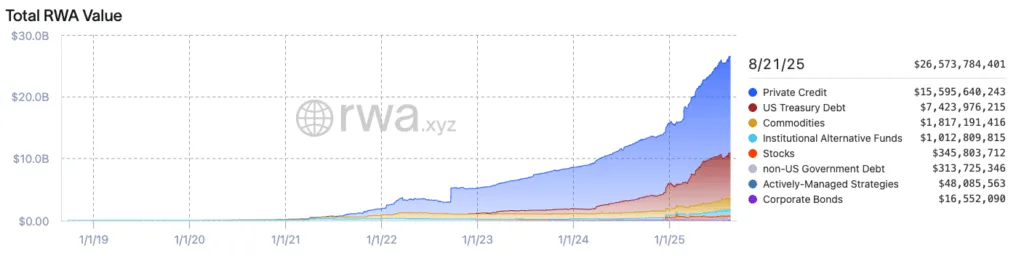
Recent information from rwa.xyz reveals that markets for tokenized real-world assets have increased to $26.57 billion as of August 21, 2025, with private credit and US Treasury debt making up the largest portion of allocations.